Introduction
Performance management is not an overnight task. Or a one-time activity that you do once and then forget about it with no consequences or side effects. Performance appraisal is both a result and an input. It’s a result of protracted activities over a period of time. It’s something that employees and managers should look forward to at the end of a measurable performance period to both reward sustained results as well as act as guidance system to evaluate and course correct where necessary. Overall, it’s an input in to molding employee behavior and culture of the organization.
Performance of an employee in a given role at any point in time is dependent on quite a lot of factors. These factors can and routinely do lead to situations where the output of an employee and the results s/he gathers over a sustained period of time are affected either negatively or positively. The role of Performance Management System is to ensure that all such peaks and troughs are accounted for and given their due weightage in the process of appraising an employee’s performance.
Organizations view humans as the most important resources that they have – today and any day. People make innovations, make technological advances, run the most important machinery, run the processes that are required to produce products and services, and lead every change or initiative. It’s safe to say that every aspect of an organization’s existence and growth depends on its employees.
Image Credit: hr-gazette
Where does it fail?
Keeping the above in mind, are Performance appraisals given their due importance? Or are they treated more like a check box activity which needs to be completed every few months? The traditional performance appraisal approaches measure employee performance against assigned goals over a period of time, irrespective of what got achieved.
Experts and industry insiders, particularly employees who are at the receiving end of appraisal cycles point out the below reasons for failure of performance management system.
- Annual Pilgrimage -: in most organizations, the critical year end appraisal mechanisms are the most important event, like an annual pilgrimage that all must attend irrespective of what they expect to get at the end of the appraisal journey.
- Punishment and reward -: the thought behind most performance management systems is that the bottom (?)% of performers need to be weeded out. The approach is more inclined towards punishing bottom performers and rewarding top performers, whereas the real reasons of such performances are mostly ignored.
- Manager driven -: The feedback and appraisal cycle is driven by manager, with or without HR intervention. The feedback is not team driven and doesn’t take in to account 360-degree feedback approach.
- Non-actionable inputs -: vague, unproven and sometimes completely incorrect statements and facts are shared, mostly to justify the rating already provided to the employee. To this end, the appraisal system seems to only be there to justify the rating, not assign just rating. The improvement areas noted at the end of the performance appraisal cycle need to be clear, well defined and time boxed.
- Not aligned to team goals and objectives -: A performance appraisal system designed to reward top performers and assign pay hikes and promotions based on individual performance alone often causes conflicts with achieving the goals of the team, which is the ultimate purpose for the team to be there in first place.
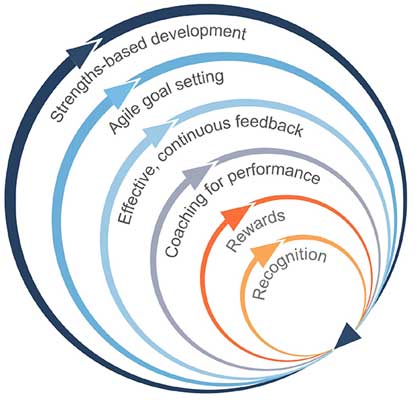
Image Credit: charilift.io
What makes performance management success? Agile performance management, of course!
A lot of performance management systems in place today don’t make much sense and are simply poorly equipped to handle the demands of high pace work environments.
In recent years, especially since Agile became the modern buzzword on every shop floor, technology has transformed and continues to transform the business world. Its entirely in the vogue, almost fashionable to use faster, collaborative, social methods to provide supportive feedback and boost the overall results of the team, i.e. the traditional benefits of performance management system implemented in Agile way. This process has overhauled performance management to match the fast-paced workplace where most people thrive.
Image Credit: charilift.io
Agile performance management is an approach to manage employee performance and development throughout the year on a continual basks as opposed to on an annual or biannual basis. It is collaborative, involving regular conversations, continuous feedback loop and improvement measurements. Agile performance management isn’t solely focused on the end product only, i.e. to award a rating, rather is concerned with how to get there. Agile performance management is more about the process to arrive at the rating giving each employee optimum chances to learn and improve along the way. Agile performance management is created for and is being increasingly adapted by a brave new world that is faster, more social and more communicative.
The main feature of agile performance management is the frequent performance discussions, or ‘check-ins’, which ideally take place on a monthly basis. These sessions are designed to help cultivate authentic, meaningful relationships and dialogue between manager and employee while providing the opportunity to exchange much needed, real, improvement oriented feedback.
Image Credit: Medium
Performance appraisal system needs to move from an active-passive input provider to a system of Disruptive Performance management
1. Role based 360-degree feedback -:
Not just the manager, but all team members chime in on the employee’s feedback. This is beneficial for multiple reasons, most importantly from the perspective of rewarding truly genuine performers.
The 360 degrees Performance Appraisal method was first used in the 1940s. Analogous to the multiple points on a compass, the 360 method provides each employee the opportunity to receive performance feedback from his or her supervisor, peers, staff members, co-workers and customers.
360 degree feedback or review mechanism is the most comprehensive appraisal system where the feedback about the employee’s performance comes from all the sources that come in contact with the employee on his / her job and are willing to provide such feedback.
Classical 360 degree feedback approach involves seeking feedback from the following sources:
- Self-Appraisal -: employee completes self-appraisal on the organization template
- Superior’s appraisal -: Immediate manager provides feedback on employee’s performance, goals achievement, inter-personal and behavioral skills, regard of organizational values and other parameters as deemed fit and included in the performance appraisal structure.
- Subordinate’s appraisal -: direct reports of the employee being appraised are invited to become a part of the review cycle and feedback is obtained on certain specific inputs.
- Peer appraisal -: like subordinate feedback, peers and co-workers of the employee being appraised are invited to become a part of the review cycle and feedback is obtained on certain specific inputs.
An average rating is produced at the end of the cycle taking aggregate of all recorded responses.
The best people to receive development advice from are those working closest. If people move frequently between ad hoc and project-based teams, they may miss the opportunity for valuable insights from temporary team members. A good 360-degree framework must allow employees to take ownership of their development by giving them the flexibility to choose who they want to receive feedback from during their performance appraisal.
2. Continuous feedback loop (Sprint level) -:
This is where the traditional performance management suffered the most. Performance feedback is not just a once-in-a-year or once-in-six-month activity. Continuous feedback refers to cyclical activity of providing feedback to employees regularly – observing, coaching, monitoring and improving each employee’s output is a daily activity. Performance feedback must correlate to every project and every sprint the employee worked upon in the outlined period. The feedback doesn’t have to be huge, or lead to path breaking improvement, it could very well be a small change in how the employee communicates, how s/he behaves or talks. Any small improvement, noticeable behavioral change or modification over sustained period of time can lead to huge improvements at the end of such time period.
3. 1:1 documented coaching sessions -:
Coaching sessions are at the heart of continuous feedback and improvement cycle. These coaching sessions not only provide employees an ‘out’ for their feelings, but also bond the supervisor / manager or anyone else in the role to their employees. People are looking for acceptance at all levels, and it’s not uncommon to find this trait among senior level employees.
The documentation of coaching session should be done with the spirit of referring to it at a later point in time purely for purposes of reinforcing the behavior and not to negatively implicate team members.
4. Set individual goals and team goals -:
Individual goals are important. However, they must also be tied with team goals. Both kind of objectives need to balance each other, and cannot be given to compete with each other. Launch a system where superlative performance is given due reward, while contribution towards team goals is awarded at a higher rate, subject to base conditions being met like achieving self-goals before helping others.
5. Invest in educating managers -:
Finally, the last and most important piece of the puzzle is the manager or the role of the manager, be it the scrum master in modern Agile settings any other person deputed in the role. It is essential for the manager to understand the performance appraisal from the standpoint of employees working in fast-paced, Agile environments and must deliver according to those expectations.
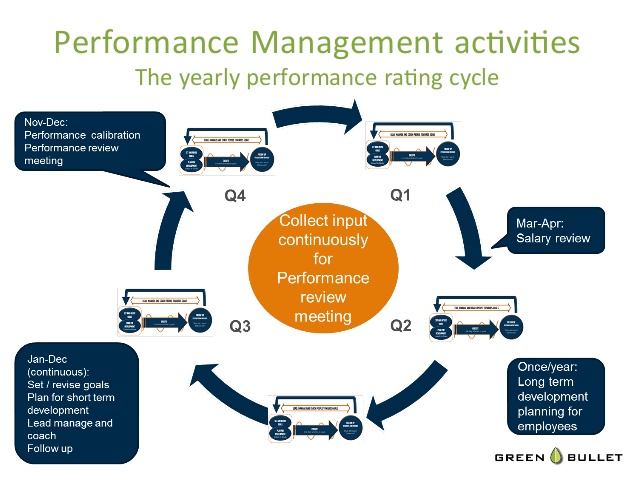
Image Credit: Green Bullet
]]>