Whenever there is a talk of infusing technology, automation and intelligence in to tasks or processes, the solutions proposed fall in to two broad buckets. The first is the conventional use of the term Artificial intelligence, machine learning, deep learning and cognitive learning, which typically work outside human intervention and are largely driven by some kind of an algorithm to achieve its goal. The handling of regular transactions as well as any exceptions are defined within the AI program and the machine doing the job in case of touch and feel jobs like manufacturing or the algorithm producing the result in case of purely online work. The second category is where Artificial Intelligence is applied to work in conjunction with the humans and human intervention and interaction is a critical part of the successful completion of the job. This second type is known as Augmented intelligence or Augmented reality.
Another way of looking at what happens with augmented and artificial intelligence is the degree to which algorithms and the programs running the physical machines are expected to make decisions on their own. Is the decision making assisted by humans, controlled by humans or completely out of control of humans?
It’s critical to note that while the technologies and fundamentals powering both Artificial intelligence and Augmented intelligence are largely the same, the applications, goals and objectives are objectively different. Simply put, AI creates a human less environment while Augmented Intelligence or Intelligence Augmented as it’s often called, seeks to create an environment for betterment of humans and human endeavors.
There’s virtually no major industry where modern AI — more specifically, “narrow AI,” which performs objective functions using data-trained models and often falls into the categories of deep learning or machine learning — hasn’t already affected. That’s especially true in the past few years, as data collection and analysis has ramped up considerably thanks to robust IoT connectivity, the proliferation of connected devices and ever-speedier computer processing.
- In Manufacturing: AI powered robots work alongside humans to perform a limited range of tasks like assembly and stacking, and predictive analysis sensors keep equipment running smoothly.
- Healthcare: In the comparatively AI-nascent field of healthcare, diseases are more quickly and accurately diagnosed, drug discovery is sped up and streamlined, virtual nursing assistants monitor patients and big data analysis helps to create a more personalized patient experience.
- Education: Textbooks are digitized with the help of AI, early-stage virtual tutors assist human instructors and facial analysis gauges the emotions of students to help determine who’s struggling or bored and better tailor the experience to their individual needs.
- Media: Journalism is harnessing AI, too, and will continue to benefit from it. Bloomberg uses Cyborg technology to help make quick sense of complex financial reports. The Associated Press employs the natural language abilities of Automated Insights to produce 3,700 earning reports stories per year — nearly four times more than in the recent past.
- Customer Service: Last but hardly least, Google is working on an AI assistant that can place human-like calls to make appointments at, say, your neighborhood hair salon. In addition to words, the system understands context and nuance.
Source: McKinsey & Company
According to a recent publication, of the 9,100 patents received by IBM inventors in 2018, 1,600 (or nearly 18 percent) were AI-related. Here’s another: Tesla founder and tech titan Elon Musk recently donated $10 million to fund ongoing research at the non-profit research company OpenAI — a mere drop in the proverbial bucket if his $1 billion co-pledge in 2015 is any indication. And in 2017, Russian president Vladimir Putin told school children that “Whoever becomes the leader in this sphere [AI] will become the ruler of the world.” He then tossed his head back and laughed maniacally.
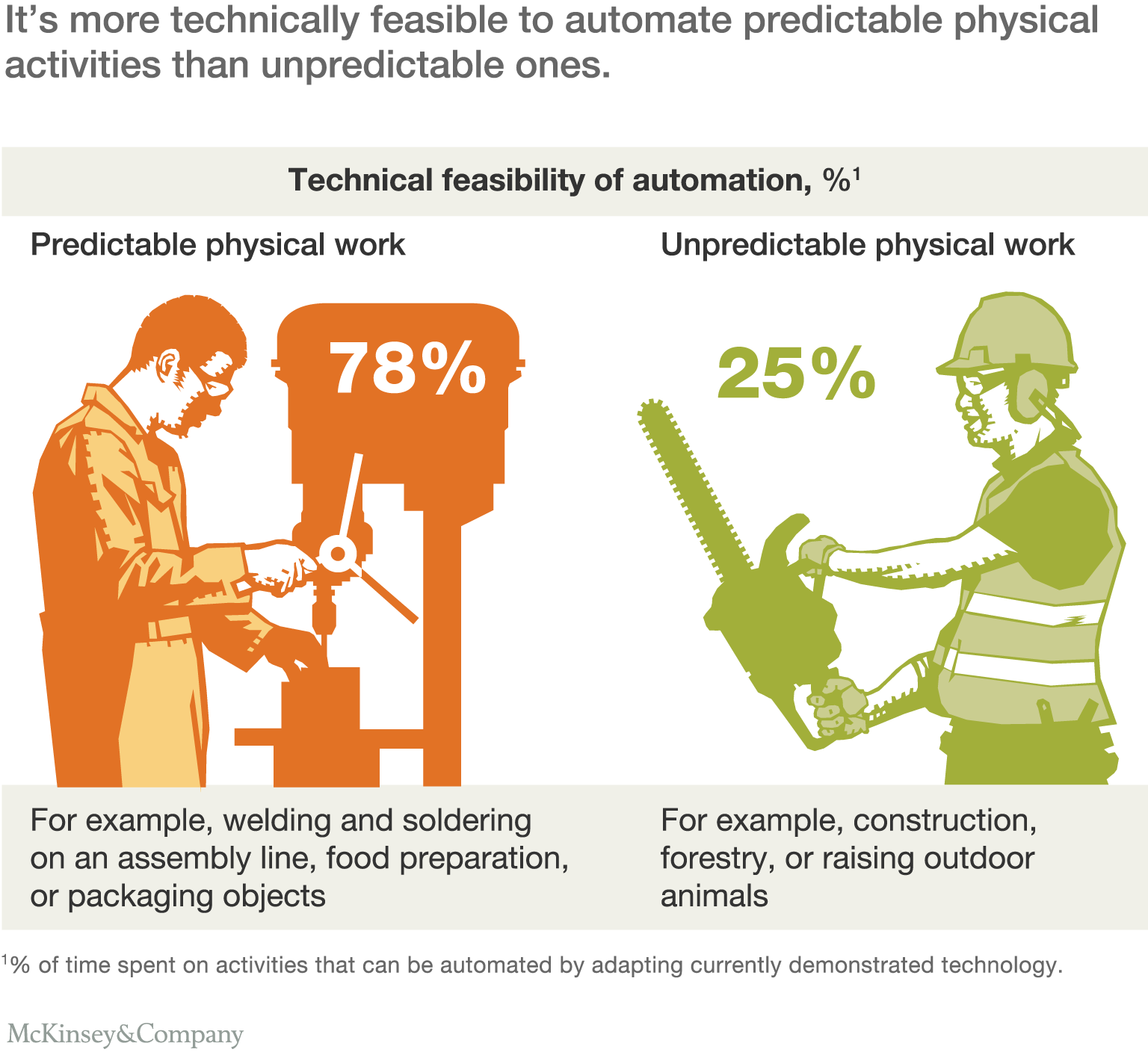
The single biggest strength of Artificial intelligence is the simple fact that it can do repetitive tasks better than anything else. And the more quantitative, the more objective the job is—separating things into bins, washing dishes, picking fruits and answering customer service calls—those are very much scripted tasks that are repetitive and routine in nature. In the matter of five, 10 or 15 years, they will be displaced by AI.
Yet even the most pragmatic AI scientists stress that today’s AI is useless in two significant ways: it has no creativity and no capacity for compassion or love. Rather, it’s “a tool to amplify human creativity.” In other words, sure you can teach AI to make strokes with a brush in a canvas, but an AI driven machine can never in a million years paint a Monalisa.
The most advanced robot costing many millions in research dollars and years of work, cannot pickup a tea cup like a 2 year old can. Or millions of sensors on a robot cannot feel taste and smell like humans do. Sure a robot Make millions of calculations in a second, which is many hundreds of times more than the most intelligent human can, sure a robot can discern each smell, or can break down each material in to its atoms and sub-atoms, but it cannot experience the same thoughts, emotions and feelings that human brain can.
The second biggest fear around AI stems from the AI and machine learning applications inheriting some of the human biases based on pre-disposed notions and behaviors that humans may code in to or indirectly influence the program.
Augmented Intelligence on the other hand doesn’t replace humans with technology rather uses Artificial intelligence to aid humans in doing a job.
In recent years, in AI technology rankings in terms of the value they create for businesses, Augmented Intelligence was ranked in second place, just below virtual agents. However, Gartner predicts that “Decision support and AI augmentation will surpass all other types of AI initiatives” creeping into first place this year and then exploding as we reach 2025 becoming around twice as valuable as virtual agents.
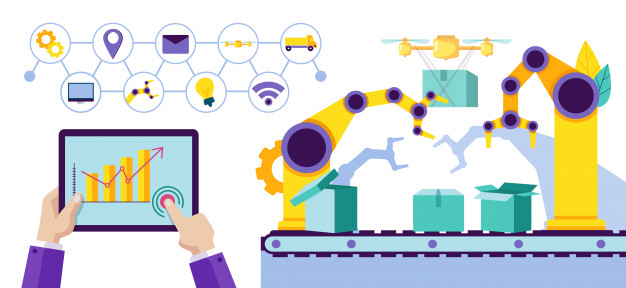
Just like regular project management work, any organization looking to employ AI needs to first define its use cases and requirements clearly and describe the Big Y, or the big problem it’s trying to solve. Then, they need to define the various aspects of business goals, or the product that they want to build. The next step is to outline data requirements and functionality to solve those business goals. And finally, what’s the ROI or returns the organizations expects. What makes AI and machine or cognitive learning projects unique is that they also need to consider the human-machine dynamic. For example, which part of the chain or which components of the product or solution do they want to hand over entirely to machines to execute, and which parts do they want to retain for their Human Resources? Where machine or a computer algorithm based program is making the decision, is it completely autonomous or is there a human there to monitor? Is The machine or computer program Only responsible to feed data, information or half finished product to human to make the final decisions? In the scope of these decisions, then, it makes a lot more sense to create an AI role matrix which can evolve over time. This matrix Lays down specifically the kind of role AI or cognitive learning system will play for that particular function or process.
Source: USM Business Systems
Getting to true autonomous intelligence or fully independent, cognitive learning powered AI model is proving to be real difficult. Even one single instance of non-compliance or faulty decision making can throw the entire program off tracks.
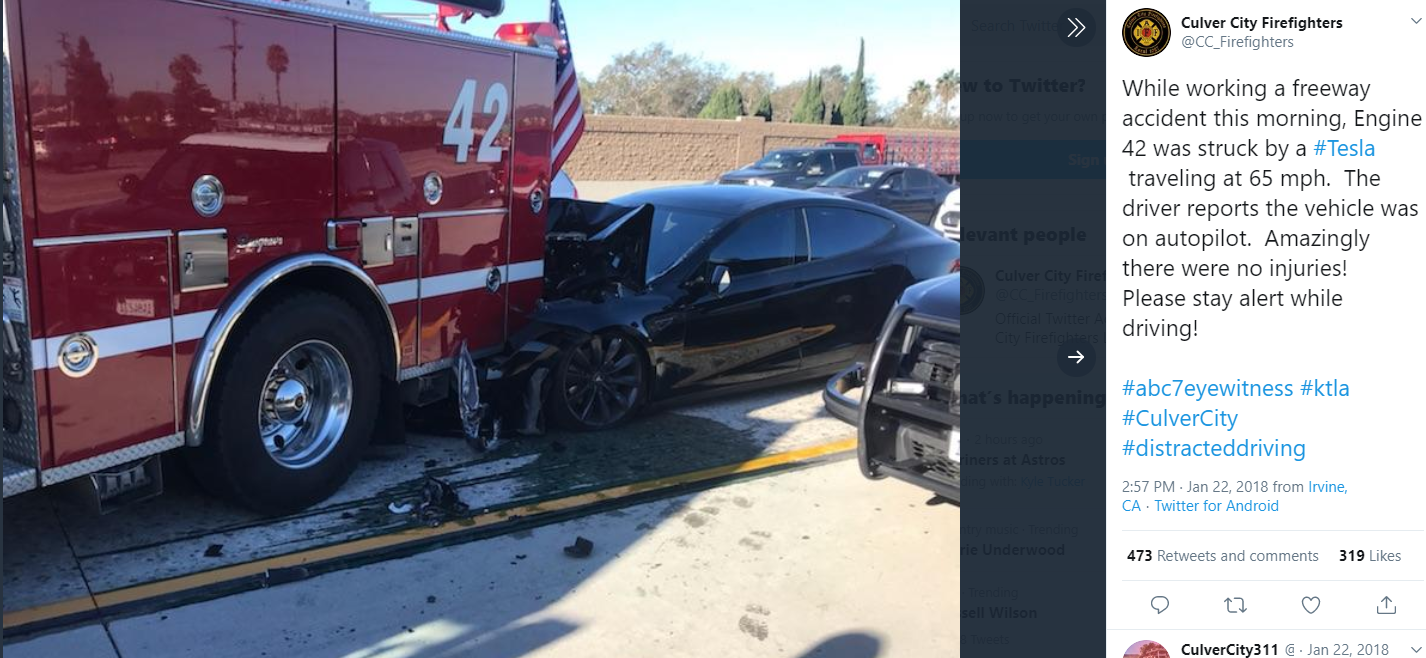
During Tesla’s 2019 Autonomy Day, Tesla CEO Elon Musk said the company is expected to have one million vehicles on the road by the end of 2020 that could function as robotaxis. Though the semi-autonomous Autopilot and Full Self-Driving, or FSD, features are loved by some, others say Musk’s driverless dream is far from becoming a reality. Despite many hundreds of millions in investment and almost a decade of efforts, Tesla’s fully autonomous driving mode is not fully autonomous anymore rather in the best-case scenario is now only viewed as a partial augmented driving mode. In other words, human driver has to control the inputs. And while some of the Tesla’s self-driving features are loved by some, many still view it as unfit for our roads. While the hype around the autonomous driving mode was skyrocketing, and just as Tesla started charging a hefty premium for their self-driving feature, a handful of incidents and accidents changed all that. Scenarios of false-positives, or false-negatives, which are built in to the algorithms powering the programs behind the autonomous driving software, lead to further complications of their own, creating as many problems as they solve. In the best-case scenario, public confidence in self-driving technology is still many years if not decades away.
Source: ABC News
Watching the Youtube training sessions posted by Waymo, the Alphabet subsidiary in charge of self-driving cars, reveals the concerns with self-driving technology. One video shows a car that repeatedly and without reason stops in the middle of a street and then drives off again. The explanation came from a passer-by who was carrying a STOP sign sticking out of his bag, misleading the vehicle. In other words, the machine can drive itself, but it lacks the ability to differentiate ‘stop’ signal in different contexts and nuances of incidents on public roads.
The loan underwriters at top banks quickly realized that leaving decision making with a compute program is a recipe for disaster as the program has inbuilt biases and no amount of learning can make the program foolproof. Hence in most cases, AI programs are only limited to the first few stages in the process while the critics decision is made by a human.
Similarly, Apple credit cards have recently discriminated against women,giving them 50% less credit than men with the same income and profile.
Let’s use Netflix as an example. Say you recently watched “Orange is the New Black.” Netflix may then suggest other shows with prison themes, or documentaries about life behind bars, or shows with a strong female lead, etc.
Based on past data (your recently watched shows and movies), it’s able to make a prediction about what you will want to watch next. Once you make your latest selection, it will adjust its algorithm to further customize your experience.
According to a 2017 scholarly article on Augmented intelligence by Researchers Zheng and Wang, Within augmented intelligence, researchers Define models according to the varied degree of AI and human influence.
- The first classification is called Human-in-the-loop hybrid-augmented intelligence) Human-in-the-loop (HITL) hybrid-augmented intelligence is defined as an intelligent model that requires human interaction. In this type of intelligent system, human is always part of the system and consequently influences the outcome in such a way that human gives further judgment if a low confident result is given by a computer. HITL hybrid-augmented intelligence also readily allows for addressing problems and requirements that may not be easily trained or classified by machine learning.
- The second classification looks at (Cognitive computing based hybrid-augmented intelligence) In general, cognitive computing (CC) based hybrid-augmented intelligence refers to new software and/or hardware that mimics the function of the human brain and improves computer’s capabilities of perception, reasoning, and decision-making. In that sense, CC based hybrid-augmented intelligence is a new framework of computing with the goal of more accurate models of how the human brain/mind senses, reasons, and responds to stimulus, especially how to build causal models, intuitive reasoning models, and associative memories in an intelligent system.
Augmented intelligence follows a five-function cadence that allows it to learn with human influence. It repeats a cycle of understanding, interpretation, reasoning, learning, and assurance. Here’s how it works:
- Understanding: Systems are fed data, which it breaks down and derives meaning from.
- Interpretation: New data is inputted; the system then reflects on old data to interpret new data sets.
- Reasoning: The system creates “output” or “results” for new data set.
- Learn: Humans give feedback on output and the system adjusts accordingly.
- Assure: Security and compliance are ensured using blockchain or AI technology.
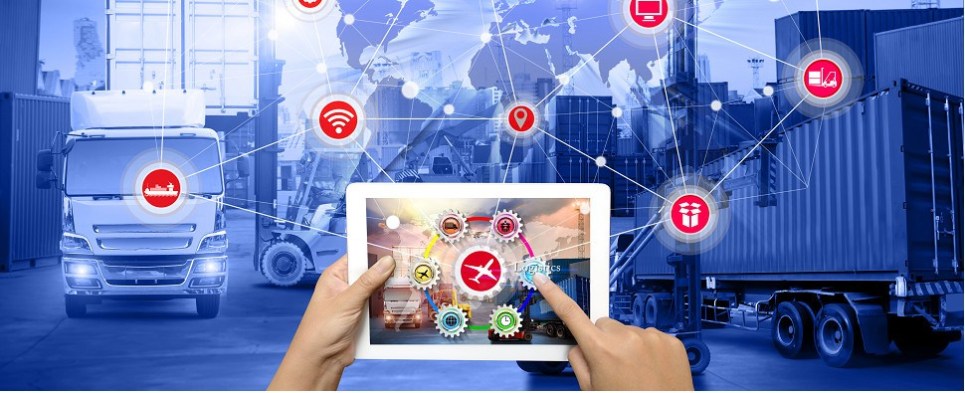
Source: Global Data Magazine
It is clear and evident that AI is here to stay. Humans have a deep reliance on Artificial Intelligence which has been around for decades. Yet, the future of Artificial Intelligence is brightest with the humans, morphing in to Augmented Intelligence. Having humans and machines work hand-in-hand is a win-win for both parties.
Most scientists and researchers agree that its probably extremely implausible, if not impossible to imagine collective human failure to the extent that AI is allowed to grow unchecked, while simultaneously all other uses of AI beneficial to humankind are ignored.
One thing is certain though: despite the ominous predictions and warnings on doomsday scenarios, arising out of the impact of AI on humanity and society, AI will never take over the world or morph in to Terminator style Machines Or Will Smith’s I robot kind of intelligence.
]]>
Introduction
According to some the vast expanse of Internet infrastructure is really just a spaghetti-work of really long wires spread everywhere. While most of the humans now largely experience the internet through Wi-Fi and phone data, the connectivity itself is provided by systems carrying the signals across the world. The signals are transmitted under the ground, carried overhead or travel through deepest oceans. What we can physically see however is just a small part of this mind-numbingly massive infrastructure, for the largest part of internet cabling is virtually passing through the deepest waters.
Since the 1990s, the global submarine or undersea cable networks have become the major foundation of worldwide internet traffic and movement of information digitally. The first submarine communication cables laid in the 1850s carried telegraphy traffic, followed by telephone traffic, then data communications traffic. In 1854, installation began on the first transatlantic telegraph cable, which connected Newfoundland and Ireland. Four years later the first transmission was sent – it took nearly 16 hours for the first trans-Atlantic cable sent from Queen Victoria to commemorate the occasion to reach President James Buchanan. Fiber optic cables and communications satellites were both developed in the 1960s, and throughout the cold-war era the undersea cable networks were used by countries to aid and strengthen their communication systems. Internet signals can be carried over satellites in space orbiting around the Earth. There are thousands of satellites in orbit around the Earth today, and the number is increasing. Though fiber optic cables and communications satellites were both developed in the 1960s, and reformed over the years, satellites communications have never been able to get rid of its inherent two-fold problem: latency issues and bit loss in data transmissions. Fiber-optic networks work by sending light over thin strands of glass. Fiber-optic cables, which are about the diameter of a garden hose, enclose multiple pairs of these fibers. Meanwhile, the optical fiber cables can transmit information at 99.7 percent the speed of light. The problems with satellite connectivity, and the advantages of undersea fiberoptic networks have tilted the tide in favor of undersea cables decidedly.
In the decades since 1960s, new wireless and satellite technologies have been invented, yet cables remain the fastest, most efficient and least expensive way to send information across the globe.
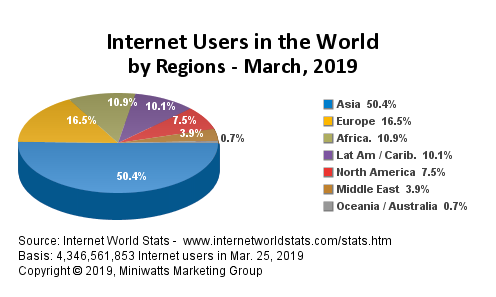
Image Source: Internet World Stats
Why is Big Tech interesting in owning the cables
In 2013, Internet traffic was 5 gigabytes per capita; this number is expected to reach 14 gigabytes per capita by 2018. Lets allow that to sink in for a moment.
In the modern internet era, where speed, transmission capabilities and robustness of the network held the key, telecom companies did most of the work by building the massive submarine information highways by laying most of the cable under the world’s oceans. During the past decade, however, tech giants (Google, Facebook, Amazon, Microsoft, etc) have started to take more interest in this space by exercising their financial muscle. Experts say submarine cable projects cost up to $350 million, depending on the length of the cable and in case of long projects like the one Facebook just launched, the costs can escalate further quite quickly.
According to this NY times article, nearly 750,000 miles of undersea cable already connects the continents to support global insatiable demand for communication and entertainment. Companies have typically pooled their resources to collaborate on undersea cable projects, like a freeway for them all to share. Alan Mauldin of the research firm Telegeography says only about 30 percent of the potential capacity of major undersea cable routes is currently in use—and more than 60 new cables are planned to enter service by 2021.
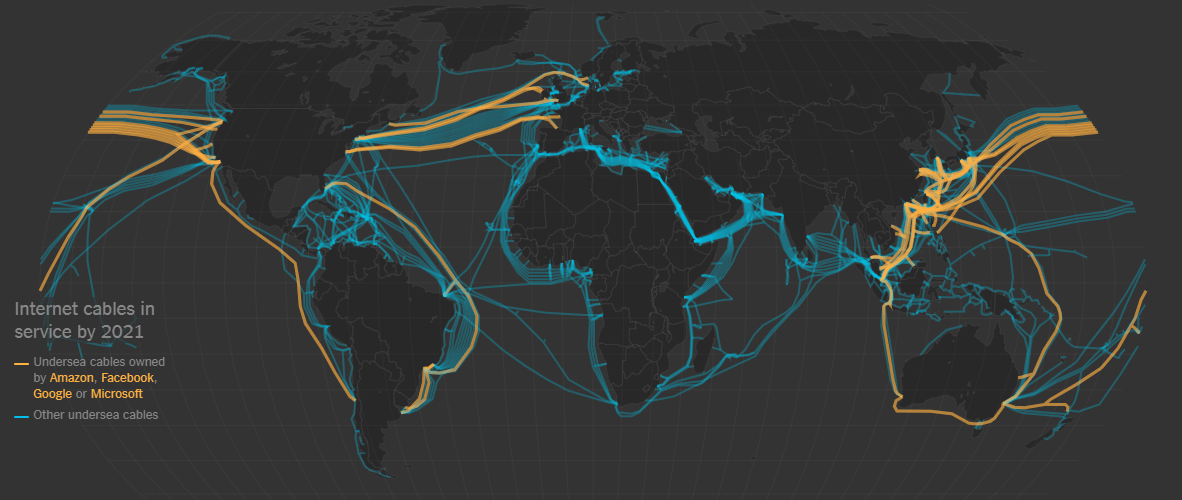
Image Source: NY Times
Traditionally, the relationship between tech companies and telecom provides has been fairly simple. Like Google’s employees using T-Mobile’s wireless services, the telecom companies built a huge undersea network sinking in billions of dollars, for the bandwidth to be consumed by tech companies to transmit data across the globe. Experts say that as undersea cable technologies improve, it’s not crazy for companies to build newer, faster routes between continents, even with so much fiber already laying idle in the ocean. This model is being disrupted as today, the current growth in new cables is driven less by telecom operators who typically lease the connectivity, and more by companies like Google, Facebook, and Microsoft who are moving from leasing to owning their own connectivity. Tech giants like Google, Facebook, Amazon and Microsoft have always craved ever more bandwidth for multitude of uses – data storage, streaming videos, photos, and other data scuttling between their global data centers.
Google is going its own way, in a first-of-its-kind project connecting the United States to Chile, home to the company’s largest data center in Latin America. Alphabet is also reportedly in talks to build its own cable system down Africa’s western coast. Just in 2019 alone, Google is planning to build three underwater cables to help expand its cloud business to new regions. In the past, Google has backed at least 14 cables globally. The company has 13 data centers open around the world, with eight more under construction — all needed to power the trillions of Google searches made each year and the more than 400 hours of video uploaded to YouTube each minute.
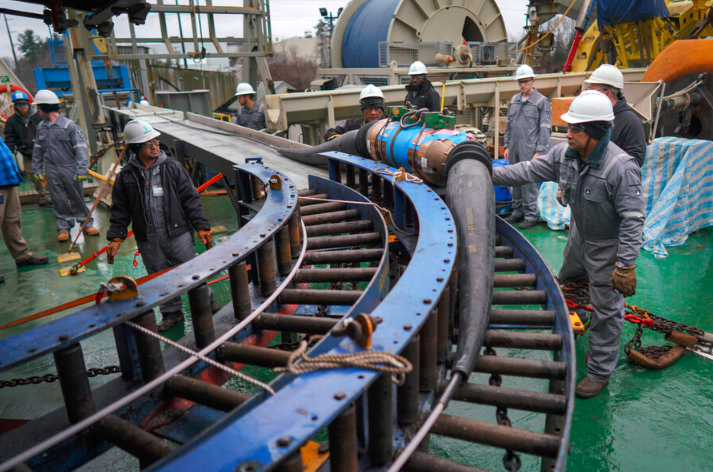
Image Source: Internet
Ben Treynor Sloss, vice president of Google’s cloud platform, said in a blog post that “together, these investments further improve our network — the world’s largest — which by some accounts delivers 25 percent of worldwide internet traffic,”.
Related to the worldwide telecommunications boom and the easy access to 4G networks along with smartphones, more people outside Europe and North America are accessing internet through smartphones in specific and through other means in general. That has prompted companies to think about new growth routes, like between North and South America, or between Europe and Africa, says Mike Hollands, an executive at European data center company Interxion. The Marea cable ticks both of those boxes, giving Facebook and Microsoft faster routes to North Africa and the Middle East, while also creating an alternate path to Europe in case one or more of the traditional routes were disrupted by something like an earthquake.
Amazon, Facebook and Microsoft have invested in others, connecting data centers in North America, South America, Asia, Europe and Africa, according to TeleGeography, a research firm.
According to the WSJ, in a project dubbed Simba, Facebook is reportedly developing an underwater data cable to encircle the African continent. Along with its newest project, Facebook already has existing undersea cable projects linking North American, European, and East Asian markets.
Huawei is launching subsea cable links to Africa.
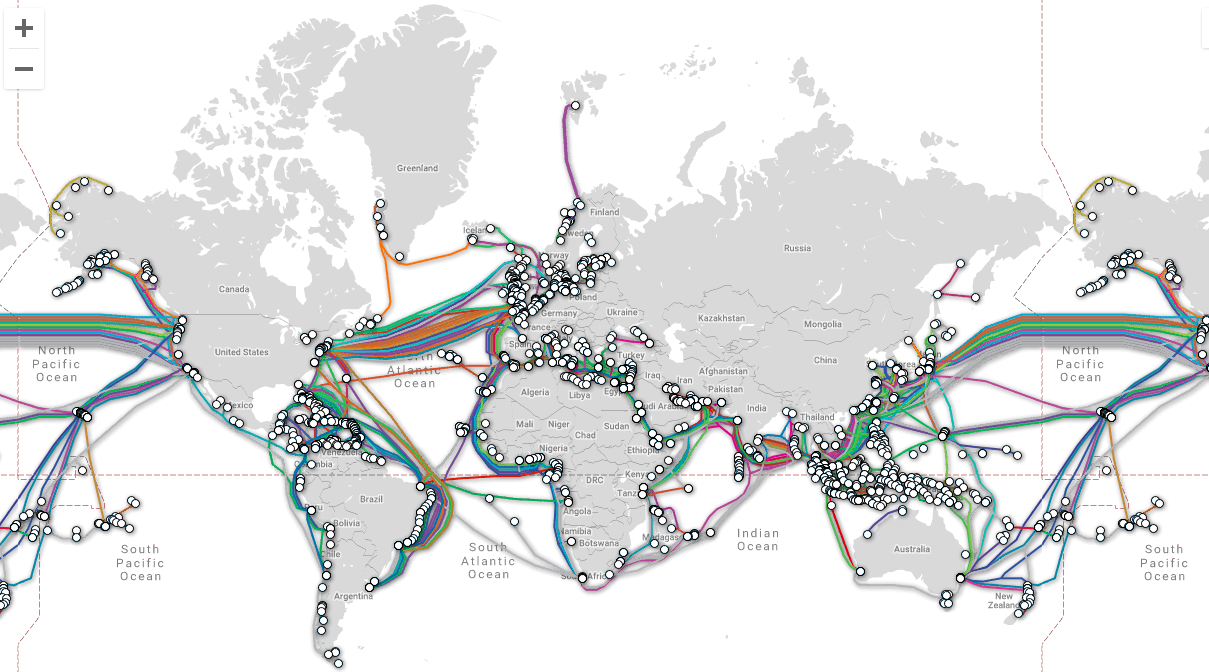
Image Source: Submarinecablemap
Benefits keep on stacking up
Experts have pointed out that simply owning its own cables has multiple benefits as having more cables means there are alternate routes for data if a cable breaks or malfunctions. This simple fact has led to a massive re-alignment of priorities among tech giants such as Google, Amazon, Facebook and Microsoft. The new desire to own undersea networks coupled with the massive wallet size and huge drive to take on risks, means that there are less impediments to stop these tech giants from seizing up as much bandwidth as they possible can.
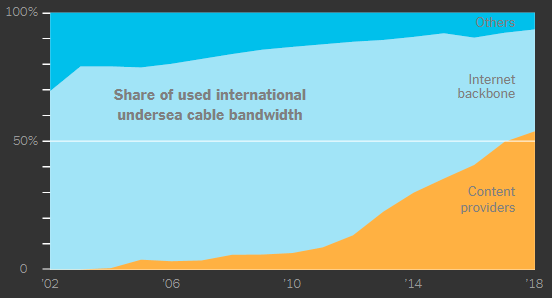
Image Source: telegeography
In addition to owning the number of undersea cables, the tech giants are investing in the underlying technology itself to improve the speed of data transmissions. Most standard long-distance undersea cables contain six or eight fiber-optic pairs. Google’s new cable dubbed Dunant, is expected to be the first to include 12 pairs, thanks to new technology developed by Google and SubCom, which designs, manufactures, and deploys undersea cables. Google predicts that its cable will transmit around 250 terabits per second which is more than 50% faster than the Facebook and Microsoft’s Marea cable, which transmits data at about 160 terabits per second between Virginia and Spain. Japanese tech giant NEC announced that it has built the technology that will enable long-distance undersea cables with 16 fiber-optic pairs, while Vijay Vusirikala, head of network architecture and optical engineering at Google, says the company is already contemplating 24-pair cables.
Not only technologically, even financially it may make more sense to own undersea cables. The companies can increase the amount of data that each fiber pair within a fiber-optic cable can carry while also packing more fiber pairs in to a given cable. As companies pump more and more data through these cables at ever increasing speeds, the value of each cable increases while the cost for each unit of data comes down.
Some challenges
It generally takes about a year of planning to chart a cable route that avoids underwater hazards, but the cables still have to withstand heavy currents, rock slides, earthquakes and interference from fishing trawlers. Each cable is expected to last up to 25 years.
In total, the volume of undersea cables is hundreds of thousands of miles long; while the cables are laid down at depths as deep as Everest Is tall. The job of laying undersea cables require its own specialized crews, machines and boats. While not the most difficult job, it’s certainly more complex than a matter of dropping wires with anvils attached. The cables must be dropped precisely, generally across flat surfaces of the ocean floor, which can be a daunting task even for the most experienced crews. Care must be taken to avoid anything that can physically disrupt or heavens forbid, damage the cable. Coral reefs, sunken ships, fish beds, and other ecological habitats and general obstructions are just few of such blockers. The cables need to be laid anywhere from shallow sea bed to deepest parts of the ocean where weather conditions can become nasty quickly.
The diameter of a shallow water cable is about the same as a soda can, while deep water cables are much thinner—about the size of a Magic Marker. Just like ships’ anchors and fishing trawls, earthquakes can cause significant damage to undersea fiber-optic cables. The damage could be a malfunction or break near or many miles below the surface of the water. When this happens, the telecom operator responsible for maintenance has to find the location of the accident and then work on repairing the impacted sections of the cable depending on the depth where the impacted portion is located. If the cable is in deep waters (6500 feet or greater), the ships lower specially designed grapnels that grab onto the cable and hoist it up for repairs, while If the cable is located in shallow waters, robots are deployed to grab the cable and haul it to the surface.
Conclusion
Demand for undersea cables will only grow as more businesses rely on cloud computing services. And technology expected around the corner, like more powerful artificial intelligence and driverless cars, will all require fast data speeds as well. Areas that didn’t have internet are now getting access, with the United Nations reporting that for the first time more than half the global population is now online.
]]>
Originally Published April 21, 2018
Artificial Intelligence is broadly referred to as any source, channel, device or usage application whereby tasks normally attributed to human intelligence, such as reasoning, interpretation, storage and processing of information, ability to analyze historical information and ultimately, decision making is reproduced outside human body and human networks.
Classic machine learning algorithms involve techniques such as decision trees and association rule learning, including market basket analysis (ie, customers who bought Y also bought Z). Deep learning, a subset of machine learning that includes neural networks, attempts to model brain architecture through the use of multiple, overlaying models.
Classic examples of Machine learning include Virtual Personal Assistants like Siri, Alexa, Google, Predictions while Commuting, Videos Surveillance, Social Media Services from personalizing your news feed to better ads targeting, Face recognition, Email Spam and Malware Filtering, Online Customer Support including chat bots, Search Engine Result Refining, Product Recommendations based on previous purchase trends, and Online Fraud Detection including efforts to curb money laundering.
From a technology and computer science perspective, bias may refer to the productive bias that enables Machine Learning, both at the level of selecting the training data-set and at the level of training the algorithms. It reminds one of David Wolpert’s ‘no free lunch theorem’. This relates to the trade-off between the size of a training data-set, its relevance, the types of algorithms used, and the accuracy and/or speed of the results. Machine learning research designs involve a number of tradeoffs between e.g. speed, predictive accuracy, over-fitting (low utility) or overgeneralizing (blind
spots), confirming that each choice amongst competing strategies has a cost: there is no free lunch as to the research design for machine learning. From a societal perspective, bias may refer to unfair treatment or even unlawful discrimination. It is crucial to distinguish inherent computational bias from the unwarranted impact of unfair or wrongful bias, while teasing out where they meet and how they interact. This includes an inquiry into the ethical assessments of ML bias, based on the fact that ML applications are re-configuring the ‘choice architectures’ of our online and offline environments. The blind application of machine learning runs the risk of amplifying biases present in data.
The underlying assumption of any machine learning program is the existence of an ideal target function or a perfect equation that determines the relationship between input data (e.g., the position of the pieces or board state) and output data (winning or losing the game). In respect to a game of chess, this assumption may hold true, but once we move from chess to human behaviors that are not constrained by a set of unambiguous rules this assumption of a perfect equation is simply wrong.
The word ‘bias’ has an established normative meaning in legal language, where it refers to ‘judgement based on preconceived notions or prejudices, as opposed to the impartial evaluation of facts’. The world around us is often described as biased in this sense, and since most machine learning techniques simply mimic large amounts of observations of the world, it should come as no surprise that the resulting systems also express the same bias
Human biases are well-documented, from implicit association tests that demonstrate biases we may not even be aware of, to field experiments that demonstrate how much these biases can affect outcomes.
Removing bias from AI is the result of deliberate, calculated and thought-out human endeavors, and certainly not an unintended byproduct of certain data analysis. Companies employing any or all five forms of AI — computer vision, natural language, virtual assistants, robotic process automation, and advanced machine learning — must realize that any output they hope to derive are only as good as the data on which the applications are trained.

Picture Credit: Google Images
Technical breakthroughs and demand for turnkey solutions has led developers to build and deploy platforms where machine-learning engines are made readily available with little or almost no investment in expensive programming teams. AWS or Amazon Web Services recently launched a “machine learning in a box” offering called SageMaker, which non-technical folk can leverage to build sophisticated machine-learning models, and Microsoft Azure’s machine-learning platform, Machine Learning Studio, doesn’t require extensive coding.
The intelligent, self-driving systems which rely on complicated algorithms to produce outcomes are as susceptible to the biases as the humans themselves. Just as the human brain builds a model of the world based on what information is fed to it, the algorithms behind machine learning systems and artificial intelligence as a whole build a model world, their own version of reality, based on the data fed to it. If a system is trained on one set of data which is overloaded with samples from a given dataset, the system will have a hard time recognizing other sets of equally valid data. Even in cases where the system is fed large amount of data of several different types, the problem persists as the data may not be deep enough for the system to make unbiased decisions.
In a small example of this bias, Google’s photo app, which can apply automatic labels to pictures in digital photo albums, classified images of black people as gorillas. Similarly, Nikon’s camera software misread images of Asian people as blinking. Of course these errors are not intentional, nor are they serious enough to give rise to widespread concerns, yet the bias of these systems has led people to question, perhaps legitimately so, the blind faith many place on artificial intelligence.
Picture Credit: Google Images
The models learn precisely what they are taught
Considering Bias while feeding data in to machine learning applications is almost becoming a pre-requisite to deploying a machine learning application and is not considered an optional refinement any longer. While machine learning systems enable efficiencies and offer advantages of breakthrough processes, there are many ways in which machines can be taught to do something immoral, unethical, or just plain wrong.
To detect the biases in Machine Learning, it is essential to understand how Machine learning actually works, and to detect the series of design choices that inform the accuracy of the outcome. Its essential to understand that each of the design choices that went in to framing the Machine Learning algorithm, entails real life trade-offs that determine the relevance, validity and reliability of the algorithm’s accuracy for real life problems.
In one of the early examples of algorithmic bias, 60 women and ethnic minorities were denied entry to St. George’s Hospital Medical School per year from 1982 to 1986, because of a new computer-guidance assessment system that denied entry to women and men with “foreign-sounding names” based on historical trends in admissions.
Machine learning in health care holds great promise as it means the avoidance of biases in diagnosis and treatment thereby improving not only the availability of care but the actual results. Health care providers and Practitioners may have bias in their diagnostic or therapeutic decision making. This human bias may be circumvented if a computer algorithm could objectively synthesize and interpret the data in the medical record and offer clinical decision support to aid or guide diagnosis and treatment. In Healthcare, the integration of machine learning with clinical decision support tools, such as computerized alerts or diagnostic support, may offer targeted and timely information that can improve clinical decisions to health care providers, doctors and nurses. Machine learning algorithms, however, as it is time and often seen are subject to biases. These biases include those related to missing data and patients not identified by algorithms, sample size and underestimation, and mis-classification and measurement error. Given many such examples, there is a growing concern that biases and deficiencies in the data used by machine learning algorithms may contribute to socioeconomic disparities in health care.
Types of Biases
Lets look at some of the basic types of biases primarily only related to datasets used to train machine learning algorithms.
Anchoring bias occurs when choices on metrics and data are based on personal experience or preference for a specific set of data. By “anchoring” to this preference, models are built on the preferred set, which could be incomplete or even contain incorrect data leading to invalid results. Because this is the “preferred” standard, realizing the outcome is invalid or contradictory and can be hard to discover.
Availability bias, similar to anchoring, is when the data set contains information based on what the modeler’s most aware of. For example, if the facility collecting the data specializes in a particular demographic or co-morbidity, the data set will be heavily weighted towards that information. If this set is then applied elsewhere, the generated model may recommend incorrect procedures or ignore possible outcomes because of the limited availability of the original data source.
Confirmation bias leads to the tendency to choose source data or model results that align with currently held beliefs or hypotheses. The generated results and output of the model can also strengthen the confirmation bias of the end-user, leading to bad outcomes.
Stability bias is driven by the belief that large changes typically do not occur, so non-conforming results are ignored, thrown out or re-modeled to conform back to the expected behavior. Even if we are feeding our models good data, the results may not align with our beliefs. It can be easy to ignore the real results.
Machines are generally held to be more trustworthy than humans. While a currency counting machine is definitely more accurate and faster than a person counting currency with bare hands, it is difficult to extrapolate the same level of trust to machines with active learning and thinking functions.
A look at Allegheny Family Screening Tool: unfairly biased, but well-designed and mitigated
In this final example, we discuss a model built from unfairly discriminatory data, but the unwanted bias may be mitigated in several ways. The Allegheny Family Screening Tool is a model designed to assist humans in deciding whether a child should be removed from their family because of abusive circumstances. The tool was designed openly and transparently with public forums and opportunities to find flaws and inequities in the software.
The unwanted bias in the model stems from a public dataset that reflects broader societal prejudices. Middle- and upper-class families have a higher ability to “hide” abuse by using private health providers. Referrals to Allegheny County occur over three times as often for African-American and biracial families than white families. Commentators like Virginia Eubanks and Ellen Broad have claimed that data issues like these can only be fixed if society is fixed, a task beyond any single engineer.
Machine Learning and neuron networks are interchangeably used within Artificial Intelligence ecosystems as these represent the way AI is progressing to meet the demands from technology savvy businesses and individuals. Often, these networks create what are known as black boxes, referring to closely guarded virtual boundaries where the internal branching, logic application and evolution of the application itself is obfuscated from public view. And as is often seen, many of the AI algorithms involve use of facial recognition technology, which is deeply flawed in itself. Facial recognition technology (FRT) which aims to analyze video, photos, thermal captures, or other imaging inputs to identify or verify a unique individual is increasingly infiltrating our lives. Facial recognition systems are being provided to airports, schools, hospitals, stadiums, shops, and can readily be applied to existing cameras systems installed in public and private spaces.
Additionally, there are already documented cases of the use of FRT by government entities that breach the civil liberties of civilians through invasive surveillance and targeting. Facial recognition systems can power mass face surveillance for the government – and already there are documented excesses, such as explicit minority profiling in China and undue police harassment in the UK. Source: Facial Recognition Technology (Part 1):
Its Impact on our Civil Rights and Liberties, report issued by United States House Committee on Oversight and Government Reform dated May 22, 2019
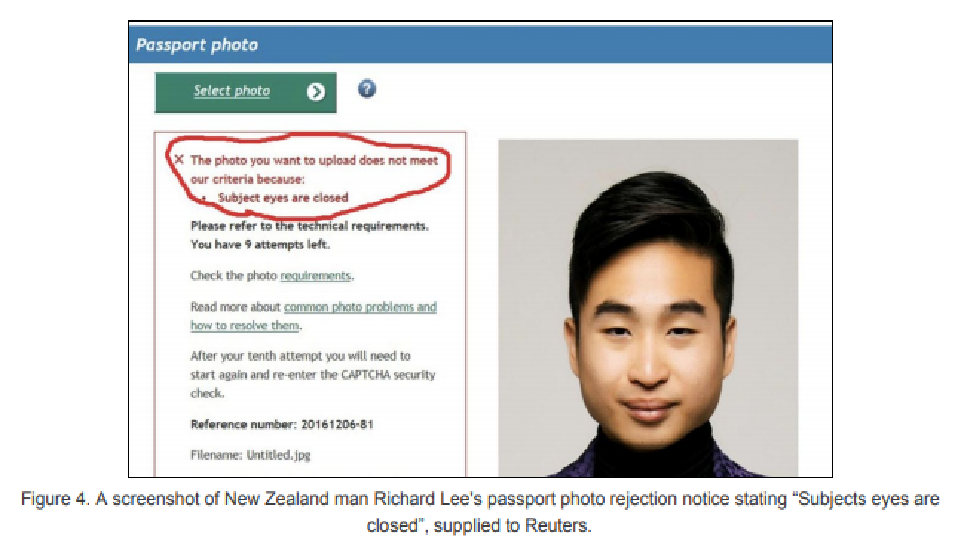
Reuters reported a case where a New Zealand man of Asian descent had his photo rejected by an online passport photo checker run by New Zealand’s department of internal affairs. The facial recognition systems registered his eyes as being closed by mistake. When government agencies attempt to integrate facial recognition into verification processes phenotypic and demographic bias can lead to a denial of services that the government has an obligation to make accessible to all constituents. Source: Facial Recognition Technology (Part 1):
Its Impact on our Civil Rights and Liberties, report issued by United States House Committee on Oversight and Government Reform dated May 22, 2019
In an investigative study published by ProPublica, the investigators found glaring gaps in how a widely used software that assessed the risk of recidivism in criminals was twice as likely to mistakenly flag black defendants as being at a higher risk of committing future crimes. In other words, simply based on the color of the skin, a machine learnt to classify someone as high risk, precisely similar to what some humans would do.
Predictive programs like the one quoted above have generally a higher chance to predicting an outcome on the basis of purely historical data biases leading to re-enforcement of those same biases. In yet another example, in many cities including New York, Los Angeles, Chicago and Miami, law enforcement agencies are using software analyses of large sets of historical crime data to forecast where crime hot spots are most likely to emerge. These areas are then policed heavily in what many argue to be perpetuation of an already vicious cycle of policing over-policed areas to detect and detain more criminals, while crimes in other parts of the city, predominantly white neighborhoods, go relatively undetected.
Picture Credit: Google Images
AI has been widely used to assess standardized testing in the United States and recent studies suggest that it could yield unfavorable results for certain demographic groups. AI also plays deciding role in hiring decisions, with up to 72% of resumes in the US never being viewed by a human.
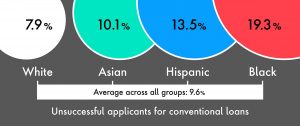
As recently as 2017, data from the Home Mortgage Disclosure Act showed that applicants from African-Americans are three times as likely and applicants from Hispanic descent are two times more likely to get rejects for conventional loans.
In more examples, Amazon’s much touted same day delivery service was made unavailable to residents in certain communities based on similar biases in the past, while women job searchers were less likely to see higher paid job ads in results to their job search queries on Google’s search engine than their male counterparts. Both these examples indicate an undesirable outcome for the target audience – though it remains a matter of some speculation if these errors are indicators of broad systemic biases or just glitches in how ad results are displayed at least in Google’s case. Regardless of its findings, the studies that found these errors and biases indicate that there are more, unknown biases occurring out there which are yet to be discovered.
Lets take a look at Fixing AI Biases
To address potential machine-learning bias, the first step is to adapt transparent means to judge what preconceptions could possibly influence decisions based on a given set of data or what biases currently exist in an organization’s processes, and actively hunt for how those biases might manifest themselves in data. Since this can be a delicate issue, many organizations bring in professionals and external experts to analyze their past and current practices.
Up until 10 years ago, the problems of bad or biased data-sets leading to unfair and / or incorrect outcomes was not even considered. The focus was on speed and agility – to build and release systems faster.
On the one hand, many people seem to believe that machine learning is agnostic, in the sense of being oblivious to human bias or independent of the design choices that determine its performance accuracy. In that sense, however, machine learning is not agnostic. On the other hand, many people seem to believe that undesirable bias in the training data can be remedied in a straightforward way, thus restoring some kind of neutral
training set, resulting in agnostic machine learning.
The errors of intelligent systems are hardly noticeable to most people, yet the presence of similar trends based on data in both historical cases and today’s artificial intelligence systems indicates a deeper malice – something which has gone unnoticed and made its way to how the machines think and act. The problem emerges as the algorithms learn, evolving in to newer and uncharted courses or neuron networks, and take the shape of something which was unimaginable to begin with.

Picture Credit: Google Images
Breaking the ‘black boxes’ refers to revealing and explaining the ways in which machine learning and neuron networks arrive at data outputs. However this is largely inhibited by the lack of transparency by AI applications to make its entire search parameters and logics open to scrutiny which adds to growing complexity and skepticism around the entire ecosystem of AI. A closer inspection of the prevalent issues within AI makes one fact painfully obvious – Governments and public institutions as well as private individuals need to do more, not just appear to be doing so, but actually undertake conscious initiatives to establish accountability in the system. Most importantly, as the enterprises invest in predictive technologies, they must commit to fairness, due process and transparency.
Posing the following questions can help researchers check for systematic bias in underlying data:
- Presence of particular groups suffering from systematic data error or ignorance?
- Have the researchers intentionally or unintentionally ignored any group?
- Are all groups represented proportionally broadly, for example considering an attribute like protected feature of race, are all races being identified or merely one or two?
- Has the research team done enough contextual work, for example identifying enough features to explain minority groups?
- Has the research team used or is likely to use or create features that are tainted?
- Has the research team considered stereotyping features?
- Are the data models apt for underlined use case?
- Is the data model accuracy similar for all groups under study?
- Has the research team identified and corrected predictions that are skewed towards certain groups?
- Has the research team optimized all required metrics and not just those that suit the business or potential favorable outcome/s?
Finally, just an effort to focus on ethics alone will not do when confronting the framing powers of machine bias, highlighting the need to bring the design choice that determine these framing powers under the Rule of Law.
By carefully altering the way different data-sets and groups are assigned to protected or sensitive classes, and ensuring these groups have equal predictive values and equality across false positive and false negative rates, the research team can better detect bias in AI.
Humans first: Collective enthusiasm for applying computer technology to every aspect of life has resulted in a tremendous amount of poorly or hastily designed systems. People and companies are so eager to do everything digitally — hiring, driving, paying bills, even choosing romantic partners — that they have stopped demanding that technology actually work to advance the needs of people for whom the technology is created. There are fundamental limits to what humans can and should do with technology.
Establishing Anchors: Many applications of machine learning actually work with a so-called “ground truth” to anchor the performance metric; to test whether the system gets it right, machine learning will often require a machine-readable indication of what is “right.” The ground truth is, for instance, based on surveys or interviews where people are asked to assess their own position, emotions, or preferences or, alternatively, based on expert opinion such as medical diagnoses made by medical doctors.
Accounting for adversarial training in training phase of Machine Learning -: Adversarial examples exploit the way artificial intelligence algorithms work to disrupt the behavior of artificial intelligence algorithms. In the past few years, adversarial machine learning has become an active area of research as the role of AI continues to grow in many of the applications we use. In adversarial training, the engineers of the machine learning algorithm retrain their models on adversarial examples to make them robust against perturbations in the data. There’s growing concern that vulnerabilities in machine learning systems can be exploited for malicious purposes.
Business Rules, Legal, Regulatory and Compliance framework: Refusing credit, flexible pricing or raising an insurance premium may be based on the freedom to contract, but that freedom is not unlimited and consumer law, competition law, financial services law and insurance law may stipulate further restrictions that must be met, potentially requiring a motivation for a refusal or specific types of price differentiation.
Rigorous Testing, Analysis and Adjustments: The study of trade-offs is an important element in the journey to reduce biases. Machine learning research designs involve a number of trade-offs between e.g. speed, predictive accuracy, over-fitting (low utility) or overgeneralizing (blind spots), confirming that each choice amongst competing strategies can be leveraged to tweak the outcome. Is speed more important, or accuracy? Is color of skin given higher weight, or anatomical features? Do bodily movements mean anything? The more important applications should be based on confirmatory research that includes inquiry into causality, so as to prevent delusional inferences that are wrongly taken for granted precisely because there is no understanding of the causal dependencies on potentially unknown parameters.
A crucial way to test for biases is by stress-testing the system as demonstrated by computer scientist Anupam Datta of Carnegie Mellon University who designed a program to test whether AI showed bias in hiring new employees. Machine learning can be used to pre-select candidates based on score arrived at through considering various criteria such as skills, ability to lift weights, gender and education. This produces a score which indicates how fit the candidate is for the job. In a candidate selection program for removal companies, where ability to lift weights is a favored requirement, hence the source for bias, Datta’s program analyzed how likely is this bias reflected in the score assigned to each application. The program randomly changed the gender and the weight applicants said they could lift in their application, both crucial parameters for the job. If there was no change in the number of women that were pre-selected by the AI for interviews previously, then it is not the changed parameters that determined the hiring process.
As history has shown us, there are hidden pitfalls beyond the general biases in AI systems. Defense and intelligence agencies are overwhelmed by the amount of data generated by surveillance and monitoring systems. An individual being tracked can form unmanageable number of related networks comprising machines and other individuals and keeping a track of all possible nodes of communication multiplied by several hundred thousand subjects can and does become overwhelming. In most glaring cases, certain individuals have slipped through the investigative net, have gone on to inflict severe and long lasting damage through acts of terror. Analysts from one of America’s spy agencies and arguably leading global agency, the NSA, are already overwhelmed by the recommendations of old-fashioned pattern-recognition software pressing them to examine certain pieces of information. Many times its just that the system flags the right individual at the right times, however human analysts or the investigators assigned to probe deeper do not trust the data they are being shown by the software. Having clear explanation of why such individual is flagged and the accurate reasons behind the flag would help convince the investigator and provide rationale for action.
Trevor Darrell’s AI research group at the University of California, Berkeley, conducted extensive research with software trained to recognize different species of birds in photographs. Instead of merely identifying, say, a Western Grebe, the software also explains the logic behind its choice – why it thinks the image in question shows a Western Grebe is because the bird has a long white neck, a pointy yellow beak and red eyes.
Through a combination of art, research, policy guidance and media advocacy, the Algorithmic Justice League is leading a cultural movement towards equitable and accountable AI.
At IBM, through research dedicated to Mitigating human bias in AI, the MIT-IBM Watson AI Lab’s efforts are drawing on recent advances in AI and computational cognitive modeling, such as contractual approaches to ethics, to describe principles that people use in decision-making and determine how human minds apply them. The goal is to build machines that apply certain human values and principles in decision-making.
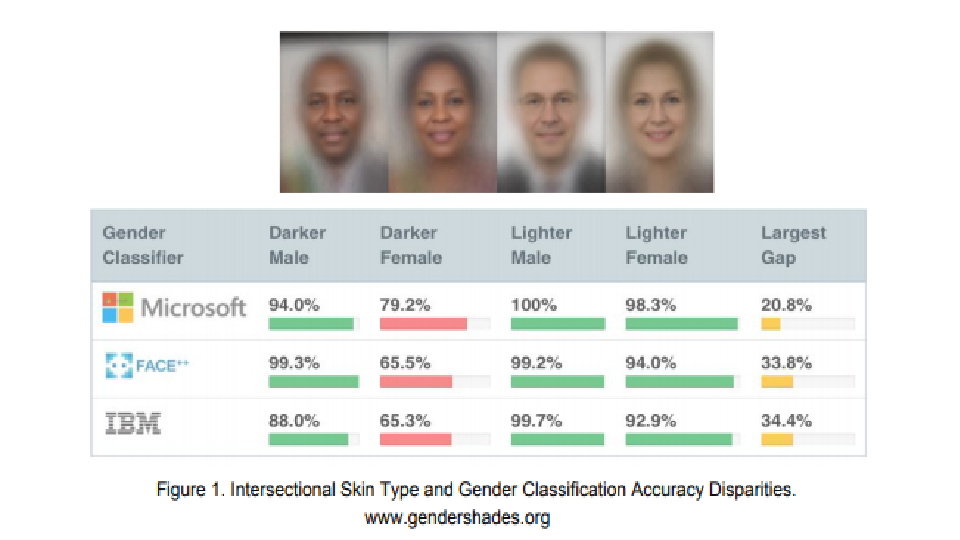
The Gender Shades project evaluates the accuracy of AI powered gender classification products through collaboration with Microsoft, Google and IBM.
Picture Credit: Google Images
Conclusion
The above biases are not alone. Nor do they represent a significant sample. Observers generally unanimously believe that these are just drops in an ocean of biases living on and growing within the systems collectively known as artificial intelligence.
The creators of technology have a living relationship with the technology they create. Machine learning and intelligent systems today take off after their inventors in many cases where the cultural and social rules to inclusion of ethical perspectives, the creators of such systems lend more to it than just their competence. In a way, artificial intelligence reflects the values of its creators. Familiar biases, old stereotypes, vision of external factors and an unfettered outlook of the world have known to become real, tangible traits while a system free of such biases and beliefs exists only in theory books.
As some view, this is essentially a fight between conflicting interests. On one hand there are people who are largely interested in maximizing the ROI on investment in technology, even as they mistakenly and painfully ignore the perils from such mindless pursuit of short term goals, while on the other hand there are people who are impacted by the outcomes of biased systems. As in any social-economic conflict, there are people who are unaffected by these biases, shielded by such factors which are favorably treated in the machine learning algorithms, hence are not bothered by the outcomes. At the same time, there are people who though unaffected today, realize the pitfalls and perils form such unfettered misplaced prioritization of developing AI and support the introduction of tighter controls around the way Artificial Intelligence is monitored, controlled and regulated. In a lot of ways, this is also a conflict where those who are aware of technology trends and possess insights must act on the behalf of those who are unaware though may be affected by implications of such biases in AI.
Automated systems are not inherently neutral. They reflect the priorities, preferences, and prejudices – the coded gaze – of those who have the power to mold artificial intelligence.
We all have an interest in creating robust technologies, AI systems, and other platforms that make our tasks easier and efficient. Further, an understanding of how the data is collected, and the purpose for which it is being used, is paramount to understanding where it can fail or be misused. On the one hand, we may seek to improve AI to limit the very serious consequences of bias and discrimination — for example, a self-driving car that fails to detect certain pedestrian faces or a greater likelihood that people with darker skin are misidentified as criminal suspects by the police. At the same time, we must continue to call into question whether that use is supported by our values and should therefore be permitted at all. If we focus only on making improvements to data-sets and machine learning and computational processes, we risk creating systems that are technically more accurate but also more capable of doing harm at an unseen, unmitigated levels.
]]>
AI Bias: inherent flaw or mere side effect!
Originally Published April 18, 2018
Introduction
Artificial Intelligence is broadly referred to as any source, channel, device or usage application whereby tasks normally attributed to human intelligence, such as reasoning, interpretation of facts, storage and deduction of information from such facts and ultimately, decision making is reproduced outside human body and human networks.
According to a Forbes article, as technology, and, importantly, our understanding of how our minds work, has progressed, our concept of what constitutes AI has changed. Rather than increasingly complex calculations, work in the field of AI has concentrated on mimicking human decision making processes and carrying out tasks in ever more human ways.
Artificial Intelligence uses are influencing people’s lives in more ways than can be counted. Autopilots in aviation is possibly one of the earliest uses of AI. Most airline captains trust auto pilot for 95% of time during an actual typical flight. AI is behind the personal virtual assistants in the iPhones, Google Home, and Amazon Echo. AI is used to recommend shopping products and brands based on past choices and history of website viewing. AI is being used to develop driver-less cars to make commuting faster and safer. It is used to recommend shows or films according to viewer’s tastes, preferences and past choices on Netflix or what songs one may like to listen to on Spotify. AI is used to how products are marketed and customized according to target audience’s tastes and preferences while steering conversations uses have with their favorite retailers, and will be used to transform retail industry around the world.
In recent interviews, Uber’s Head of Machine Learning Danny Lange confirmed Uber’s use of machine learning for its popular features like ETAs for rides, estimated meal delivery times on UberEATS, computing optimal pickup locations, as well as for fraud detection. The pioneering research behind these features is what sets Uber different from its competitors, its executives feel. And while users ultimately get to decide that, there is no doubt that AI powered applications are not just part of the ecosystem, rather form an ecosystem of their own, which is continually expanding equally in its size and impact.
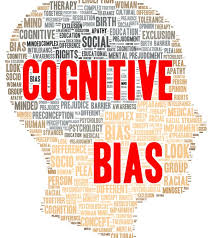
Image Credit: Psychology roots
What is Artificial Intelligence?
Artificial intelligence then in other words is simply the reproduction of human intelligence and capabilities outside the human body. The work that can be done by machines or mechanical applications or software programs carrying out very basic rudimentary and rule based decision making can be termed as Artificial Intelligence. We regularly interface with such systems on a daily basis – airline ticketing and check in systems; chat bots and intelligent IVRs replacing customer service agents; human profiling software and applications flagging any abnormal profile or profile that fits one or more among the list of many criterion for detailed human checks; banking sector applications where any abnormal transaction falling outside a pattern is flagged for manual checks are a few among immeasurable applications of Artificial intelligence. Basically, any task done by humans which involved repetitive application of mind and knowledge, can be handled to automated processes or devices. This is also known as applied AI.
As humans grow and learn newer things, apply their knowledge and continue to learn thereby expanding both the repository of knowledge and their understanding of such repository, i.e. the breadth and width of subject matter, a credible and reliable Artificial Intelligence system must have the ability to learn continually based on the amount of information available to it at any given time. As early as 1959, thinkers laid down this expectation – that its simple to teach computers how to learn, rather than teaching them everything they need to know.
As internet became common during 1990s and 2000s, the emergence of huge troves of data, and availability of such data for analysis in order to learn human needs, even before humans themselves could understand those needs, has become the new future of Information Technology. Technology is no more just to aid humans, but has the potential today to govern every aspect of human lives. And this is a trend which is only growing and becoming more pervading than ever before. The data collected today is not just about humans, but its also about the machines which collect data about humans themselves. Data from a source is not just about that source alone, but contains many different layers of abstraction providing many useful insights not just in to the primary purpose of study but in to related fields as well.
However there is another aspect of Artificial Intelligence – generalized AI. This aspect caters to much deeper, and perhaps is the truest representation of artificial intelligence. Generalized AI is what was responsible for field of study like Machine Learning and Neural Networks, both of which are central to the idea of Artificial Intelligence. The generalized AI is powered by new concepts like deep learning. The invention of deep learning, a technique which uses special computer programs called neural networks to churn through large volumes of data and is trained to identify and remember patterns in that data set, means that technology which gives a good impression of being intelligent is spreading rapidly.
Machine learning is a sub-field or an application of AI. This involves feeding tons of data gradually – whether it’s in the form of text, images or voice – and adding a classifier to this data. An example would be showing the computer an image of a woman working in an office and then labelling this as woman office worker. Over time and with addition of multiple parameters for each data set and complicated algorithms, the system will learn to make predictions based on the data it is reading. These predictions follow certain rule sets, specified and hard coded in to the machine on the basis of which decisions are made, while simultaneously also becoming inputs in to accuracy analysis to improve decision making for future data sets.
The neural networks are the newest and possibly the most exciting layer within Artificial Intelligence that is powering a new breed of research and machine learning. This new breed of deep machine learning is inspired by the natural evolution of human brain and its connected neurons. The neuron networks use a series of interconnected units or processors and are adaptive systems that can adjust their outputs based on doing, essentially ‘learning’ by example and past data sets as they go, adapting their behavior based on results. This mimics evolution in the natural world, but at a much faster pace, with the algorithms quickly adapting to the patterns and results discovered to become increasingly accurate and valid.
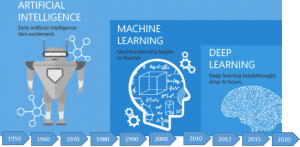
Image Credit : Internet
Neural networks can identify patterns and trends among data that would be too difficult or time-consuming to deduce through human research (picture going through millions of data sets and sub-sets), consequently creating outputs that would otherwise be too complex to manually code using traditional programming techniques.
And as the technology progresses and becomes ever-more complex and autonomous, it also becomes harder to understand, not just for the end users, but even for the people who built the platforms in the first place. This has raised concerns about a lack of accountability, hidden biases, and the ability to have clear visibility of what is driving life-changing decisions and courses of action. This is commonly referred to as Black Box in Artificial Intelligence, where what goes in (inputs) and what comes out (output) is visible and transparent, yet the process followed by the machine or what goes on inside the machine (the brain) is not visible. Scientists and data researchers are not able to pinpoint what learning are being adapted by the machine, though the outputs being produced are desirable.
Bias in Artificial Intelligence
AI Applications range from intelligent IVRs, data analytics, speech-to-text transcription to healthcare where it is being used in myriad of ways including detecting early signs of blindness. AI now runs quality control in factories and cooling systems in data centers. States hope to employ AI to recognize threat from terrorist propaganda sites and remove them from the web. AI is central to attempts to develop self-driving vehicles. Among the ten most valuable quoted companies in the world, seven say they have plans to put deep-learning-based AI at the heart of their operations in future or are already doing so.
Machine Learning and neuron networks are interchangeably used within Artificial Intelligence ecosystems as these represent the way AI is progressing to meet the demands from technology savvy businesses and individuals. Often, these networks create what are known as black boxes, referring to closely guarded virtual boundaries where the internal branching, logic application and evolution of the application itself is obfuscated from public view. And as is often seen, many of the AI algorithms involve use of facial recognition technology, which is deeply flawed in itself. Facial recognition technology (FRT) which aims to analyze video, photos, thermal captures, or other imaging inputs to identify or verify a unique individual is increasingly infiltrating our lives. Facial recognition systems are being provided to airports, schools, hospitals, stadiums, shops, and can readily be applied to existing cameras systems installed in public and private spaces.
Additionally, there are already documented cases of the use of FRT by government entities that breach the civil liberties of civilians through invasive surveillance and targeting. Facial recognition systems can power mass face surveillance for the government – and already there are documented excesses, such as explicit minority profiling in China and undue police harassment in the UK. Source: Facial Recognition Technology (Part 1):
Its Impact on our Civil Rights and Liberties, report issued by United States House Committee on Oversight and Government Reform dated May 22, 2019
Reuters reported a case where a New Zealand man of Asian descent had his photo rejected by an online passport photo checker run by New Zealand’s department of internal affairs. The facial recognition systems registered his eyes as being closed by mistake. When government agencies attempt to integrate facial recognition into verification processes phenotypic and demographic bias can lead to a denial of services that the government has an obligation to make accessible to all constituents. Source: Facial Recognition Technology (Part 1):
Its Impact on our Civil Rights and Liberties, report issued by United States House Committee on Oversight and Government Reform dated May 22, 2019.
People are often too willing to trust in Artificial Intelligence applications, or machine learning mathematical models because they believe that these systems will remove human bias. However, as the machine algorithms and systems replace human processes, these machines are not generally held to similar standards. A big part of the problem is that individuals and companies that develop and apply machine learning systems, and Government regulators who have the mandate to govern the usage, show little interest in monitoring and limiting algorithmic bias. Financial and technology companies use all sorts of mathematical models and aren’t transparent about how they operate.
As with most new technologies, the research wings of the Armed Forces made initial forays in to teaching machines how to do human jobs that involved at the very least a complex application of information abstraction – or as we know it today, Artificial Intelligence and Machine Learning. From the early days of attempted use of AI and Machine Learning applications, a widely circulated though highly improbable or at the very least exaggerated, parable has been told and retold multiple times in forums as wide as coffee table discussions to online articles and research papers. While the story itself may be apocryphal, an almost impossible number of sources citing the story has given it a legendary description. Some researchers attribute this story to a paper published in 1964, almost 5 decades before concept of Artificial intelligence, machine learning etc became common.

Image Credit: Dilbert
For an amusing and dramatic case of creative but unintelligent generalization, consider the legend of one of connectionism’s first applications. In the early days of the ‘perceptron’ the army decided to train an artificial neural network to recognize tanks partly hidden behind trees in the woods. They took a number of pictures of a woods without tanks, and then pictures of the same woods with tanks clearly sticking out from behind trees. They then trained a net to discriminate the two classes of pictures. The results were impressive, and the army was even more impressed when it turned out that the net could generalize its knowledge to pictures from each set that had not been used in training the net. Just to make sure that the net had indeed learned to recognize partially hidden tanks, however, the researchers took some more pictures in the same woods and showed them to the trained net. They were shocked and depressed to find that with the new pictures the net totally failed to discriminate between pictures of trees with partially concealed tanks behind them and just plain trees. The mystery was finally solved when someone noticed that the training pictures of the woods without tanks were taken on a cloudy day, whereas those with tanks were taken on a sunny day. The net had learned to recognize and generalize the difference between a woods with and without shadows!
This bias is not limited to just one study or research project, nor is it an isolated phenomena. Whenever there is a dataset of human decisions, it naturally includes bias. This bias can manifest in many ways and could include hiring decisions, grading student exams, medical diagnosis, loan approvals, etc. In fact anything described in text, in image or in voice requires information processing – and this will be influenced by cultural, gender or race biases.

Image Credit: upliftconnect
One example of AI systems is in financial industry, where complicated algorithms assess credit worthiness and credit risk before issuing credit cards or approving small loans. The task is to filter clients in order to avoid processing any that are likely to fail to make payments. Using data of declined clients, history of bad debts, or delinquencies and associating them with a set of rules could easily provide basis of decisions that machine could produce without human intervention. However, this could also lead to biases getting built in to the system, for example, applications from certain section of people are seen to have higher rejection rates based either on their employment type or simply, gender.
The financial industry is not alone in observing these biases creeping in. LinkedIn, the popular professional and career website, for instance, had an issue where highly-paid jobs were not displayed as frequently for searches by women as they were for men because of the way its algorithms were written. This gender based discrimination came about as the initial users of the site’s job search function were predominantly male for these high-paying jobs so the machine learning aspect just ended up proposing these jobs to men – thereby simply reinforcing the bias against women
The concerns of biases creeping in are not only limited to lower level, data centric and rule based tasks in applications. These concerns are equally, and perhaps more dangerously manifested within the uses of deep machine learning that requires minimal guidance, but ‘learns’ as it goes through identifying patterns from the data and information it can access. Its use of neural networks and evolutionary algorithms resembles a tangled mess of connections that are nearly impossible for analysts to disassemble and fully understand.
As explained earlier, this lack of understanding leads to pervasive fears of something unknown lurking just beneath the surface. The nearly non-transparent ways in which the deep learning machines itself ‘learn’ to navigate our worlds, at the very least, demand closer inspection in order to be fully understood, if not fully trusted.
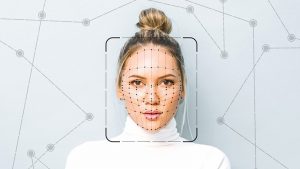
Image Credit: Internet
Another relevant real world example here is of how Google ranks search results. This is a notoriously secret formula, and has been the subject of countless allegations of anti-trust movements, conjectures of how the system manipulates search results and other far more wild theories. Digital agencies and professionals have made and continue to make careers out of their own interpretation of the rules of the game, trying to deliver what they think Google wants to be able to boost their rankings. Many functions are powered by complex algorithms, code, programming or servers, and yet are still deemed trustworthy enough for investing large chunks of the marketing budget.
A system called COMPAS, made by a company called Northpointe, offers to predict defendants’ likelihood of reoffending, and is used by some judges to determine whether an inmate is granted parole. The working details of this program are guarded under heavy veils of secrecy, but an investigation by ProPublica found evidence that the model may be biased against minorities.
The much touted facial recognition algorithm used by various products and applications worked for perfectly for lighter-skinned subjects, however it couldn’t recognize many pictures of people with darker complexion. It’s not a unique problem; in 2015, a Google algorithm classified faces of black people as gorillas.
There have been calls to end the use of ‘black box’ algorithms in government because, without true clarity on how they work, there can be no accountability for decisions that affect the public. Fears have also been raised over the use of bias within decision-making algorithms, but with a perceived lack of a due process in place to prevent or protect against this.
Image Credit: Internet
Bias Elimination: Is it possible?
As deep learning systems, neural networks and machines become capable of performing profound and abstract functions, the fear from AI going rampant becomes more real. The real fear stems not so much from the machines suddenly stop obeying humans or start behaving of their own volition, or at least attempt to do so, rather the real fear arises from the fact that machines do exactly what they are told to do but do so in an incomprehensible manner where creators and users of the technology do not have any visibility and hence lack control. The reason behind this fear is simple – the deep learning networks are taught (LEARN) to rearrange their digital processes in response to the data ingested. The bits of computer code within the neuron networks is designed to copy the way human brains work, by drawing connections between events and information. This implies that once the network is designed and trained, even the creators of the network have little control or even visibility in to what it is doing. Of course, permitting such machines and systems to make critical decisions, be it in financial or healthcare industries or anywhere else, amounts to putting human lives in to the hands of machines, the working and operations of which are still not fully understood. It is akin to a beta program being allowed to fly jet full of passengers and cargo over densely populated areas, and though there are pilots present in the cockpit, their role is reduced to observers’ role.
In a MIT Technology review article from October 2017 titled Forget Killer Robots—Bias Is the Real AI Danger, the problem of bias in machine learning is likely to become more significant as the technology spreads to critical areas like medicine and law, and as more people without a deep technical understanding are tasked with deploying it. Some experts warn that algorithmic bias is already pervasive in many industries, and that almost no one is making an effort to identify or correct it
To rid the AI and deep machine learning from these biases is a complex proposition. As previously discussed, these biases exist due to multiple factors, from type of use of application, to data based biases, to people based reasons, and finally due to a regulatory apathy.
Data based biases general refer to biases included in AI applications and machine learning due to un-clean, poor quality data with biased results already included being uploaded in to a system. This is no brain-teaser, as ‘Garbage in-Garbage out’ is a pretty well-known pitfall.
People based biases generally refer to biases arising out of how interpretation of business rules and data parameters is decided, as well as disinterested stakeholders who are interested in the bottom line and not ridding the AI applications and machine learning systems of long term health and transparency.
Biases due to type of application refer generally to usage based biases and lack of transparency depending largely on the industry type. For example, security, finance and healthcare generally tend to operate with largely secretive processes and restrict access to their processes and systems to any outsiders making it difficult to detect such biases.
Finally, lack of any regulatory oversight, is seen as the final nail in the coffin. The overall perception is that biased algorithms and systems are everywhere, yet no one seems to care. In-house regulators are generally under significant pressure to minimize any application downtime or to suggest expensive fixes. External watchdogs generally lack teeth, while those external regulators who wield some kind of power primarily through policy formulation, typically government agencies, are seldom interested in regulating the uses of AI and machine learning. And while the Congress may be rightly worried about the threats of this unknown equation, the progress seems to be slower and farther than what is needed.
Artificial Intelligence applications suffer from a natural, lack of diversity which in many cases is indicative of deep-rooted cultural norms. AI assistants like Apple’s Siri or Amazon’s Alexa have default female names, voices, and personas, are largely seen as helpful or passive supporters of a user’s lifestyle due in part to their personal messaging and in part to their shopping list task orientation. Meanwhile, their counterparts like IBM’s Watson or Salesforce’s Einstein are perceived as complex problem-solvers tackling global issues, perhaps in part at least due to their male-branded disposition and in part due to their outward problem solving approach. The quickest way to flip this public perception on its head is to render AI genderless. The more long-term approach requires expanding the talent pool of people working on the next generation of AI applications and machine learning technologies to include multiple viewpoints and dispositions in producing a homogenous product, which is culturally neutral yet sensitive to audiences’ diverse requirements.
Another approach is to introduce adequate ‘Bias’ testing before releasing any new version of an existing AI application. Software and application testing is already pretty standardized functions within software development processes, however bias testing is something which is still unknown even among the technology giants. Bias testing must become de-facto for AI applications, while for continually learning machine learning or deep learning applications, the machine or the system must be made complaint to run ‘Bias’ testing standards before fresh automated deployments, or in other cases at regular, frequent intervals, for example, once every 15 days or 30 days depending on the feasibility.
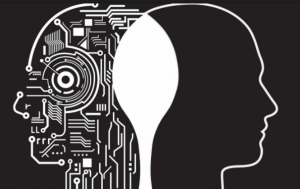
Image Credit: TNW
Conclusion
Facebook’s news feed algorithm can certainly shape the public perception of events, social interactions and even major news events. Other algorithms may already be subtly distorting the kinds of medical care a person receives, or how they get treated in the criminal justice system. Most of the times the biases in AI are not well-known, these may be subtle, hard to notice under the surface ripples which even when noticed are generally dismissed as non-events. On other occasions the biases may not be even shared publically, partly due to non-discovery and partly due to illicit attempts at fix-the-problem before-it-gets-out-of-hand approach.
In real terms, the threat from AI is perhaps not as serious as its usually portrayed in books or movies. However it doesn’t take much for the threat to be manifested in the present day, rather than at some indeterminable date in future. That is the biggest threat of AI where many believe that the AI applications and systems today have the potential to spin uncontrollably out of hands of their creators and users.
As AI is used to produce more meaningful results and power more and more high profile and public facing services, such as self-driving cars, medical treatment suggestions, early warning systems in fields such as oil exploration, or automated defense systems, concerns have understandably been raised about what is going on behind the scenes. If people are willing to put their lives in the hands of AI-powered and machine learning applications, then they would want to be sure that someone understands how the technology works, how in-built biases take effect and how it powers decisions, and more importantly, that someone has the power and means to remove these biases or at least restrict the applications if the biases get out of hand, or if the need arises in any other manner.
]]>