
Whenever there is a talk of infusing technology, automation and intelligence in to tasks or processes, the solutions proposed fall in to two broad buckets. The first is the conventional use of the term Artificial intelligence, machine learning, deep learning and cognitive learning, which typically work outside human intervention and are largely driven by some kind of an algorithm to achieve its goal. The handling of regular transactions as well as any exceptions are defined within the AI program and the machine doing the job in case of touch and feel jobs like manufacturing or the algorithm producing the result in case of purely online work. The second category is where Artificial Intelligence is applied to work in conjunction with the humans and human intervention and interaction is a critical part of the successful completion of the job. This second type is known as Augmented intelligence or Augmented reality.
Another way of looking at what happens with augmented and artificial intelligence is the degree to which algorithms and the programs running the physical machines are expected to make decisions on their own. Is the decision making assisted by humans, controlled by humans or completely out of control of humans?
It’s critical to note that while the technologies and fundamentals powering both Artificial intelligence and Augmented intelligence are largely the same, the applications, goals and objectives are objectively different. Simply put, AI creates a human less environment while Augmented Intelligence or Intelligence Augmented as it’s often called, seeks to create an environment for betterment of humans and human endeavors.
There’s virtually no major industry where modern AI — more specifically, “narrow AI,” which performs objective functions using data-trained models and often falls into the categories of deep learning or machine learning — hasn’t already affected. That’s especially true in the past few years, as data collection and analysis has ramped up considerably thanks to robust IoT connectivity, the proliferation of connected devices and ever-speedier computer processing.
- In Manufacturing: AI powered robots work alongside humans to perform a limited range of tasks like assembly and stacking, and predictive analysis sensors keep equipment running smoothly.
- Healthcare: In the comparatively AI-nascent field of healthcare, diseases are more quickly and accurately diagnosed, drug discovery is sped up and streamlined, virtual nursing assistants monitor patients and big data analysis helps to create a more personalized patient experience.
- Education: Textbooks are digitized with the help of AI, early-stage virtual tutors assist human instructors and facial analysis gauges the emotions of students to help determine who’s struggling or bored and better tailor the experience to their individual needs.
- Media: Journalism is harnessing AI, too, and will continue to benefit from it. Bloomberg uses Cyborg technology to help make quick sense of complex financial reports. The Associated Press employs the natural language abilities of Automated Insights to produce 3,700 earning reports stories per year — nearly four times more than in the recent past.
- Customer Service: Last but hardly least, Google is working on an AI assistant that can place human-like calls to make appointments at, say, your neighborhood hair salon. In addition to words, the system understands context and nuance.
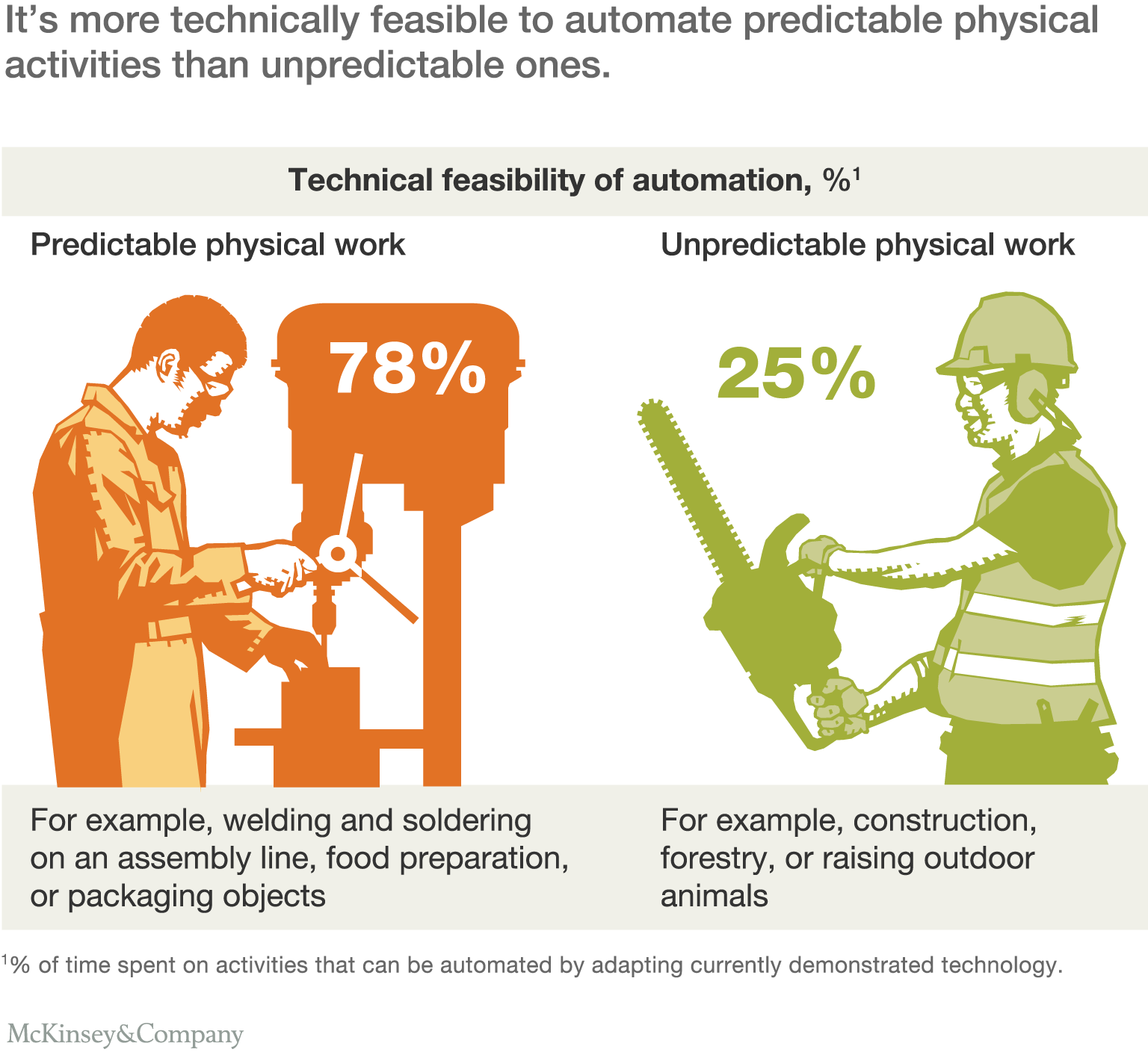
Source: McKinsey & Company
According to a recent publication, of the 9,100 patents received by IBM inventors in 2018, 1,600 (or nearly 18 percent) were AI-related. Here’s another: Tesla founder and tech titan Elon Musk recently donated $10 million to fund ongoing research at the non-profit research company OpenAI — a mere drop in the proverbial bucket if his $1 billion co-pledge in 2015 is any indication. And in 2017, Russian president Vladimir Putin told school children that “Whoever becomes the leader in this sphere [AI] will become the ruler of the world.” He then tossed his head back and laughed maniacally.
The single biggest strength of Artificial intelligence is the simple fact that it can do repetitive tasks better than anything else. And the more quantitative, the more objective the job is—separating things into bins, washing dishes, picking fruits and answering customer service calls—those are very much scripted tasks that are repetitive and routine in nature. In the matter of five, 10 or 15 years, they will be displaced by AI.
Yet even the most pragmatic AI scientists stress that today’s AI is useless in two significant ways: it has no creativity and no capacity for compassion or love. Rather, it’s “a tool to amplify human creativity.” In other words, sure you can teach AI to make strokes with a brush in a canvas, but an AI driven machine can never in a million years paint a Monalisa.
The most advanced robot costing many millions in research dollars and years of work, cannot pickup a tea cup like a 2 year old can. Or millions of sensors on a robot cannot feel taste and smell like humans do. Sure a robot Make millions of calculations in a second, which is many hundreds of times more than the most intelligent human can, sure a robot can discern each smell, or can break down each material in to its atoms and sub-atoms, but it cannot experience the same thoughts, emotions and feelings that human brain can.
The second biggest fear around AI stems from the AI and machine learning applications inheriting some of the human biases based on pre-disposed notions and behaviors that humans may code in to or indirectly influence the program.
Augmented Intelligence on the other hand doesn’t replace humans with technology rather uses Artificial intelligence to aid humans in doing a job.
In recent years, in AI technology rankings in terms of the value they create for businesses, Augmented Intelligence was ranked in second place, just below virtual agents. However, Gartner predicts that “Decision support and AI augmentation will surpass all other types of AI initiatives” creeping into first place this year and then exploding as we reach 2025 becoming around twice as valuable as virtual agents.
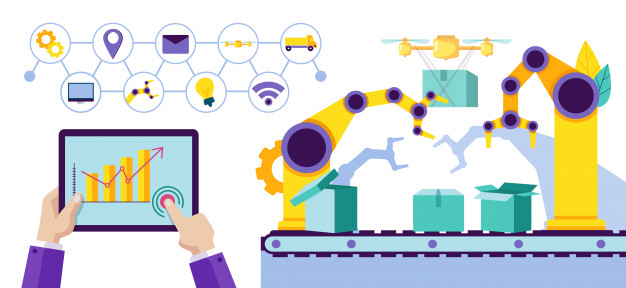
Just like regular project management work, any organization looking to employ AI needs to first define its use cases and requirements clearly and describe the Big Y, or the big problem it’s trying to solve. Then, they need to define the various aspects of business goals, or the product that they want to build. The next step is to outline data requirements and functionality to solve those business goals. And finally, what’s the ROI or returns the organizations expects. What makes AI and machine or cognitive learning projects unique is that they also need to consider the human-machine dynamic. For example, which part of the chain or which components of the product or solution do they want to hand over entirely to machines to execute, and which parts do they want to retain for their Human Resources? Where machine or a computer algorithm based program is making the decision, is it completely autonomous or is there a human there to monitor? Is The machine or computer program Only responsible to feed data, information or half finished product to human to make the final decisions? In the scope of these decisions, then, it makes a lot more sense to create an AI role matrix which can evolve over time. This matrix Lays down specifically the kind of role AI or cognitive learning system will play for that particular function or process.
Source: USM Business Systems
Getting to true autonomous intelligence or fully independent, cognitive learning powered AI model is proving to be real difficult. Even one single instance of non-compliance or faulty decision making can throw the entire program off tracks.
During Tesla’s 2019 Autonomy Day, Tesla CEO Elon Musk said the company is expected to have one million vehicles on the road by the end of 2020 that could function as robotaxis. Though the semi-autonomous Autopilot and Full Self-Driving, or FSD, features are loved by some, others say Musk’s driverless dream is far from becoming a reality. Despite many hundreds of millions in investment and almost a decade of efforts, Tesla’s fully autonomous driving mode is not fully autonomous anymore rather in the best-case scenario is now only viewed as a partial augmented driving mode. In other words, human driver has to control the inputs. And while some of the Tesla’s self-driving features are loved by some, many still view it as unfit for our roads. While the hype around the autonomous driving mode was skyrocketing, and just as Tesla started charging a hefty premium for their self-driving feature, a handful of incidents and accidents changed all that. Scenarios of false-positives, or false-negatives, which are built in to the algorithms powering the programs behind the autonomous driving software, lead to further complications of their own, creating as many problems as they solve. In the best-case scenario, public confidence in self-driving technology is still many years if not decades away.

Source: ABC News
Watching the Youtube training sessions posted by Waymo, the Alphabet subsidiary in charge of self-driving cars, reveals the concerns with self-driving technology. One video shows a car that repeatedly and without reason stops in the middle of a street and then drives off again. The explanation came from a passer-by who was carrying a STOP sign sticking out of his bag, misleading the vehicle. In other words, the machine can drive itself, but it lacks the ability to differentiate ‘stop’ signal in different contexts and nuances of incidents on public roads.
The loan underwriters at top banks quickly realized that leaving decision making with a compute program is a recipe for disaster as the program has inbuilt biases and no amount of learning can make the program foolproof. Hence in most cases, AI programs are only limited to the first few stages in the process while the critics decision is made by a human.
Similarly, Apple credit cards have recently discriminated against women,giving them 50% less credit than men with the same income and profile.
Let’s use Netflix as an example. Say you recently watched “Orange is the New Black.” Netflix may then suggest other shows with prison themes, or documentaries about life behind bars, or shows with a strong female lead, etc.
Based on past data (your recently watched shows and movies), it’s able to make a prediction about what you will want to watch next. Once you make your latest selection, it will adjust its algorithm to further customize your experience.
According to a 2017 scholarly article on Augmented intelligence by Researchers Zheng and Wang, Within augmented intelligence, researchers Define models according to the varied degree of AI and human influence.
- The first classification is called Human-in-the-loop hybrid-augmented intelligence) Human-in-the-loop (HITL) hybrid-augmented intelligence is defined as an intelligent model that requires human interaction. In this type of intelligent system, human is always part of the system and consequently influences the outcome in such a way that human gives further judgment if a low confident result is given by a computer. HITL hybrid-augmented intelligence also readily allows for addressing problems and requirements that may not be easily trained or classified by machine learning.
- The second classification looks at (Cognitive computing based hybrid-augmented intelligence) In general, cognitive computing (CC) based hybrid-augmented intelligence refers to new software and/or hardware that mimics the function of the human brain and improves computer’s capabilities of perception, reasoning, and decision-making. In that sense, CC based hybrid-augmented intelligence is a new framework of computing with the goal of more accurate models of how the human brain/mind senses, reasons, and responds to stimulus, especially how to build causal models, intuitive reasoning models, and associative memories in an intelligent system.
Augmented intelligence follows a five-function cadence that allows it to learn with human influence. It repeats a cycle of understanding, interpretation, reasoning, learning, and assurance. Here’s how it works:
- Understanding: Systems are fed data, which it breaks down and derives meaning from.
- Interpretation: New data is inputted; the system then reflects on old data to interpret new data sets.
- Reasoning: The system creates “output” or “results” for new data set.
- Learn: Humans give feedback on output and the system adjusts accordingly.
- Assure: Security and compliance are ensured using blockchain or AI technology.

Source: Global Data Magazine
It is clear and evident that AI is here to stay. Humans have a deep reliance on Artificial Intelligence which has been around for decades. Yet, the future of Artificial Intelligence is brightest with the humans, morphing in to Augmented Intelligence. Having humans and machines work hand-in-hand is a win-win for both parties.
Most scientists and researchers agree that its probably extremely implausible, if not impossible to imagine collective human failure to the extent that AI is allowed to grow unchecked, while simultaneously all other uses of AI beneficial to humankind are ignored.
One thing is certain though: despite the ominous predictions and warnings on doomsday scenarios, arising out of the impact of AI on humanity and society, AI will never take over the world or morph in to Terminator style Machines Or Will Smith’s I robot kind of intelligence.
]]>
Originally Published July 21, 2018
Introduction
All software systems exist to serve a business need. However all software systems are not made in the same way or follow the same structure. Software systems vary in their complexity and size. There’s a an ecosystem that exists across a wide spectrum ranging from traditional software systems commonly called ‘monoliths’ (giant one-piece bundles of code) to ‘microservices’ (tiny single-function systems or apps communicating with each other).
Monoliths or conventional software systems are conceived, built and operated as a single unit. Because of their size and complexity, even smallest changes in monolithic systems involve building and deploying the whole application. Flexibility is almost zero while the entire system requires huge efforts to just maintain and run day to day operations. Scaling monolithic applications is another challenge why organizations are seeing less and less benefits in operating such software systems.
On the other hand, microservices come in to picture as a combination of various small features where each feature serves only one distinct purpose of the system. Martin Fowler describes microservices as an approach to developing an application as a suite of small services.
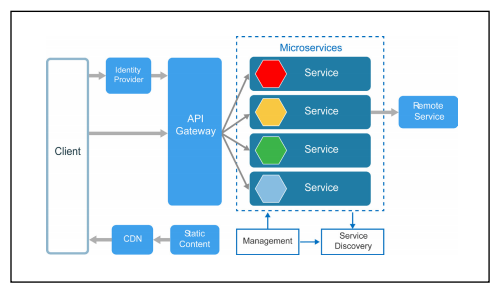
Image Credit: Internet
Microservices Architecture – Explained
With microservices, modules or functionalities within an application can be independently produced, deployed and operated. Microservices architectures offers businesses an unique ability to build and operate only those functionalities which are required. Microservices architecture focuses on creating software as single-function components (microservices) with well-defined interfaces and operations that communicate via APIs.
As the microservices are independently deployable and scalable, each service exists within a firm boundary, even allowing for different services to be written in different programming languages and can also be managed by different teams.
The most important parameter to decide what and how many Microservices are needed is to identify business needs that need to be met. A functionality can be loosely defined as a purpose of the particular element – for example user getting authenticated through an username / password combination is a a functionality and authentication is the business feature. What counts is how various business features (functionalities) are categorized as business capabilities and then split, where required, as fully independent, fine-grained, and self-contained microservices. Hence, the Microservices architecture has certain distinctive features making it more desirable for some business cases than others.
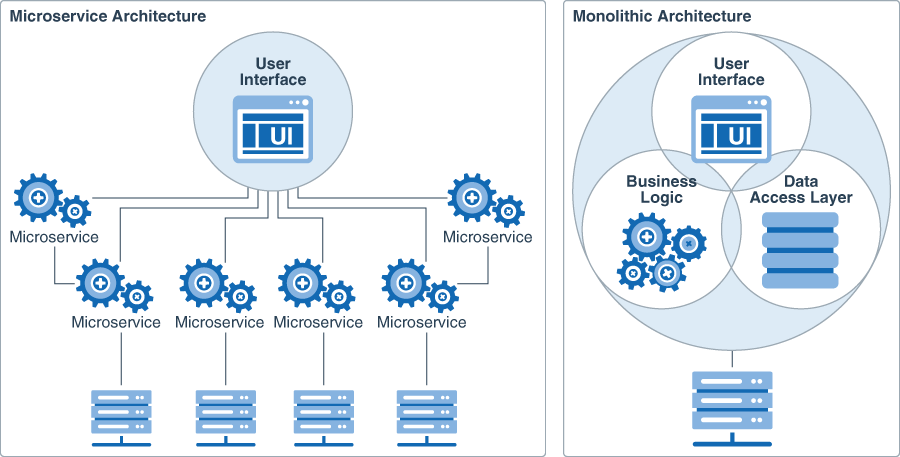
Image Credit: Oracle
Benefits and Advantages of Microservices Architecture
The main concept behind microservices architecture is that most types of applications and business units structured around their IT portfolio become easier to build and maintain when they are broken down into smaller, composable pieces which work together. To put it differently, each module or component is developed and operated separately, and the application is then simply the sum of all its constituent components. In microservice architecture, each service runs a distinct and independent process and usually manages its own database. This provides development teams with a more decentralized approach to building software while also allowing each service to be deployed, rebuilt, redeployed and managed independently.
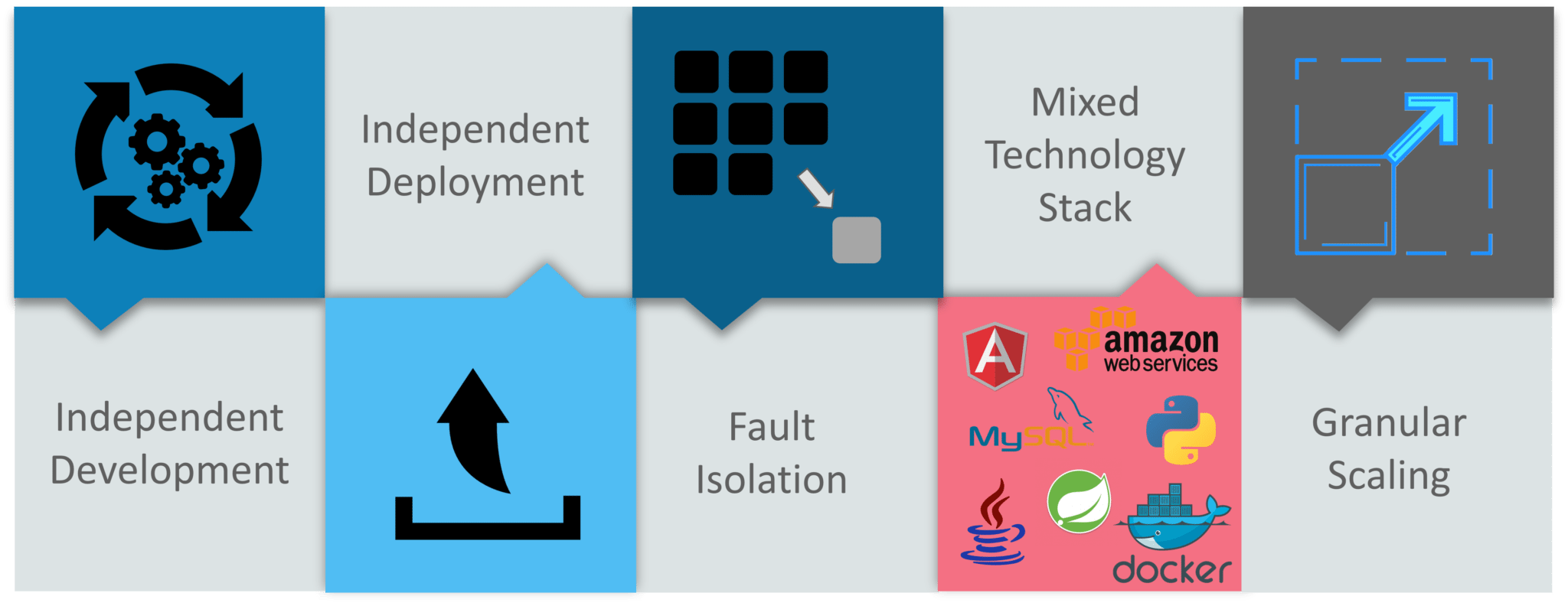
Image: Advantages of microservices architecture
1. Enabling Agile Development
- Microservices architecture involves organizing services around business features. Each service is self-contained and generally implements a single business capability. Hence, value delivered to business is immediate rather than waiting for big bang value delivery as in case of monolithic applications.
- Applications / software built on microservices model are broken down in to smaller, outcome driven components or services. Each of these components or services can be produced, deployed and redeployed independently throughout the lifecycle.
- Developers and tech teams get the freedom to work on individual components or services and features delivering short increments of business value.
- Testing cycles are quick and short; and complex, endless regression tests are eliminated as there are limited components to be tested. Defect fixing is vastly improved as well.
- Customer feedback cycle is greatly helped as smaller microservices are easier to focus on and relevant feedback can be provided without confusing between complex features in case of monolithic applications.
2. Optimization / Flexibility
- In the microservices architecture, each service is a separate codebase, generally managed by a small development team.
- Services are responsible for persisting their own data or external state. This differs from the monolithic application model, where a separate data layer handles data persistence.
- There are components or microservices which are better written in one language. Microservices architecture enables developers to write code for different services in different languages.
3. Operations / Fault tolerance
- Microservices architecture leads to greater fault tolerance within an application or software. Since the application is a suite of multiple small microservices, it leads to better fault isolation as when one microservice fails, the others will largely continue to work.
- Downtime is severely reduced as individual components are easier and quicker to fix, while the fixes themselves can be deployed quickly rather than bringing down whole application and repeating endless regression tests to ensure that fix implemented doesn’t break any other component in case of monolithic applications
4. CI / CD
- By default, microservices architecture enables easy integration through quick deployments, many times using open-source continuous integration tools such as Jenkins, etc.
- Services are deployed independently. A dev team can update an existing service without rebuilding and redeploying the entire application.
- The microservice architecture enables continuous delivery. Microservices architecture works very well with containers, such as Docker.
5. Security
- Microservices vastly simplifies security monitoring because various parts of an application or software are isolated, hence can be easily observed and managed.
- Security threats once identified can be quickly isolated and thus prevented from spreading to other parts of the application or software.
- Components or services can be spread across multiple data centers and / or environments and run on different systems to reduce risk and downtime while providing enhanced disaster recovery planning.
6. Scalability / Reusability
- Smaller pieces of functionality are better re-used; integration with third party services is quicker and less complex.
- Microservices architecture gels very well with cloud infrastructure, thereby becoming highly scalable
7. Ease of operation
- Components thus built are easy to understand since they each represent a small piece of functionality, and are easy to modify for developers, thus helping create resilience within the structure.
- A new team member can become productive quickly by understanding and working on individual models instead of wasting time understanding the complete application and various interfaces.

Image Credit: Internet
Microservices Architecture – early adapters
As in case of any new technical offering, there are organizations which were quick to adapt to microservices, just as there are organizations who held out. Organizations like Netflix, eBay, Amazon, the UK Government Digital Service, Twitter, PayPal, The Guardian, and many other large-scale websites and applications have all gradually evolved from monolithic to microservices architecture.
In case of retail giant Walmart, IT department of Walmart Canada was plagued with problems arising out of working with an architecture for the internet of 2005, primarily designed around desktops, laptops and monoliths of a classic monolithic application. The problem was the IT infrastructure worked fine for 90% of the time and seemed to miserably fail during remaining 10% of times. The impact of this 10% failure rate was spectacular – at peak times, like during holiday season, major holidays and other events, the website couldn’t handle 6 million pageviews per minute and made any kind of positive customer experience impossible to achieve. Business impact – poor customer experience, lost revenue / sales to the tune of millions of dollars, losing market share, etc. Walmart Canada wanted to prepare for the world by 2020, with 4 billion people connected and 25+ million apps available. With this intent, Walmart changed its platform to microservices architecture. The impact of this change was immediate and as clear as day. Conversions were up by 20% literally overnight, mobile orders went up by 98% instantly, no downtime on major events like Black Friday or Boxing Day, operational savings were significant since they moved off expensive hardware onto commodity hardware and saved 40% of the computing power and experienced 20-50% cost savings overall.
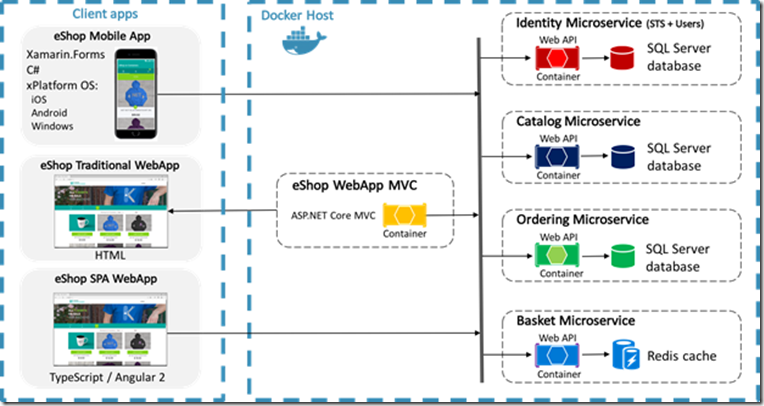
Image: an example of Microsoft Azure
Image Credit: Microsoft blog
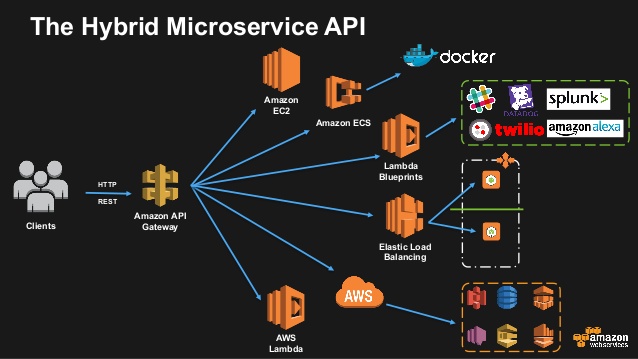
Image: an example of microservices architecture on AWS
Image Credit: Amazon AWS Blog
In 2000, Amazon faced a similar challenge with its primary business, the retail business website Amazon.com being managed as a single monolithic application. The complex scale and size of the application meant that Amazon had to maintain teams of engineers just to support very mundane tasks of pushing new fixes and releases through its production environment. The process of adding a new feature, or changing an existing one, or a simple bugfix was extremely complex and inefficient. Each change needed to be coordinated across a wide spectrum of stakeholders and technical teams to ensure the new changes do not break anything in the existing code. If the development team wanted to roll out a feature, the schedule needed to be coordinated very closely with other stakeholders.
Amazon soon chose to implement a services oriented architecture and proceeded to break down their one, central, hierarchical product development team into small, “two-pizza teams.” They wanted teams so small that they could feed them with just two pizzas. These smaller teams were given clear mandate and operating boundaries and were put in charge of one or few microservices so they were defining their own feature roadmap, designing their features, implementing their features, then testing, deploying and operating them. The results were simply too good. Amazon dramatically improved its front-end development lifecycle, with the product teams enabled to quickly make decisions and crank out new features for their microservices. Now the company makes 50 million deployments a year, thanks to the microservice architecture and their continuous delivery processes.
Breaking your applications into microservices isn’t always easy or enough — once done, someone has to manage, orchestrate them and deal with the new stack. The biggest mistake organizations make when moving to microservices architecture model is underestimating how it’s going to change the way they to think about applications and especially the way they think about teams developing those applications. Here are few points to be careful of while deciding path to microservices adaption.
- Implementing Microservices without making changes to the development culture
- Implementing Microservices without the prerequisites
- Moving too fast and moving too much
- Unrealistic expectations from microservices architecture, something on the lines of magic pills!
- Selecting wrong applications to promote to microservices model
Microservices Architecture – Final word
The philosophy of the microservices architecture is: “Do one thing and do it well.” Services might run within the same process, but they should be independently deployable and easy to replace. They can be implemented using different programming languages, databases, and software environment. The services are small and fine-grained to perform a single function. They embrace automation of testing and deployment, continuous delivery software development process, failure and faults, similar to anti-fragile systems. Each service is elastic, resilient, composable, minimal, and complete.
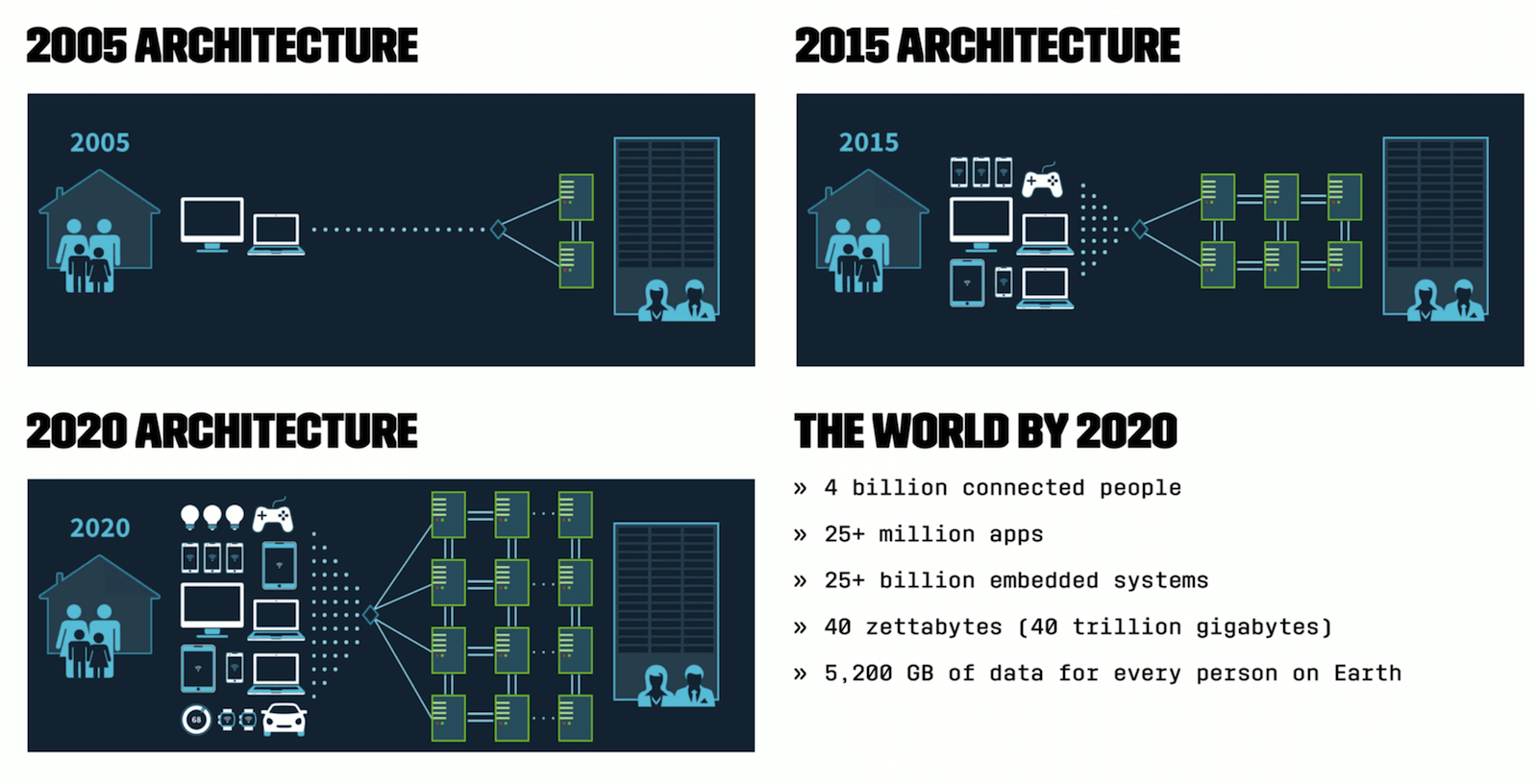
Image Credit: RisingStack
]]>AI Bias: inherent flaw or mere side effect!
Originally Published April 18, 2018
Introduction
Artificial Intelligence is broadly referred to as any source, channel, device or usage application whereby tasks normally attributed to human intelligence, such as reasoning, interpretation of facts, storage and deduction of information from such facts and ultimately, decision making is reproduced outside human body and human networks.
According to a Forbes article, as technology, and, importantly, our understanding of how our minds work, has progressed, our concept of what constitutes AI has changed. Rather than increasingly complex calculations, work in the field of AI has concentrated on mimicking human decision making processes and carrying out tasks in ever more human ways.
Artificial Intelligence uses are influencing people’s lives in more ways than can be counted. Autopilots in aviation is possibly one of the earliest uses of AI. Most airline captains trust auto pilot for 95% of time during an actual typical flight. AI is behind the personal virtual assistants in the iPhones, Google Home, and Amazon Echo. AI is used to recommend shopping products and brands based on past choices and history of website viewing. AI is being used to develop driver-less cars to make commuting faster and safer. It is used to recommend shows or films according to viewer’s tastes, preferences and past choices on Netflix or what songs one may like to listen to on Spotify. AI is used to how products are marketed and customized according to target audience’s tastes and preferences while steering conversations uses have with their favorite retailers, and will be used to transform retail industry around the world.
In recent interviews, Uber’s Head of Machine Learning Danny Lange confirmed Uber’s use of machine learning for its popular features like ETAs for rides, estimated meal delivery times on UberEATS, computing optimal pickup locations, as well as for fraud detection. The pioneering research behind these features is what sets Uber different from its competitors, its executives feel. And while users ultimately get to decide that, there is no doubt that AI powered applications are not just part of the ecosystem, rather form an ecosystem of their own, which is continually expanding equally in its size and impact.
Image Credit: Psychology roots
What is Artificial Intelligence?
Artificial intelligence then in other words is simply the reproduction of human intelligence and capabilities outside the human body. The work that can be done by machines or mechanical applications or software programs carrying out very basic rudimentary and rule based decision making can be termed as Artificial Intelligence. We regularly interface with such systems on a daily basis – airline ticketing and check in systems; chat bots and intelligent IVRs replacing customer service agents; human profiling software and applications flagging any abnormal profile or profile that fits one or more among the list of many criterion for detailed human checks; banking sector applications where any abnormal transaction falling outside a pattern is flagged for manual checks are a few among immeasurable applications of Artificial intelligence. Basically, any task done by humans which involved repetitive application of mind and knowledge, can be handled to automated processes or devices. This is also known as applied AI.
As humans grow and learn newer things, apply their knowledge and continue to learn thereby expanding both the repository of knowledge and their understanding of such repository, i.e. the breadth and width of subject matter, a credible and reliable Artificial Intelligence system must have the ability to learn continually based on the amount of information available to it at any given time. As early as 1959, thinkers laid down this expectation – that its simple to teach computers how to learn, rather than teaching them everything they need to know.
As internet became common during 1990s and 2000s, the emergence of huge troves of data, and availability of such data for analysis in order to learn human needs, even before humans themselves could understand those needs, has become the new future of Information Technology. Technology is no more just to aid humans, but has the potential today to govern every aspect of human lives. And this is a trend which is only growing and becoming more pervading than ever before. The data collected today is not just about humans, but its also about the machines which collect data about humans themselves. Data from a source is not just about that source alone, but contains many different layers of abstraction providing many useful insights not just in to the primary purpose of study but in to related fields as well.
However there is another aspect of Artificial Intelligence – generalized AI. This aspect caters to much deeper, and perhaps is the truest representation of artificial intelligence. Generalized AI is what was responsible for field of study like Machine Learning and Neural Networks, both of which are central to the idea of Artificial Intelligence. The generalized AI is powered by new concepts like deep learning. The invention of deep learning, a technique which uses special computer programs called neural networks to churn through large volumes of data and is trained to identify and remember patterns in that data set, means that technology which gives a good impression of being intelligent is spreading rapidly.
Machine learning is a sub-field or an application of AI. This involves feeding tons of data gradually – whether it’s in the form of text, images or voice – and adding a classifier to this data. An example would be showing the computer an image of a woman working in an office and then labelling this as woman office worker. Over time and with addition of multiple parameters for each data set and complicated algorithms, the system will learn to make predictions based on the data it is reading. These predictions follow certain rule sets, specified and hard coded in to the machine on the basis of which decisions are made, while simultaneously also becoming inputs in to accuracy analysis to improve decision making for future data sets.
The neural networks are the newest and possibly the most exciting layer within Artificial Intelligence that is powering a new breed of research and machine learning. This new breed of deep machine learning is inspired by the natural evolution of human brain and its connected neurons. The neuron networks use a series of interconnected units or processors and are adaptive systems that can adjust their outputs based on doing, essentially ‘learning’ by example and past data sets as they go, adapting their behavior based on results. This mimics evolution in the natural world, but at a much faster pace, with the algorithms quickly adapting to the patterns and results discovered to become increasingly accurate and valid.
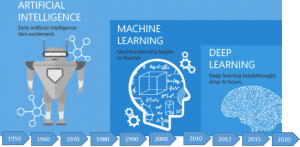
Image Credit : Internet
Neural networks can identify patterns and trends among data that would be too difficult or time-consuming to deduce through human research (picture going through millions of data sets and sub-sets), consequently creating outputs that would otherwise be too complex to manually code using traditional programming techniques.
And as the technology progresses and becomes ever-more complex and autonomous, it also becomes harder to understand, not just for the end users, but even for the people who built the platforms in the first place. This has raised concerns about a lack of accountability, hidden biases, and the ability to have clear visibility of what is driving life-changing decisions and courses of action. This is commonly referred to as Black Box in Artificial Intelligence, where what goes in (inputs) and what comes out (output) is visible and transparent, yet the process followed by the machine or what goes on inside the machine (the brain) is not visible. Scientists and data researchers are not able to pinpoint what learning are being adapted by the machine, though the outputs being produced are desirable.
Bias in Artificial Intelligence
AI Applications range from intelligent IVRs, data analytics, speech-to-text transcription to healthcare where it is being used in myriad of ways including detecting early signs of blindness. AI now runs quality control in factories and cooling systems in data centers. States hope to employ AI to recognize threat from terrorist propaganda sites and remove them from the web. AI is central to attempts to develop self-driving vehicles. Among the ten most valuable quoted companies in the world, seven say they have plans to put deep-learning-based AI at the heart of their operations in future or are already doing so.
Machine Learning and neuron networks are interchangeably used within Artificial Intelligence ecosystems as these represent the way AI is progressing to meet the demands from technology savvy businesses and individuals. Often, these networks create what are known as black boxes, referring to closely guarded virtual boundaries where the internal branching, logic application and evolution of the application itself is obfuscated from public view. And as is often seen, many of the AI algorithms involve use of facial recognition technology, which is deeply flawed in itself. Facial recognition technology (FRT) which aims to analyze video, photos, thermal captures, or other imaging inputs to identify or verify a unique individual is increasingly infiltrating our lives. Facial recognition systems are being provided to airports, schools, hospitals, stadiums, shops, and can readily be applied to existing cameras systems installed in public and private spaces.
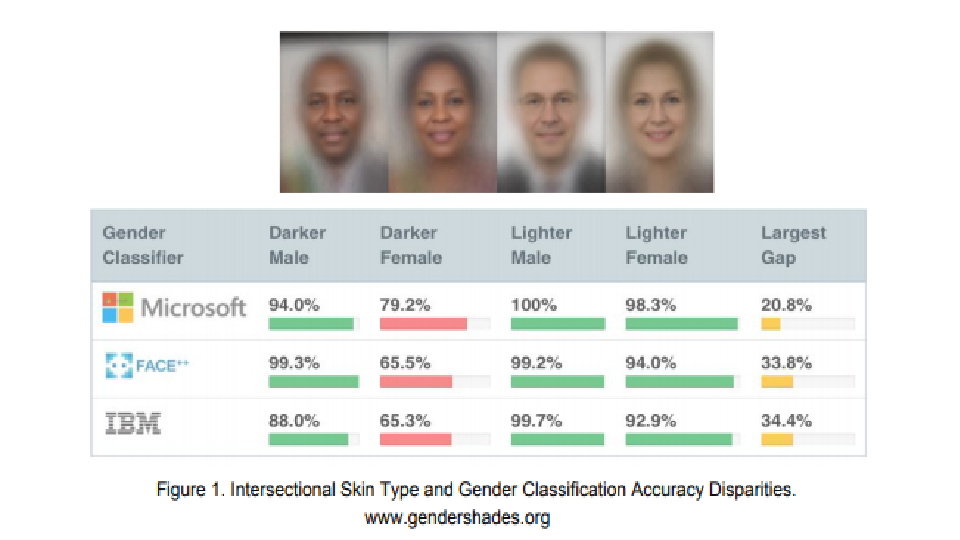
Additionally, there are already documented cases of the use of FRT by government entities that breach the civil liberties of civilians through invasive surveillance and targeting. Facial recognition systems can power mass face surveillance for the government – and already there are documented excesses, such as explicit minority profiling in China and undue police harassment in the UK. Source: Facial Recognition Technology (Part 1):
Its Impact on our Civil Rights and Liberties, report issued by United States House Committee on Oversight and Government Reform dated May 22, 2019

Reuters reported a case where a New Zealand man of Asian descent had his photo rejected by an online passport photo checker run by New Zealand’s department of internal affairs. The facial recognition systems registered his eyes as being closed by mistake. When government agencies attempt to integrate facial recognition into verification processes phenotypic and demographic bias can lead to a denial of services that the government has an obligation to make accessible to all constituents. Source: Facial Recognition Technology (Part 1):
Its Impact on our Civil Rights and Liberties, report issued by United States House Committee on Oversight and Government Reform dated May 22, 2019.
People are often too willing to trust in Artificial Intelligence applications, or machine learning mathematical models because they believe that these systems will remove human bias. However, as the machine algorithms and systems replace human processes, these machines are not generally held to similar standards. A big part of the problem is that individuals and companies that develop and apply machine learning systems, and Government regulators who have the mandate to govern the usage, show little interest in monitoring and limiting algorithmic bias. Financial and technology companies use all sorts of mathematical models and aren’t transparent about how they operate.
As with most new technologies, the research wings of the Armed Forces made initial forays in to teaching machines how to do human jobs that involved at the very least a complex application of information abstraction – or as we know it today, Artificial Intelligence and Machine Learning. From the early days of attempted use of AI and Machine Learning applications, a widely circulated though highly improbable or at the very least exaggerated, parable has been told and retold multiple times in forums as wide as coffee table discussions to online articles and research papers. While the story itself may be apocryphal, an almost impossible number of sources citing the story has given it a legendary description. Some researchers attribute this story to a paper published in 1964, almost 5 decades before concept of Artificial intelligence, machine learning etc became common.

Image Credit: Dilbert
For an amusing and dramatic case of creative but unintelligent generalization, consider the legend of one of connectionism’s first applications. In the early days of the ‘perceptron’ the army decided to train an artificial neural network to recognize tanks partly hidden behind trees in the woods. They took a number of pictures of a woods without tanks, and then pictures of the same woods with tanks clearly sticking out from behind trees. They then trained a net to discriminate the two classes of pictures. The results were impressive, and the army was even more impressed when it turned out that the net could generalize its knowledge to pictures from each set that had not been used in training the net. Just to make sure that the net had indeed learned to recognize partially hidden tanks, however, the researchers took some more pictures in the same woods and showed them to the trained net. They were shocked and depressed to find that with the new pictures the net totally failed to discriminate between pictures of trees with partially concealed tanks behind them and just plain trees. The mystery was finally solved when someone noticed that the training pictures of the woods without tanks were taken on a cloudy day, whereas those with tanks were taken on a sunny day. The net had learned to recognize and generalize the difference between a woods with and without shadows!
This bias is not limited to just one study or research project, nor is it an isolated phenomena. Whenever there is a dataset of human decisions, it naturally includes bias. This bias can manifest in many ways and could include hiring decisions, grading student exams, medical diagnosis, loan approvals, etc. In fact anything described in text, in image or in voice requires information processing – and this will be influenced by cultural, gender or race biases.

Image Credit: upliftconnect
One example of AI systems is in financial industry, where complicated algorithms assess credit worthiness and credit risk before issuing credit cards or approving small loans. The task is to filter clients in order to avoid processing any that are likely to fail to make payments. Using data of declined clients, history of bad debts, or delinquencies and associating them with a set of rules could easily provide basis of decisions that machine could produce without human intervention. However, this could also lead to biases getting built in to the system, for example, applications from certain section of people are seen to have higher rejection rates based either on their employment type or simply, gender.
The financial industry is not alone in observing these biases creeping in. LinkedIn, the popular professional and career website, for instance, had an issue where highly-paid jobs were not displayed as frequently for searches by women as they were for men because of the way its algorithms were written. This gender based discrimination came about as the initial users of the site’s job search function were predominantly male for these high-paying jobs so the machine learning aspect just ended up proposing these jobs to men – thereby simply reinforcing the bias against women
The concerns of biases creeping in are not only limited to lower level, data centric and rule based tasks in applications. These concerns are equally, and perhaps more dangerously manifested within the uses of deep machine learning that requires minimal guidance, but ‘learns’ as it goes through identifying patterns from the data and information it can access. Its use of neural networks and evolutionary algorithms resembles a tangled mess of connections that are nearly impossible for analysts to disassemble and fully understand.
As explained earlier, this lack of understanding leads to pervasive fears of something unknown lurking just beneath the surface. The nearly non-transparent ways in which the deep learning machines itself ‘learn’ to navigate our worlds, at the very least, demand closer inspection in order to be fully understood, if not fully trusted.

Image Credit: Internet
Another relevant real world example here is of how Google ranks search results. This is a notoriously secret formula, and has been the subject of countless allegations of anti-trust movements, conjectures of how the system manipulates search results and other far more wild theories. Digital agencies and professionals have made and continue to make careers out of their own interpretation of the rules of the game, trying to deliver what they think Google wants to be able to boost their rankings. Many functions are powered by complex algorithms, code, programming or servers, and yet are still deemed trustworthy enough for investing large chunks of the marketing budget.
A system called COMPAS, made by a company called Northpointe, offers to predict defendants’ likelihood of reoffending, and is used by some judges to determine whether an inmate is granted parole. The working details of this program are guarded under heavy veils of secrecy, but an investigation by ProPublica found evidence that the model may be biased against minorities.
The much touted facial recognition algorithm used by various products and applications worked for perfectly for lighter-skinned subjects, however it couldn’t recognize many pictures of people with darker complexion. It’s not a unique problem; in 2015, a Google algorithm classified faces of black people as gorillas.
There have been calls to end the use of ‘black box’ algorithms in government because, without true clarity on how they work, there can be no accountability for decisions that affect the public. Fears have also been raised over the use of bias within decision-making algorithms, but with a perceived lack of a due process in place to prevent or protect against this.

Image Credit: Internet
Bias Elimination: Is it possible?
As deep learning systems, neural networks and machines become capable of performing profound and abstract functions, the fear from AI going rampant becomes more real. The real fear stems not so much from the machines suddenly stop obeying humans or start behaving of their own volition, or at least attempt to do so, rather the real fear arises from the fact that machines do exactly what they are told to do but do so in an incomprehensible manner where creators and users of the technology do not have any visibility and hence lack control. The reason behind this fear is simple – the deep learning networks are taught (LEARN) to rearrange their digital processes in response to the data ingested. The bits of computer code within the neuron networks is designed to copy the way human brains work, by drawing connections between events and information. This implies that once the network is designed and trained, even the creators of the network have little control or even visibility in to what it is doing. Of course, permitting such machines and systems to make critical decisions, be it in financial or healthcare industries or anywhere else, amounts to putting human lives in to the hands of machines, the working and operations of which are still not fully understood. It is akin to a beta program being allowed to fly jet full of passengers and cargo over densely populated areas, and though there are pilots present in the cockpit, their role is reduced to observers’ role.
In a MIT Technology review article from October 2017 titled Forget Killer Robots—Bias Is the Real AI Danger, the problem of bias in machine learning is likely to become more significant as the technology spreads to critical areas like medicine and law, and as more people without a deep technical understanding are tasked with deploying it. Some experts warn that algorithmic bias is already pervasive in many industries, and that almost no one is making an effort to identify or correct it
To rid the AI and deep machine learning from these biases is a complex proposition. As previously discussed, these biases exist due to multiple factors, from type of use of application, to data based biases, to people based reasons, and finally due to a regulatory apathy.
Data based biases general refer to biases included in AI applications and machine learning due to un-clean, poor quality data with biased results already included being uploaded in to a system. This is no brain-teaser, as ‘Garbage in-Garbage out’ is a pretty well-known pitfall.
People based biases generally refer to biases arising out of how interpretation of business rules and data parameters is decided, as well as disinterested stakeholders who are interested in the bottom line and not ridding the AI applications and machine learning systems of long term health and transparency.
Biases due to type of application refer generally to usage based biases and lack of transparency depending largely on the industry type. For example, security, finance and healthcare generally tend to operate with largely secretive processes and restrict access to their processes and systems to any outsiders making it difficult to detect such biases.
Finally, lack of any regulatory oversight, is seen as the final nail in the coffin. The overall perception is that biased algorithms and systems are everywhere, yet no one seems to care. In-house regulators are generally under significant pressure to minimize any application downtime or to suggest expensive fixes. External watchdogs generally lack teeth, while those external regulators who wield some kind of power primarily through policy formulation, typically government agencies, are seldom interested in regulating the uses of AI and machine learning. And while the Congress may be rightly worried about the threats of this unknown equation, the progress seems to be slower and farther than what is needed.
Artificial Intelligence applications suffer from a natural, lack of diversity which in many cases is indicative of deep-rooted cultural norms. AI assistants like Apple’s Siri or Amazon’s Alexa have default female names, voices, and personas, are largely seen as helpful or passive supporters of a user’s lifestyle due in part to their personal messaging and in part to their shopping list task orientation. Meanwhile, their counterparts like IBM’s Watson or Salesforce’s Einstein are perceived as complex problem-solvers tackling global issues, perhaps in part at least due to their male-branded disposition and in part due to their outward problem solving approach. The quickest way to flip this public perception on its head is to render AI genderless. The more long-term approach requires expanding the talent pool of people working on the next generation of AI applications and machine learning technologies to include multiple viewpoints and dispositions in producing a homogenous product, which is culturally neutral yet sensitive to audiences’ diverse requirements.
Another approach is to introduce adequate ‘Bias’ testing before releasing any new version of an existing AI application. Software and application testing is already pretty standardized functions within software development processes, however bias testing is something which is still unknown even among the technology giants. Bias testing must become de-facto for AI applications, while for continually learning machine learning or deep learning applications, the machine or the system must be made complaint to run ‘Bias’ testing standards before fresh automated deployments, or in other cases at regular, frequent intervals, for example, once every 15 days or 30 days depending on the feasibility.
Image Credit: TNW
Conclusion
Facebook’s news feed algorithm can certainly shape the public perception of events, social interactions and even major news events. Other algorithms may already be subtly distorting the kinds of medical care a person receives, or how they get treated in the criminal justice system. Most of the times the biases in AI are not well-known, these may be subtle, hard to notice under the surface ripples which even when noticed are generally dismissed as non-events. On other occasions the biases may not be even shared publically, partly due to non-discovery and partly due to illicit attempts at fix-the-problem before-it-gets-out-of-hand approach.
In real terms, the threat from AI is perhaps not as serious as its usually portrayed in books or movies. However it doesn’t take much for the threat to be manifested in the present day, rather than at some indeterminable date in future. That is the biggest threat of AI where many believe that the AI applications and systems today have the potential to spin uncontrollably out of hands of their creators and users.
As AI is used to produce more meaningful results and power more and more high profile and public facing services, such as self-driving cars, medical treatment suggestions, early warning systems in fields such as oil exploration, or automated defense systems, concerns have understandably been raised about what is going on behind the scenes. If people are willing to put their lives in the hands of AI-powered and machine learning applications, then they would want to be sure that someone understands how the technology works, how in-built biases take effect and how it powers decisions, and more importantly, that someone has the power and means to remove these biases or at least restrict the applications if the biases get out of hand, or if the need arises in any other manner.
]]>