
All companies, from one-person proprietorship to those employing hundreds of thousands of people, established firms or start-ups, are equally struggling in these trying times. One can surely, and perhaps effectively argue about the impact which may vary on a case to case basis, however generally speaking, the newer a company, the bigger the battle in front of it.
Startups are going through a tough time during this pandemic situation. India has the third highest number of startups next to U.S. and China. Quite obviously, the country is highly affected by the downturn of startups. Especially, during a time when the government has placed more emphasis in the development of startups for economic growth. But the Covid pandemic seem to thwart the plans of Government to nurture more startups for their economic growth. During this pandemic crisis, it is reported that most startups have failed, and only a few seem to be in the curve of progression.
Covid hampers Startups
Covid has had a devastating impact on almost every business in the world. The most affected industries include travel, hospitality and education among others. The social distancing behavior has restricted people from attending offices. These issues have caused the businesses to struggle in running their day to day operations. In many cases it is reported that the work productivity has been highly hit during the pandemic.
Although, many firms are managing through remote work, the effectiveness in terms of productivity, communication and collaborative work is a big question. Apart from it, many businesses are disrupted and new opportunities seem to arise. Experts estimate that the impact of Covid is believed to last for many months, and we can expect a recession hit economy for the next several years.
As per a nationwide survey on the ‘Impact of COVID-19 on Indian Start-ups’ conducted by Federation of Indian Chambers of Commerce and Industry (FICCI), jointly with the Indian Angel Network (IAN) with 250 start-ups, 70% of start-ups stated that their businesses have impacted by Covid-19. About 12% of the start-ups have shut operations and 60% are operating with disruptions.
The survey depicts that only 22% of the start-ups have cash reserves to meet the fixed cost expenses of their companies over the next 3-6 months.
The findings show that 68% of the start-ups are majorly cutting down their operational and administrative expenses.
Close to 30% of the companies stated that they will lay off employees if the lockdown was extended too long.
About 43% of the start-ups have already started salary cuts in the range of 20-40% over the period of April-June 2020.
On the investment front, 33% start-ups said that the investors have put the investment decision on hold and 10% stated that the deals have been called off.
Fragile nature of startups makes things worse
Startups in general are very fragile considering the constraints they operate in. Many startups may have very little funding to bootstrap their process. We understand how hard it takes for a startup to be successful under normal circumstances. Finding the right product fit for the market and acquiring customers are among the factors that determine the success and growth of a startup. The Corona pandemic makes it difficult for startups, since the world undergoes unpredictable changes and business is hard to get. The startups need more incubation and support during their initial years to be more productive in the future. These factors that make startups more fragile in nature make them vulnerable and difficult to survive.
In this Corona pandemic situation, the startup firms are affected badly. It is believed that about 90% of the startups have failed in India. There is another report that the startups have cash reserves to last only for the next 3 months. These are bad news for the startups in our economy. The fragile nature of startups and the inexperience of entrepreneurs can very well be the cause for such failures.
A quarter of India’s startups would be in serious trouble if adverse consequences of the COVID-19 pandemic persist for long, according to information technology industry veteran Senapathy (Kris) Gopalakrishnan. “There will be more failures, unless they get additional funding from existing investors or support from banks on working capital or support from government for some form of debt or grants. We will see more companies get hurt as this prolongs,” said the Chairman of early stage startup accelerator and venture fund, Axilor Ventures.
A comparison of priority investment sectors pre and during COVID-19 shows that 35% of the investors are now looking at investments in healthcare start-ups, followed by EdTech, AI/Deep Tech, FinTech and Agri. Meanwhile, 44% of the incubators surveyed highlighted that their day-to-day operations have been considerably impacted by the COVID-19.

How should startups respond to the Corona crisis
However, there is a silver-lining amidst all the gloom of Corona pandemic. We will take a look at some of the brave startups who have looked up-to new opportunities for growth. Indian startups have ground-breaking ideas and are hard-working people, and success is just around the corner. A few startups are adapting to the present situation and meeting the needs of current market conditions. These are certain aspects that can help startups to survive during the pandemic.
New Opportunities Arise amidst Corona
It is time for startups to look beyond the ordinary to be successful. Relying on traditional mode of business may not yield good results. That may be the reason for failure of many startups. Successful startups have capitalized on the new opportunities that are presenting itself in the society. To make this understand better, people are looking for safety during this time, and providing ways for safe products and services can help startups to stay afloat. Startups should keep looking for those new opportunities that are opening up, and make plans to meet those opportunities. After all this is not the end of the world and keeping your company alive for the next several months can be crucial for their success in the long run.

Rapid Innovation
Rapid innovation is another startup thing that’s caught the eye of business community. Think of startups like Uber, Airbnb and many others, they all brought an innovative idea to the table. The world is a different place because of these firms. These rapid innovative ideas are the prime reason for the success of these next generation technology firms. They saw a unique need in the society and countered it with smart tech solutions that solved people’s problems. Uber has solved the cab problem in providing a hassle-free cab riding experience in the city. Take Aribnb, they provide an innovative concept in accommodating people in shared spaces, which is a big hit and has grown to become a multi-million dollar company. Likewise, many startups today are coming with rapid innovation ideas to fight the Corona pandemic. It is a noble effort by the startups to endeavor in such activities through their ideas and technology. I personally know of an Artificial Intelligence startup that lends its AI search technology for free to the medical community to find vaccine for Corona. The AI start up firm found their technology suitable for medical research community and tailor made their AI product to be useful for medical research purpose.
Government initiative to sustain Startups
The Government has a huge role to play to support startup firms in this pandemic. The Indian government has come up with many initiatives to support startups in the country. The business community can take advantage of these government initiatives and make the best out of it. The government has announced new plans to mentor startups, regulatory reforms in favor of startups, funding sources and investor engagement facility to name a few. It is indeed difficult for startups to survive without favorable government initiatives. It is imperative that Government looks keenly into the affairs of startup development and does the needful. These initiatives can meet the financial deficit of startups. The mentorship programs provided by the Government can be handy to get business insights for experienced campaigners. They can provide valuable advice to steer the startups in the right direction nullifying the Covid impact.
Stakeholder support is essential for Startup growth
The support of stakeholder can go a long way in sustaining the Startups. During these tough times, sometimes startups may need additional funding or much needed morale boost from the stakeholders. It is vital for Stakeholder to have confidence on the ambitions of startups. These are little things that can fetch a long distance. Encourage and support from the stakeholder can keep the morale of the team to achieve their goals.
Success stories of Startups and coping mechanism
Some startups are doing a great job in adapting to the present circumstance. For instance, Zomato has been hit badly as customers have grown skeptical about buying food online. The firm went ahead to establish measures to comfort its clients about the safety of their food, and found a vast opportunity. Zomato has made good business strategic moves in finding big opportunities opposed to smaller ones to be able to survive. They have founded a new segment called Zomato Market where groceries are delivered to home residents, which adds great value to customers during this pandemic. The success of the Zomato Market has led them to launch their extended service in countries like UAE and Lebanon. In an interesting equation, Zomato is ready to deliver alcohol to home residents.
While the travel industry has taken a heavy beating, firms like MakeMyTrip have to be on the edge to add tremendous value to the present scenario to stay afloat. In a strategic move, MakeMyTrip realized the present travel equation and is offering a platform for short stays for their customers. They have piloted a short stay program for travelers wanting to visit Tirupathi in collaboration with Goibibo and Redbus. MakeMyTrip is keen to provide a great experience for its customers even during this pandemic situation, and their co-branded cards with leading banks like ICICI provide a rewarding travel experience.
A popular gym and fitness joint called Curefit in the country has succumbed to the pressures of Covid. The firm has taken to online classes to keep their gym facility running. They have created a subscription model, so the fitness enthusiasts can still keep the ball rolling and maintain their perfect physique. The virtual classes will help them to stay connected with their instructors, and continue their exercise routine.
What we can perceive from these interesting stories is there are ways to keep a business going. Zomato, Makemytrip and Curefit are good examples on how startups are coping during this pandemic. The entrepreneurs who have put their thinking cap on to assess the situation and do the right thing have found the big advantage.
It is tough, but not impossible
Startups can leverage the government support, policies, stakeholder support, rapid innovation to come successfully out of this Covid crisis. It can be tough, but it is not impossible. We should appreciate the noble efforts of some startups who have geared up in fighting the Corona spread. Seeing the new opportunities and adapting to the disruptive world is key to surviving in this pandemic. Taking the right initiatives at the right time and having the belief to succeed will help startups to see through this massive storm.
“Startups must use their strengths in innovation to re-strategize and re-think their business,” said Ganesh Raju, Co-Chair, FICCI Start-up Committee and Founder, TurboStart.
]]>
A look at how Regulators, Companies and Individuals are shaping the Broadband map across America

Technology and the needs of businesses and consumers continue to evolve. Over the last 2 decades of mass internet penetration, availability and affordability have become the two key cornerstones of any efforts to shape internet policy, whether its at a regulatory level, like FCC or representatives of state broadband programs or at an internet service provider company level, like AT&T, Verizon.
Broadly speaking, according to FCC definition, Broadband is defined as reliable high-speed internet, having download speeds of at least 25 megabits per second (Mbps) and upload speeds of at least 3 Mbps. Broadband internet may be delivered via multiple technologies, including Fiber broadband, fixed wireless, digital subscriber line (DSL), or Cable broadband. Each technology has varying costs of setup and maintenance, with cable being generally regarded as the most cost-effective though technologically limited solution.
Perhaps more so than any other technological innovation in human history, the Internet has changed our daily lives in significant and permanent ways. Among many other things, the transformation has occurred faster than any other adaption of technological changes. Over the space of 2 decades, home broadband adoption has grown from 3% of all American adults age 18 and older to almost 80%. By comparison, it took telephone to nearly 8 decades and electricity more than 30 years to reach the same level of penetration, despite deals .
Broadband is increasingly intertwined with the daily functions of modern life. It is transforming education, social services, healthcare, agriculture, supporting economic development initiatives, and is a critical piece of efforts to improve human life and socio-economic factors of human development.
Broadband has become the quintessential communication essential in the digital age and the era of Internet. Literally and figuratively, everything is available on the internet. And being connected, being connected always, has become an objective, an input and a goal statement in and of itself. Everyone, everywhere, has some purpose which requires them to access internet resources, unless of course, people making the active choice of living off the grid. However, with more than 19 million disconnected households across the country at the most conservative level of estimate, it is impossible to capitalize on broadband’s full economic and social impacts. While a presidential platform can incentive policy reform at the federal level, the road to change is still a long one, slowed by political infighting and congressional discord.
Internet Availability and Affordability for everyone
When people refer to broadband, most are referring to interrelated, sometimes overlapping characteristics of the sector. These two characteristics are like two sides of the same coin, and in every facet are tied to each other. The first is the digital telecommunications backbone or the infrastructure, whether wireless like mobile or wired technologies like Cable, DSL, etc, that enables outreach and availability of high-speed transmission of data. This digital backbone and physical infrastructure is both capital-intensive and technology-intensive, as in the front-end infrastructure, the towers, the wire lines, the cables, the physical buildings and exchanges and offices where the telecommunication equipment is assembled requires significant up-front monetary investment as well as time, whereas set-up of back-end technology and processes to enable the operations, billing and provisioning of broadband services requires years of preparation. The other side of this coin, the federalist and state policy frameworks that govern physical infrastructure and related coverage especially in areas with limited revenue and growth potential, dictate how the implementations are carried out. Though broadband’s antiquated definition tends to focus strictly on the transfer speeds and the network capabilities of the underlying technology, iin reality, broadband infrastructure can only reach its potential if every individual can use the service, and if policy frameworks are in place to support ubiquitous, near barrier-less adoption.
By pricing the broadband service, especially the entry levels prohibitively high so that its out of reach of certain section of the society, or by excluding the geographical areas or communities altogether, or by not investing or reducing the investment in upgrade and maintenance of the lines, it is certainly true that in certain parts of the country the entry barriers to obtain sufficiently fast broadband connection are too high. And lastly, not having adequate competition at a market level not only forces the customers to settle for low standards of service, but stifles innovation and investment, two most critical factors for market growth.
There are three primary areas within the colloquial term broadband availability that must be broken down for an effective analysis. These are availability of service, affordability of services and the presence or lack of competition, as in, the competition exerted by each internet service provider competing for market share. Lets look at these briefly.
- Availability of Service -: this is apparently self-explanatory and generally the first step of internet connectivity. This is plan and simple availability of broadband signal in an area. According to the most recent data available, the Federal Communications Commission (FCC) estimates that 21 million Americans still lack broadband access according to the most recent data available. Many researchers have however cast serious aspersions on the veracity of this data, at times placing the number of people without access to reasonable internet as high as 162 million.
- Availability of speed tiers and plans and Affordability -: FCC voted in January 2020 to approve a $20.4 billion Rural Digital Opportunity Fund that will make grants to broadband providers to build broadband networks where there is currently no or substandard service, however the money will be disbursed without any guarantee that the grant recipients will help to make broadband more affordable for low-income customers. It is strongly believed that to avoid corruption and to prevent this from becoming yet-another-failed scheme, Congress and the FCC should require, as a condition for funding this broadband deployment, true high-speed service at actually affordable prices—for instance, service rated at 50 Mbps for upload and download with unlimited usage for $10 per month to eligible recipients. What is alarming is that home broadband adoption rates aren’t improving. Approximately 73% of U.S adults use broadband service at home, but that figure has remained stable for the past three years. Too many people aren’t subscribing to broadband even when it is available to them. Affordable service is crucial.
- Lack of more than one service provider -: According to a Fortune Article, laws in 19 states restrict local communities from experimenting to increase broadband deployment. These laws should be revisited and repealed. An indubitable truth – when new competition is introduced in broadband markets, the benefits are demonstrable. Look no further than Kansas City, Kan.; Chattanooga, Tenn.; Wilson, N.C.; and Longmont, Colo. for evidence that competition from private or municipal broadband provider results in incumbent providers dropping prices and increasing speeds — benefits which can not be realized with any amount of coaxing or appeals as seen in nearby areas where old standards still persisted in a market without competition. An estimated 35% of people have only 1 choice of broadband provider; another 37% have just two to choose from. Without competition, people—especially those with lower incomes or those who live in rural areas—are threatened with artificially high prices, lower-quality service, and little innovation. A Wall Street Journal report published last year found that low-income areas and high-income areas pay similar median monthly costs (about $66) for stand-alone internet, but poorer areas get 40% slower speeds for the price.
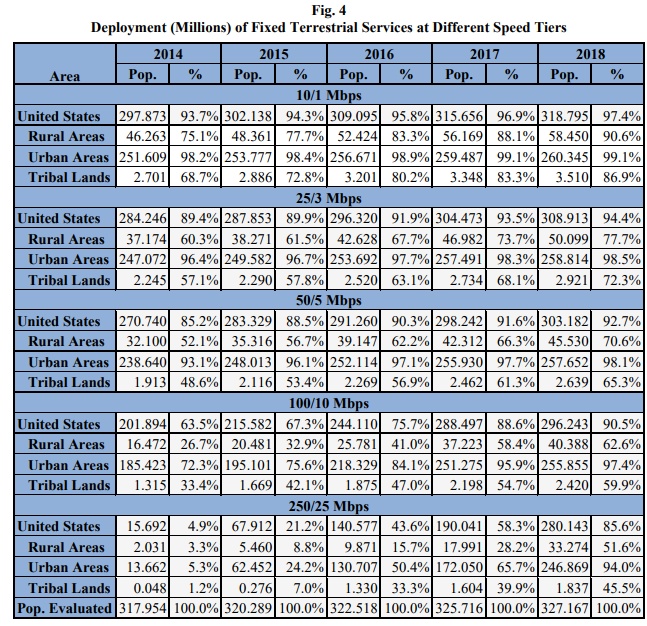
Image: Figure 4 FCC report
Figure 4 shows deployment of fixed terrestrial services at various speed tiers from year end 2014 through 2018.132 As of December 2018, fixed terrestrial service of 50/5 Mbps service is deployed to 92.7% of the population, up from 91.6% in 2017. Between 2017 and 2018, the deployment
of 100/10 Mbps increased from 88.6% to 90.5% of the population, and the deployment of 250/25 Mbps dramatically increased from 58.3% to 85.6% of the population. While deployment in rural areas and on Tribal lands lags behind deployment in urban areas at all five speed tiers, but the data show year-over year improvements for all speeds in these areas. For example, the deployment of 250/25 Mbps increased from 28.2% to 51.6% of the rural population
While fiber is the fastest home internet option by far, availability is still scattered. Due to the high cost of installing fiber service directly to homes, even major cities are still predominantly served by cable. Chicago, for example, only has 21% fiber availability as of 2020. Dallas has about 61% — and that’s actually high availability compared to other major metros in the US.
Image: CBS News
Challenges and Impact of inequitable distribution of broadband connectivity
Communities without reliable high-speed internet service cite a growing gap between the availability of resources and opportunities to their residents compared to those in communities that have a robust network. Given the ubiquitous nature of internet access, its vastly important to recognize how denial of broadband internet access, whether intentional or unintentional has become a severely debilitating factor for people and communities. Recognizing the importance of broadband and responding to such frustrations, states, communities and even individual people are seeking to close this gap. Most states have established programs to expand broadband access to communities that lack broadband internet connectivity or are undeserved. State efforts to expand broadband access are primarily focused on extending wired and fixed wireless infrastructure to the last mile: homes and small businesses. While Internet service providers, generally private companies licensed to distribute wireless and wired connectivity services have delivered reliable high-speed internet to households in most urban and suburban areas, many rural areas and areas with less population density remain under-served or lack services altogether. The issue of under-serving is particularly complex because people and regulators have used different definitions and standards from time to time. The challenge of closing the last-mile gap is compounded by geography, demographics, and the numbers and types of entities that provide service. In some states and regions, these patterns have led to uneven deployment of broadband infrastructure. While one rural community may have “fiber to the home and to the farm and to the cabin” provided by a local telephone company or cooperative, a neighboring community may lack the same level of broadband access.
While the Federal Government owns or manages key assets that support telecommunications infrastructure, the bulk of America’s telecommunications infrastructure is owned and managed by private-sector companies. This private market is a significant asset to our Nation’s economy and has helped the United States innovate and lead the world in each wave of telecommunications technology. Over the past several decades, Federal partnerships have been especially important for deployment in high-cost rural areas, where the unique challenges of geography, population density, and deployment costs may make it unprofitable to expand or operate networks – creating significant gaps in rural broadband coverage.
There are a unique set of challenges associated with delivering high-speed broadband to rural locations that service providers do not encounter in more urban locations, including geographical variables and high costs. Fortunately, recent fixed wireless solutions are equipped to address these variables as they serve as a cost-effective alternative to drop, distribution and/or feeder fiber, providing a whole new set of deployment models to the traditional Fiber-to-the-x (FTTx) deployment models. Unlike “urban jungles,” rural areas have a varying degree of terrain. Depending on the geography of the region, providers can encounter anything from rock and sand to compacted dirt and mud — making planning and executing a fiber buildout difficult. Many times, technicians are unaware of what type of soil composition they will be digging into until the project has begun. And then, they may find that getting the adequate trenches dug to lay the fiber is near impossible
According to a Fortune Article, Wealthier communities are two to three times more likely to have more than two choices for broadband providers than are communities with lower-than-average household incomes. With limited competition, it is perhaps unsurprising that Americans pay the second-highest broadband prices among OECD countries. Yet when new competition is introduced in broadband markets, the benefits are demonstrable. Look no further than Kansas City, Kan.; Chattanooga, Tenn.; Wilson, N.C.; and Longmont, Colo. for evidence that competition from a private or municipal broadband provider results in incumbent providers dropping prices and increasing speeds—but not in nearby areas the new competition didn’t serve.

Internet Availability and Affordability exacerbated in the Covid-19 era
Families across America, especially in semi-urban and rural areas often have to contend with throttled internet speeds. During Covid-19 as many families were forced to stay at home and do most of their activities at home, the demand for internet bandwidth has cast strains on the internet service providers’ ability as well as the rising data bills for many families.
Most families are hit by both the availability and affordability aspect. Contending with throttled internet speeds, many families often drives miles to find a spot where they can stream videos for work and class, including parking in acquaintances’ driveways to connect to Wi-Fi or a public utility like libraries or near a cellular tower across town.
The public health crisis has exposed New York’s digital divide. Lawmakers representing communities in upstate New York have voiced concerns about the issue for years, fighting to increase access to high-speed internet in rural communities that often struggle to even get a bar of cell service. But despite repeated pledges by state officials to remedy the situation, access to high-speed broadband internet remains elusive in the state’s bucolic areas.

“I would say that this current pandemic has really brought to light the challenges facing rural America when it comes to the lack of broadband,” said U.S. Rep. Anthony Brindisi, a Democrat whose district includes Utica and Binghamton. “These are challenges that many of us have been screaming about for many years, but [now] it seems to be very visible to the public at large.”
According to state Sen. Jen Metzger, a Democrat who represents a largely rural district in the Hudson Valley and Catskills., “There are many households that simply can’t afford it, and so we’re essentially reinforcing cycles of poverty and making it difficult for young people to realize their full potential in school and beyond,”
According to a Politico Article, Gov. Andrew Cuomo committed to providing broadband access to every New Yorker by the end of 2018, but missed the deadline. The percentage of New York residents and businesses served by “wired or wireless broadband” has gone from 70 percent in 2015, when Cuomo announced his program, to 98 percent, according to Department of Public Service spokesperson Jim Denn. According to David Little, executive director of the Rural Schools Association. “There’s vast stretches of land outside of urban areas that don’t have it, and so you have thousands of students sitting outside school buses being used as Wi-Fi hotspots so students could have some access closer to home.”
Teachers throughout the state have come up with creative solutions to help their students, including shipping out paper packets with assignments that students then mail back and calling students on landlines to assist with homework.
But for the most part, the coronavirus pandemic has frustrated families who have been calling for improved access for years.
Joanne Mazzotte, a counselor for the Crown Point Central School District in Essex County, said she hopes broadband is recognized as a basic necessity after the pandemic because of the struggles her family and others have faced. Cellular service in the area is so bad that to upload a file to Google Drive, “We’d have to huddle around one window and it would still take half an hour” despite living on a main road, she said.

How to get the Internet Service Providers to act
According to Industry estimates, based on variables like pole mounted or buried cables, laying fiber infrastructure can cost between $18,000 and $22,000 per mile. It’s all about return on investment (how quickly can the company get its cash investment back in order to reinvest in additional projects), and ability to grow the company.
Let’s look at a simple example with the following assumptions:
- $20,000 per mile for fiber infrastructure cost
- $600 per home to deliver service from the street
- 13 homes per mile (typical service area may have between 10 and 15)
- Average monthly cost for the provider to actually deliver the service after installation is $32 per month
- The subscriber pays on an average $65 per month for the service
- Net revenue per home is $33 per home
For a one mile build with 13 homes, the total project cost would be $20,000 PLUS the $600 for each home that connected to the service, about $2,140 per home – assuming that every home took service. If only 7 of those homes sign up for service, the cost per home served jumps to $3,460. By dividing the cost per home by the net revenue per home of $33, its simple to see that it will take nearly nine years for the provider to break even on the investment.
In case of multiple occupancy buildings, on average, fiber optic cable installation costs $1 to $6 per foot depending on the fiber count. It’s very difficult to estimate an exact price for an entire building to be wired, however an example would be $15,000 to $30,000 for a building with 100 to 200 drops. Fiber optic cabling is somewhat more expensive up front than copper cabling, but the greater capacity and reliability of fiber can actually reduce long-term costs.
It has been shown that States and local government bodies can use multiple policy levers to drive Internet Service Providers to expand broadband access, and some of these actions do not have to be dependent on available funding. States often support private enterprise broadband deployment through various means. In addition, where the Internet Service Providers fail to react, the state governments reserve the right to bring in non-profit cooperatives and special focus groups to build the necessary infrastructure.
- Grants and loans to service providers: States provide support, primarily through grants, to facilitate broadband deployment in un-served and under-served areas. Several states, including Minnesota and Tennessee, have funded their broadband expansion programs through appropriations, while others, including California and Colorado, have re-purposed funds that have traditionally supported universal telephone service.
- Identifying, setting up and promoting nonprofit utility cooperatives, and local governments to help make projects economically viable. In Minnesota, The Governor’s Task Force on Broadband, formed in 2011, provides a forum for stakeholders to study and discuss issues related to broadband. The Office of Broadband Development, Minnesota aims to connect all homes and businesses at speeds of at least 25 Mbps/3 Mbps by 2022 and 100 Mbps/20 Mbps by 2026 and become a national and international leader. West Virginia has passed several bills to encourage broadband expansion. In 2017, the Legislature passed a measure that established a goal of providing broadband access statewide, allowed the formation of cooperatives to provide the service, created a loan guarantee program to reduce risk for commercial lenders, and allowed Internet Service Providers to use micro-trenching technology to install infrastructure. In Maine, Maine’s ConnectME Authority, established in 2006 through the Advanced Technology Infrastructure Act, provides planning and infrastructure grants to facilitate broadband deployment to un-served and under-served communities. Between 2016 and 2018, ConnectME funded 14 planning grants totaling $451,000. Planning grants also help prepare applicants for ConnectME infrastructure grants. Between 2006 and 2018, ConnectME funded 144 infrastructure projects, providing more than $12 million to bring broadband infrastructure to nearly 40,000 households. In 2015, North Carolina’s Legislature tasked its Broadband Infrastructure Office (BIO), within the North Carolina Department of Information Technology, with developing a state broadband plan.
The universal service Schools and Libraries Program, commonly known as “E-rate,” provides discounts of up to 90 percent to help eligible schools and libraries in the United States obtain affordable telecommunications and internet access. The program is intended to ensure that schools and libraries have access to affordable telecommunications and information services.
There are currently 331 municipal networks in operation today in the U.S. We reviewed every state that has roadblocks preventing the establishment of municipal networks and compared them to states that do not have such restrictions in place. What we found was that states without restrictions enjoyed higher access to low-priced broadband plans on average.
According to a 2019 report on the health of municipal broadband, 22 states now have substantive roadblocks to establishing municipal networks to residents, down from last year’s 25. Three more states, Arkansas, California and Connecticut now permit such municipal broadband networks in full. Residents in states with no roadblocks or restrictions in place against municipal broadband have, on average, 10% greater access to low-price broadband (which we classify as any standalone internet plan $60 per month or less).
Many industry insiders feel that with the Covid-19 crisis, the focus is shifting to correct the systemic imbalances that have existed and that were confabulated or bloated due to decades of mismanagement and allowing private internet service providers to have a free rein. There’s absolutely no reason that people living in rural areas or Indian country and folks living in under-served areas must leave the safety and comfort of their homes and sit in a car outside of school or library in order to do the things that people in more than 90% of United States take for granted, that is, being able to access reasonable broadband internet from home. Further, now with Covid-19, telehealth is being used for primary care visits. The patient can stay at home and connect to their primary care provider via the internet. That way people don’t have to risk the face-to-face interaction. And so if there’s a silver lining to all of this, maybe this crisis, this pandemic, is bringing these issues to the forefront. And saying, look, there is no reason that people living in certain parts of country need to deal with essentially what is third-world connectivity.
In terms of funding to support tele-health implementation, now with Covid-19, the FCC has $200 million available to help hospitals and clinics to provide services to patients in their homes. Under the program, healthcare entities would have internet service providers bid on service improvements, such as laying fiber to a hospital or clinic, and then the funds would cover up to 65 percent of the costs of the service improvements.
One way to make sure internet gets to everyone is to make the internet a utility. It has to be free and open and available to everyone, everywhere, every time. All of the rural under-served and not served areas and Indian country needs broadband. All of these areas and communities need additional spectrum to do what they need to do. Everything ranging from tele-health to the new innovations that are taking place is denied to people where there is lack of adequate broadband capabilities.
Much has been written about the digital divide and its impact on those with limited access to broadband Internet service. Broadband Internet service has become a cornerstone to the world economy, as many things including advertising, sales, news, education, job applications, and basic communication move predominantly online. Those with broadband Internet tend to have an advantage over those without, and the people least likely to have broadband access live in rural areas. Unless broadband access is addressed in rural areas, today’s disadvantages resulting from limited broadband access will continue to grow in prominence as bandwidth needs expand and the broadband definition changes in the future. There’s always existed this lack of parity in telecommunications between rural and urban areas and from the beginning of federal communications laws in 1934, the FCC was created precisely to address a lack of access in more rural and remote areas. And so its time for everyone, the FCC, private telecom companies and local and state governments to embrace this principle called universal service, the idea that all Americans would have access to communications services.
