Notice: Function _load_textdomain_just_in_time was called incorrectly. Translation loading for the boldgrid-inspirations domain was triggered too early. This is usually an indicator for some code in the plugin or theme running too early. Translations should be loaded at the init action or later. Please see Debugging in WordPress for more information. (This message was added in version 6.7.0.) in /home/nearth9/public_html/wp-includes/functions.php on line 6170

Notice: Function _load_textdomain_just_in_time was called incorrectly. Translation loading for the heartbeat-control domain was triggered too early. This is usually an indicator for some code in the plugin or theme running too early. Translations should be loaded at the init action or later. Please see Debugging in WordPress for more information. (This message was added in version 6.7.0.) in /home/nearth9/public_html/wp-includes/functions.php on line 6170

Notice: Function _load_textdomain_just_in_time was called incorrectly. Translation loading for the nginx-helper domain was triggered too early. This is usually an indicator for some code in the plugin or theme running too early. Translations should be loaded at the init action or later. Please see Debugging in WordPress for more information. (This message was added in version 6.7.0.) in /home/nearth9/public_html/wp-includes/functions.php on line 6170

Notice: Function _load_textdomain_just_in_time was called incorrectly. Translation loading for the ninja-forms domain was triggered too early. This is usually an indicator for some code in the plugin or theme running too early. Translations should be loaded at the init action or later. Please see Debugging in WordPress for more information. (This message was added in version 6.7.0.) in /home/nearth9/public_html/wp-includes/functions.php on line 6170
Strategy and Innovation – Earthtech https://1earthtech.com Wed, 23 Sep 2020 16:32:39 +0000 en-US hourly 1 https://wordpress.org/?v=7.0.9 146148357 Expanding Horizons by expanding reach of Broadband https://1earthtech.com/expand-internet-broadband/ https://1earthtech.com/expand-internet-broadband/#respond Tue, 15 Sep 2020 03:43:40 +0000 https://1earthtech.com/?p=1116 A study in Equal Distribution of Internet Access

A look at how Regulators, Companies and Individuals are shaping the Broadband map across America



Technology and the needs of businesses and consumers continue to evolve. Over the last 2 decades of mass internet penetration, availability and affordability have become the two key cornerstones of any efforts to shape internet policy, whether its at a regulatory level, like FCC or representatives of state broadband programs or at an internet service provider company level, like AT&T, Verizon.


Broadly speaking, according to FCC definition, Broadband is defined as reliable high-speed internet, having download speeds of at least 25 megabits per second (Mbps) and upload speeds of at least 3 Mbps. Broadband internet may be delivered via multiple technologies, including Fiber broadband, fixed wireless, digital subscriber line (DSL), or Cable broadband. Each technology has varying costs of setup and maintenance, with cable being generally regarded as the most cost-effective though technologically limited solution.


Perhaps more so than any other technological innovation in human history, the Internet has changed our daily lives in significant and permanent ways. Among many other things, the transformation has occurred faster than any other adaption of technological changes. Over the space of 2 decades, home broadband adoption has grown from 3% of all American adults age 18 and older to almost 80%. By comparison, it took telephone to  nearly 8 decades and electricity more than 30 years to reach the same level of penetration, despite deals .


Broadband is increasingly intertwined with the daily functions of modern life. It is transforming education, social services, healthcare, agriculture, supporting economic development initiatives, and is a critical piece of efforts to improve human life and socio-economic factors of human development.


Broadband has become the quintessential communication essential in the digital age and the era of Internet. Literally and figuratively, everything is available on the internet. And being connected, being connected always, has become an objective, an input and a goal statement in and of itself. Everyone, everywhere, has some purpose which requires them to access internet resources, unless of course, people making the active choice of living off the grid. However, with more than 19 million disconnected households across the country at the most conservative level of estimate, it is impossible to capitalize on broadband’s full economic and social impacts. While a presidential platform can incentive policy reform at the federal level, the road to change is still a long one, slowed by political infighting and congressional discord.



Internet Availability and Affordability for everyone

When people refer to broadband, most are referring to interrelated, sometimes overlapping characteristics of the sector. These two characteristics are like two sides of the same coin, and in every facet are tied to each other. The first is the digital telecommunications backbone or the infrastructure, whether wireless like mobile or wired technologies like Cable, DSL, etc, that enables outreach and availability of high-speed transmission of data. This digital backbone and physical infrastructure is both capital-intensive and technology-intensive, as in the front-end infrastructure, the towers, the wire lines, the cables, the physical buildings and exchanges and offices where the telecommunication equipment is assembled requires significant up-front monetary investment as well as time, whereas set-up of back-end technology and processes to enable the operations, billing and provisioning of broadband services requires years of preparation.  The other side of this coin, the federalist and state policy frameworks that govern physical infrastructure and related coverage especially in areas with limited revenue and growth potential, dictate how the implementations are carried out.  Though broadband’s antiquated definition tends to focus strictly on the transfer speeds and the network capabilities of the underlying technology, iin reality, broadband infrastructure can only reach its potential if every individual can use the service, and if policy frameworks are in place to support ubiquitous, near barrier-less adoption.


By pricing the broadband service, especially the entry levels prohibitively high so that its out of reach of certain section of the society, or by excluding the geographical areas or communities altogether, or by not investing or reducing the investment in upgrade and maintenance of the lines, it is certainly true that in certain parts of the country the entry barriers to obtain sufficiently fast broadband connection are too high. And lastly, not having adequate competition at a market level not only forces the customers to settle for low standards of service, but stifles innovation and investment, two most critical factors for market growth.


There are three primary areas within the colloquial term broadband availability that must be broken down for an effective analysis. These are availability of service, affordability of services and the presence or lack of competition, as in, the competition exerted by each internet service provider competing for market share. Lets look at these briefly.


  1. Availability of Service -: this is apparently self-explanatory and generally the first step of internet connectivity. This is plan and simple availability of broadband signal in an area. According to the most recent data available, the Federal Communications Commission (FCC) estimates that 21 million Americans still lack broadband access according to the most recent data available. Many researchers have however cast serious aspersions on the veracity of this data, at times placing the number of people without access to reasonable internet as high as 162 million.
  2. Availability of speed tiers and plans and Affordability -: FCC voted in January 2020 to approve a $20.4 billion Rural Digital Opportunity Fund that will make grants to broadband providers to build broadband networks where there is currently no or substandard service, however the money will be disbursed without any guarantee that the grant recipients will help to make broadband more affordable for low-income customers. It is strongly believed that to avoid corruption and to prevent this from becoming yet-another-failed scheme, Congress and the FCC should require, as a condition for funding this broadband deployment, true high-speed service at actually affordable prices—for instance, service rated at 50 Mbps for upload and download with unlimited usage for $10 per month to eligible recipients. What is alarming is that home broadband adoption rates aren’t improving. Approximately 73% of U.S adults use broadband service at home, but that figure has remained stable for the past three years. Too many people aren’t subscribing to broadband even when it is available to them. Affordable service is crucial.
  3. Lack of more than one service provider -: According to a Fortune Article, laws in 19 states restrict local communities from experimenting to increase broadband deployment. These laws should be revisited and repealed. An indubitable truth – when new competition is introduced in broadband markets, the benefits are demonstrable. Look no further than Kansas City, Kan.; Chattanooga, Tenn.; Wilson, N.C.; and Longmont, Colo. for evidence that competition from private or municipal broadband provider results in incumbent providers dropping prices and increasing speeds — benefits which can not be realized with any amount of coaxing or appeals as seen in nearby areas where old standards still persisted in a market without competition. An estimated 35% of people have only 1 choice of broadband provider; another 37% have just two to choose from. Without competition, people—especially those with lower incomes or those who live in rural areas—are threatened with artificially high prices, lower-quality service, and little innovation. A Wall Street Journal report published last year found that low-income areas and high-income areas pay similar median monthly costs (about $66) for stand-alone internet, but poorer areas get 40% slower speeds for the price.
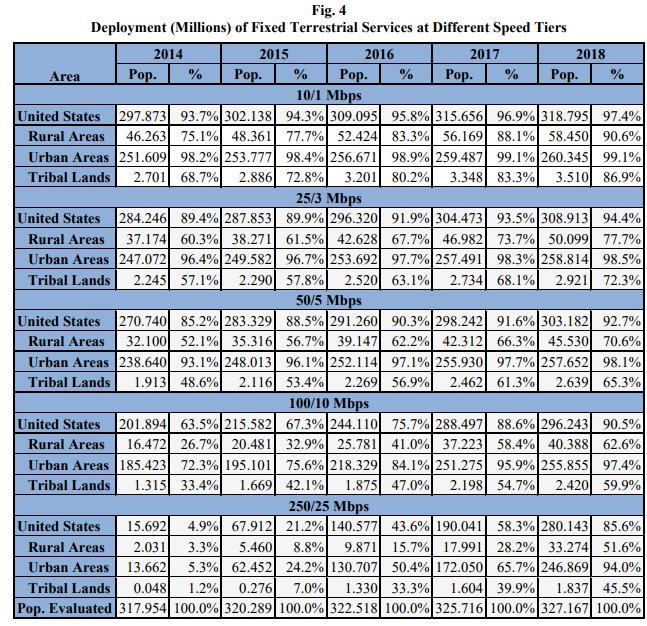


Image: Figure 4 FCC report

Figure 4 shows deployment of fixed terrestrial services at various speed tiers from year end 2014 through 2018.132 As of December 2018, fixed terrestrial service of 50/5 Mbps service is deployed to 92.7% of the population, up from 91.6% in 2017. Between 2017 and 2018, the deployment
of 100/10 Mbps increased from 88.6% to 90.5% of the population, and the deployment of 250/25 Mbps dramatically increased from 58.3% to 85.6% of the population. While deployment in rural areas and on Tribal lands lags behind deployment in urban areas at all five speed tiers, but the data show year-over year improvements for all speeds in these areas. For example, the deployment of 250/25 Mbps increased from 28.2% to 51.6% of the rural population


While fiber is the fastest home internet option by far, availability is still scattered. Due to the high cost of installing fiber service directly to homes, even major cities are still predominantly served by cable. Chicago, for example, only has 21% fiber availability as of 2020. Dallas has about 61% — and that’s actually high availability compared to other major metros in the US.

The great broadband divide: Living without high-speed internet access - CBS News

Image: CBS News


Challenges and Impact of inequitable distribution of broadband connectivity

Communities without reliable high-speed internet service cite a growing gap between the availability of resources and opportunities to their residents compared to those in communities that have a robust network. Given the ubiquitous nature of internet access, its vastly important to recognize how denial of broadband internet access, whether intentional or unintentional has become a severely debilitating factor for people and communities. Recognizing the importance of broadband and responding to such frustrations, states, communities and even individual people are seeking to close this gap. Most states have established programs to expand broadband access to communities that lack broadband internet connectivity or are undeserved. State efforts to expand broadband access are primarily focused on extending wired and fixed wireless infrastructure to the last mile: homes and small businesses. While Internet service providers, generally private companies licensed to distribute wireless and wired connectivity services have delivered reliable high-speed internet to households in most urban and suburban areas, many rural areas and areas with less population density remain under-served or lack services altogether. The issue of under-serving is particularly complex because people and regulators have used different definitions and standards from time to time. The challenge of closing the last-mile gap is compounded by geography, demographics, and the numbers and types of entities that provide service. In some states and regions, these patterns have led to uneven deployment of broadband infrastructure. While one rural community may have “fiber to the home and to the farm and to the cabin” provided by a local telephone company or cooperative, a neighboring community may lack the same level of broadband access.


While the Federal Government owns or manages key assets that support telecommunications infrastructure, the bulk of America’s telecommunications infrastructure is owned and managed by private-sector companies. This private market is a significant asset to our Nation’s economy and has helped the United States innovate and lead the world in each wave of telecommunications technology. Over the past several decades, Federal partnerships have been especially important for deployment in high-cost rural areas, where the unique challenges of geography, population density, and deployment costs may make it unprofitable to expand or operate networks – creating significant gaps in rural broadband coverage.


There are a unique set of challenges associated with delivering high-speed broadband to rural locations that service providers do not encounter in more urban locations, including geographical variables and high costs. Fortunately, recent fixed wireless solutions are equipped to address these variables as they serve as a cost-effective alternative to drop, distribution and/or feeder fiber, providing a whole new set of deployment models to the traditional Fiber-to-the-x (FTTx) deployment models. Unlike “urban jungles,” rural areas have a varying degree of terrain. Depending on the geography of the region, providers can encounter anything from rock and sand to compacted dirt and mud — making planning and executing a fiber buildout difficult. Many times, technicians are unaware of what type of soil composition they will be digging into until the project has begun. And then, they may find that getting the adequate trenches dug to lay the fiber is near impossible


According to a Fortune Article, Wealthier communities are two to three times more likely to have more than two choices for broadband providers than are communities with lower-than-average household incomes. With limited competition, it is perhaps unsurprising that Americans pay the second-highest broadband prices among OECD countries. Yet when new competition is introduced in broadband markets, the benefits are demonstrable. Look no further than Kansas City, Kan.; Chattanooga, Tenn.; Wilson, N.C.; and Longmont, Colo. for evidence that competition from a private or municipal broadband provider results in incumbent providers dropping prices and increasing speeds—but not in nearby areas the new competition didn’t serve.

 

The Challenges of Broadband Access in Rural Schools - edWeb


Internet Availability and Affordability exacerbated in the Covid-19 era

Families across America, especially in semi-urban and rural areas often have to contend with throttled internet speeds. During Covid-19 as many families were forced to stay at home and do most of their activities at home, the demand for internet bandwidth has cast strains on the internet service providers’ ability as well as the rising data bills for many families.


Most families are hit by both the availability and affordability aspect. Contending with throttled internet speeds, many families often drives miles to find a spot where they can stream videos for work and class, including parking in acquaintances’ driveways to connect to Wi-Fi or a public utility like libraries or near a cellular tower across town.


The public health crisis has exposed New York’s digital divide. Lawmakers representing communities in upstate New York have voiced concerns about the issue for years, fighting to increase access to high-speed internet in rural communities that often struggle to even get a bar of cell service. But despite repeated pledges by state officials to remedy the situation, access to high-speed broadband internet remains elusive in the state’s bucolic areas.


Pandemic exposes rural broadband access challenges - Farm and Dairy


“I would say that this current pandemic has really brought to light the challenges facing rural America when it comes to the lack of broadband,” said U.S. Rep. Anthony Brindisi, a Democrat whose district includes Utica and Binghamton. “These are challenges that many of us have been screaming about for many years, but [now] it seems to be very visible to the public at large.”


According to state Sen. Jen Metzger, a Democrat who represents a largely rural district in the Hudson Valley and Catskills., “There are many households that simply can’t afford it, and so we’re essentially reinforcing cycles of poverty and making it difficult for young people to realize their full potential in school and beyond,”


According to a Politico Article, Gov. Andrew Cuomo committed to providing broadband access to every New Yorker by the end of 2018, but missed the deadline. The percentage of New York residents and businesses served by “wired or wireless broadband” has gone from 70 percent in 2015, when Cuomo announced his program, to 98 percent, according to Department of Public Service spokesperson Jim Denn. According to David Little, executive director of the Rural Schools Association. “There’s vast stretches of land outside of urban areas that don’t have it, and so you have thousands of students sitting outside school buses being used as Wi-Fi hotspots so students could have some access closer to home.”


Teachers throughout the state have come up with creative solutions to help their students, including shipping out paper packets with assignments that students then mail back and calling students on landlines to assist with homework.


But for the most part, the coronavirus pandemic has frustrated families who have been calling for improved access for years.


Joanne Mazzotte, a counselor for the Crown Point Central School District in Essex County, said she hopes broadband is recognized as a basic necessity after the pandemic because of the struggles her family and others have faced. Cellular service in the area is so bad that to upload a file to Google Drive, “We’d have to huddle around one window and it would still take half an hour” despite living on a main road, she said.

America's ISPs Are Bringing Rural America Up to Speed | NCTA — The Internet & Television Association


How to get the Internet Service Providers to act

According to Industry estimates, based on variables like pole mounted or buried cables, laying fiber infrastructure can cost between $18,000 and $22,000 per mile. It’s all about return on investment (how quickly can the company get its cash investment back in order to reinvest in additional projects), and ability to grow the company.

Let’s look at a simple example with the following assumptions:


  • $20,000 per mile for fiber infrastructure cost
  • $600 per home to deliver service from the street
  • 13 homes per mile (typical service area may have between 10 and 15)
  • Average monthly cost for the provider to actually deliver the service after installation is $32 per month
  • The subscriber pays on an average $65 per month for the service
  • Net revenue per home is $33 per home


For a one mile build with 13 homes, the total project cost would be $20,000 PLUS the $600 for each home that connected to the service, about $2,140 per home – assuming that every home took service.  If only 7 of those homes sign up for service, the cost per home served jumps to $3,460.   By dividing the cost per home by the net revenue per home of $33, its simple to see that it will take nearly nine years for the provider to break even on the investment.


In case of multiple occupancy buildings, on average, fiber optic cable installation costs $1 to $6 per foot depending on the fiber count. It’s very difficult to estimate an exact price for an entire building to be wired, however an example would be $15,000 to $30,000 for a building with 100 to 200 drops. Fiber optic cabling is somewhat more expensive up front than copper cabling, but the greater capacity and reliability of fiber can actually reduce long-term costs.

 

Ag Outlook Highlights Challenges to Rural Broadband, Ag Transportation


It has been shown that States and local government bodies can use multiple policy levers to drive Internet Service Providers to expand broadband access, and some of these actions do not have to be dependent on available funding. States often support private enterprise broadband deployment through various means. In addition, where the Internet Service Providers fail to react, the state governments reserve the right to bring in non-profit cooperatives and special focus groups to build the necessary infrastructure.


  1. Grants and loans to service providers: States provide support, primarily through grants, to facilitate broadband deployment in un-served and under-served areas. Several states, including Minnesota and Tennessee, have funded their broadband expansion programs through appropriations, while others, including California and Colorado, have re-purposed funds that have traditionally supported universal telephone service.
  2. Identifying, setting up and promoting nonprofit utility cooperatives, and local governments to help make projects economically viable. In Minnesota, The Governor’s Task Force on Broadband, formed in 2011, provides a forum for stakeholders to study and discuss issues related to broadband. The Office of Broadband Development, Minnesota aims to connect all homes and businesses at speeds of at least 25 Mbps/3 Mbps by 2022 and 100 Mbps/20 Mbps by 2026 and become a national and international leader. West Virginia has passed several bills to encourage broadband expansion. In 2017, the Legislature passed a measure that established a goal of providing broadband access statewide, allowed the formation of cooperatives to provide the service, created a loan guarantee program to reduce risk for commercial lenders, and allowed Internet Service Providers to use micro-trenching technology to install infrastructure. In Maine, Maine’s ConnectME Authority, established in 2006 through the Advanced Technology Infrastructure Act, provides planning and infrastructure grants to facilitate broadband deployment to un-served and under-served communities. Between 2016 and 2018, ConnectME funded 14 planning grants totaling $451,000. Planning grants also help prepare applicants for ConnectME infrastructure grants. Between 2006 and 2018, ConnectME funded 144 infrastructure projects, providing more than $12 million to bring broadband infrastructure to nearly 40,000 households. In 2015, North Carolina’s Legislature tasked its Broadband Infrastructure Office (BIO), within the North Carolina Department of Information Technology, with developing a state broadband plan.


The universal service Schools and Libraries Program, commonly known as “E-rate,” provides discounts of up to 90 percent to help eligible schools and libraries in the United States obtain affordable telecommunications and internet access. The program is intended to ensure that schools and libraries have access to affordable telecommunications and information services.


There are currently 331 municipal networks in operation today in the U.S. We reviewed every state that has roadblocks preventing the establishment of municipal networks and compared them to states that do not have such restrictions in place. What we found was that states without restrictions enjoyed higher access to low-priced broadband plans on average.


According to a 2019 report on the health of municipal broadband, 22 states now have substantive roadblocks to establishing municipal networks to residents, down from last year’s 25. Three more states, Arkansas, California and Connecticut now permit such municipal broadband networks in full. Residents in states with no roadblocks or restrictions in place against municipal broadband have, on average, 10% greater access to low-price broadband (which we classify as any standalone internet plan $60 per month or less).


Many industry insiders feel that with the Covid-19 crisis, the focus is shifting to correct the systemic imbalances that have existed and that were confabulated or bloated due to decades of mismanagement and allowing private internet service providers to have a free rein. There’s absolutely no reason that people living in rural areas or Indian country and folks living in under-served areas must leave the safety and comfort of their homes and sit in a car outside of school or library in order to do the things that people in more than 90% of United States take for granted, that is, being able to access reasonable broadband internet from home. Further, now with Covid-19, telehealth is being used for primary care visits. The patient can stay at home and connect to their primary care provider via the internet. That way people don’t have to risk the face-to-face interaction. And so if there’s a silver lining to all of this, maybe this crisis, this pandemic, is bringing these issues to the forefront. And saying, look, there is no reason that people living in certain parts of country need to deal with essentially what is third-world connectivity.


In terms of funding to support tele-health implementation, now with Covid-19, the FCC has $200 million available to help hospitals and clinics to provide services to patients in their homes.  Under the program, healthcare entities would have internet service providers bid on service improvements, such as laying fiber to a hospital or clinic, and then the funds would cover up to 65 percent of the costs of the service improvements.


One way to make sure internet gets to everyone is to make the internet a utility. It has to be free and open and available to everyone, everywhere, every time. All of the rural under-served and not served areas and Indian country needs broadband. All of these areas and communities need  additional spectrum to do what they need to do. Everything ranging from tele-health to the new innovations that are taking place is denied to people where there is lack of adequate broadband capabilities.


Much has been written about the digital divide and its impact on those with limited access to broadband Internet service. Broadband Internet service has become a cornerstone to the world economy, as many things including advertising, sales, news, education, job applications, and basic communication move predominantly online. Those with broadband Internet tend to have an advantage over those without, and the people least likely to have broadband access live in rural areas. Unless broadband access is addressed in rural areas, today’s disadvantages resulting from limited broadband access will continue to grow in prominence as bandwidth needs expand and the broadband definition changes in the future. There’s always existed this lack of parity in telecommunications between rural and urban areas and from the beginning of federal communications laws in 1934, the FCC was created precisely to address a lack of access in more rural and remote areas. And so its time for everyone, the FCC, private telecom companies and local and state governments to embrace this principle called universal service, the idea that all Americans would have access to communications services.


Why rural areas can't catch a break when it comes to speedy broadband - CNET

]]>
https://1earthtech.com/expand-internet-broadband/feed/ 0 1116
Exposure Notification Express https://1earthtech.com/exposure-notification-express/ https://1earthtech.com/exposure-notification-express/#respond Fri, 04 Sep 2020 17:01:18 +0000 https://1earthtech.com/?p=1111 Contact tracing with Exposure Notification Express


This is part II of our blog post on Exposure Notification. Our original blog on Exposure Notification was published August 30th.

Coronavirus: Apple iPhones can contact-trace without Covid app - BBC News


Let’s look at the Background

Public Health Agencies around the world and especially in US have had little success with using mobile phones based technology to monitor the spread of Coronavirus and to warn users proactively.


Some public health agencies in the United States and around the world wanted to build mobile apps that would help them track the spread of the virus, through a process known as “contact tracing.” Due to the slow moving government apparatus, legal and procedural requirements and the logistical challenges, few of such program could take off. The contact-tracing apps that were initially launched did not function properly because of certain limitations, primarily the concerns around privacy and collection of data.


Apple and Google announced a surprise partnership at the start of this pandemic in April. When Apple and Google announced their work together on the COVID-19 Exposure Notification API, the companies put behind years of rivalry to join hands to help people and Public Health Authorities fight this massive battle. Apple and Google announced two phases of the Contact Tracing project. During the first phase, which is what came with iOS 13.5, laid out that that users first download an app from their public health authority and then opt-in to Exposure Notifications. The process of Exposure Notification System works through sharing anonymous Bluetooth beacons with nearby devices running the same software, tagging those that suggest extended and close contact associated with coronavirus spread, and saving the last 14 days of these records.


At the same time, Apple and Google also indicated start of work on the second phase, which would reduce the reliance on contact tracing app from public health authorities while bringing the core functions of the COVID-19 Exposure Notification technology directly into iOS and Android. This is essentially what Apple and Google announced on Tuesday, 1st September.


List of countries using Google and Apple's COVID-19 Contact Tracing API


So what is new in the second phase of Exposure Notifications

Apple and Google announced on 01st September that their joint program, contact tracing Exposure Notifications System, can inform people of potential exposure to COVID-19 without a dedicated Exposure Notifications app. The second phase of this program, the companies announced, re-launches the warning software in a new and better Avatar, so that state public health agencies can participate without having to create customized apps. This app-less functionality is called Exposure Notifications Express and is only available when a Public Health Authority (PHA) supports it.


The two partners, Apple and Google are introducing new tools that benefit both the public and public health authorities, making it much easier for public health authorities to implement digital exposure notification, while reducing a step in the process for the general users. For public health authorities, now they do not need to worry about the need for developing and maintaining their own individual contact tracing application. Apple made this breakthrough via the iOS 13.7 system update, released 01st September to general public, while Google is implementing it with an automatically generated application on Android 6.0, upcoming later in September, taking a little longer because of the very different method through which it manages system services and OS updates.


For public health authorities, the new changes bring significant ease of operation as the process of adopting Exposure Notifications Express by users is significantly streamlined compared to adopting the existing Exposure Notification API where users first had to download the contact tracing application. Public health authorities simply provide a configuration file that includes their name, logo, criteria for triggering an exposure notification, and information and protocol that is displayed to users following an exposure. The existing way of Exposure Notification API demanded that users download the contact tracing application from their public health authority first before proceeding with other steps. This was a major headache for public health organizations who were required to maintain their own infrastructure and software application.  Further it was an additional and often confusing step for users. Now that part is completely eliminated benefiting both public health authorities and users.


Further Apple and Google say that they will use the information provided by the public health authorities to offer a fully operational Exposure Notification Systems on behalf of the public health authority directly integrated into their respective operating systems, in case of Apple this is iOS 13.7.


Crucially, Public health authorities still have full control over the system, though, and there are no additional privacy or data related concerns. The Public Health Authorities still dictate and control the process of triggering notifications, what is the language and structure of the advice, and guidance on the next course of action for exposed individuals.


I downloaded Covidwise, America's first Bluetooth exposure-notification app. You should, too. - The Washington Post


iOS 13.7 changes

With the new Exposure Notification Express, which forms the second phase of Exposure Notification System, the system removes one of the key barriers to adoption that led to a slow start to the software. Once users update iOS 13.7, users can now enable COVID-19 Exposure Notifications directly in the Settings app on their iPhone. This new process is called Exposure Notifications Express. The process is as simple as enabling user preferences in any other application and just takes a few taps, including agreeing to the public health agency terms and conditions of service. Additionally, users will also be able to opt-in to receive a push notification when their local public health authority adopts Exposure Notifications Express.


Once an user enables exposure notifications in the Settings, their iPhone will begin monitoring with Bluetooth to log possible exposures so the user can be notified of a potential COVID-19 exposure based on the guidelines set by the local public health authority. The process of monitoring and triggering Exposure Notification System works without any changes, through sharing anonymous Bluetooth beacons with nearby devices running the same software, tagging those that suggest extended and close contact associated with coronavirus spread, and saving the last 14 days of these records.


At least in the United States, many people haven’t had the option of participating, as states have been slow to create apps. Now, with “exposure notifications express,” states will have less work to participate. Through this simplification pf approach, Apple and Google hope that adaption rate of the Exposure Notifications Express system will dramatically increase, at both levels, from users and public health authorities. The first public health authorities in the United States to adopt the Exposure Notification Express system will be Maryland, Nevada, Virginia, and Washington, D.C.


Users who live in states that participate in the software may get a pop-up notification, prompting them to opt into the program. By following simple steps, they can share their Bluetooth data and receive notifications if they come in contact with another participant who has tested positive. For states that already have a contact tracing application standalone application using the COVID-19 Exposure Notification API, those apps can still exist and operate on their own. As of right now, Apple and Google say that 25 states and territories, representing more than 55% of the population, are exploring Exposure Notifications System solutions.


Finally, Apple and Google emphasize that all of the original privacy protections of the Exposure Notification API also extend to the Exposure Notifications Express. Users must explicitly enable exposure notifications, nothing is enabled by default. No location data is shared and the system does not share your identity with other users, Apple, or Google. All matching is done on-device and users have full control over whether they want to report a positive test.


“I would say this is an improvement,” said Jeffrey Kahn, director of the Johns Hopkins Berman Institute of Bioethics. Kahn, who has been studying the use of technology to fight the virus, said states have been hamstrung by indecision around which technology vendors they should use to build their apps, among other issues. He said this may help speed up adoption, but shouldn’t be considered a magic bullet.


“Public health agencies are carrying an extraordinary load in managing the novel coronavirus response,” said Scott J. Becker, head of the Association of Public Health Laboratories, in a statement provided by the companies. “The easier we make it for state and territorial public health agencies to develop and deploy, the sooner we can expand COVID-19 exposure notification in our communities and help end the pandemic.”


]]>
https://1earthtech.com/exposure-notification-express/feed/ 0 1111
Social Media and managing content! https://1earthtech.com/social-media-moderation-content/ https://1earthtech.com/social-media-moderation-content/#respond Wed, 22 Jan 2020 21:51:46 +0000 https://1earthtech.com/?p=781

This article offers a critical view of how content available on the internet quintessentially shapes public opinions and provides an unique challenge to governments around the world.

Introduction

The Social media today has a very different impact potential than it used to 10 years ago. Today the social media is capable of influencing country-wide elections, swaying public opinions, making or breaking brands and people associated with those names, and raising or flat-lining issues. The power wielded by content is truly mind-boggling when one considers that more than 56% of world’s population is online one way or the other. With growing penetration of smartphones and increase in bandwidth accompanied with decrease in data charges, content sharing is becoming ubiquitous and as easy as texting or talking.


Governments, regulators and public experts around the world have expressed concern amidst growing need to monitor content which is distributed largely freely today. Who controls what can be seen publicly has been a matter of much debate which is far from settled, however almost everyone involved favors some level of control on viewership of the media content posted online, or in other words, policing the internet. Most through recognize this policing as not a negative or an impediment, rather as a virtue or a social responsibility. Given the power, both direct and indirect, that content platforms usually possess, online available content has become the new hidden weapon on both sides of the debate.


The best way to prevent undesirable content from being seen is to never let it be uploaded in the first place. If content publishing platforms like Facebook, YouTube and several hundred others out there are required to screen every single video or post uploaded on their platform, it would simply lose out on millions of subscribers who want to upload their content immediately. If the platforms employ AI powered algorithms to pull down videos, then it must expect errors and content being pulled down or demoted needlessly.


Image Credit: Internet

Is Social media uncontrollable?

YouTube works in 80 different languages, is free at the entry level, is available almost everywhere, is extremely popular in the 18 – 24 year age group around the world, even in countries like P.R. China which have their own version of YouTube, and is increasingly being used to ‘monetize’ content like never before. With such mass viewership, Cisco predicts that videos will make up more than 80% of global internet traffic by 2022. YouTube, the world’s foremost content sharing site, has close to 2 billion logged-in users each month (one doesn’t need to be a logged in user to just view videos). Given its low entry barrier, almost everyone with an internet connection has used YouTube at some time.


Social media platforms, especially where content is freely distributed, or nearly freely distributed, have had an unfettered run over the past decade leading to their massive popularity today.


“We’re just a platform” is almost an extremely convenient way to avoid taking full responsibility for an increasingly serious set of problems. Yet this is exactly the approach that majority of platforms have adapted when it came to own up the responsibility of content moderation and review.


Few years back, Steve Stephens recorded himself murdering an innocent victim and then uploaded the footage to Facebook. The horrific act put Facebook under immense pressure to do something. This incident is not alone as there have been may documented cases of teens posting suicides on the internet.


Recently, the ghastly attack on the two churches in Christchurch, New Zealand killing more than 50 people was streamed live on Facebook for the world to see. Millions of people watched in disbelief while the lone gunman went on a rampage gunning down unarmed civilians. The video was streamed for several minutes while YouTube Moderators fought back hard taking down the video as newer versions kept popping up seemingly beating the controls that YouTube has in place to immediately flag already removed material. The up-loaders were able to sneak past by using a loophole – exact re-uploads of the video are banned by YouTube, however videos that contain clips of the original footage must be sent to human moderators for review, thereby delaying the process. And again this loophole existed for a purely legitimate reason – to ensure that news videos that use a portion of the video for their segments aren’t removed in the process.


For all live streaming and news events, especially ‘Breaking News’, YouTube’s safety team prefers not to use the system for immediately removing child pornography and terrorism-related content, by fingerprinting the footage using a hash system, and rather depends on a system similar to its copyright tool, Content ID, but not exactly the same. The system takes the much longer route – it first searches re-uploaded versions of the original video for similar metadata and imagery. If it’s an unedited re-upload, it’s removed. If it’s edited, the tool flags it to a team of human moderators, both full-time employees at YouTube and contractors, who determine if the video violates the company’s policies. YouTube considers the removal of newsworthy videos to be just as harmful. YouTube prohibits footage that’s meant to “shock or disgust viewers,” which can include the aftermath of an attack. If it’s used for news purposes, however, YouTube says the footage is allowed but may be age-restricted to protect younger viewers, reports The Verge.


Image Source: Internet


Rasty Turek, CEO of Pex, a video analytics platform that is also working on a tool to identify re-uploaded or stolen content, told The Verge that the issue is how the product is implemented. Turek, who closely studies YouTube’s Content ID software, points to the fact that it takes 30 seconds for the software to even register whether something is re-uploaded before being handed off for manual review. YouTube’s Content ID tool takes “a couple of minutes, or sometimes even hours, to register the content,” Turek said. That’s normally not a problem for copyright issues, but it poses real problems when applied to urgent situations. A YouTube spokesperson could not tell The Verge if that number was accurate.


Further, Turek contends, There is no harm to a society when copyrighted things or leaks aren’t taken down immediately. There is harm to a society here though when live-streaming and breaking news puts harmful content out there. This is precisely the reason why live-streaming is considered a high-risk area by Facebook and YouTube and nearly every other platform that provides live-streaming. People need to have different credentials for live-streaming and people violating rules related to live-streaming, who are sometimes caught using Content ID once the live stream is over, lose their streaming privileges because it’s an area that YouTube can’t police as thoroughly. The teams at YouTube are working on it, according to the company, but it’s one the safety team acknowledges is very difficult. Turek agrees.


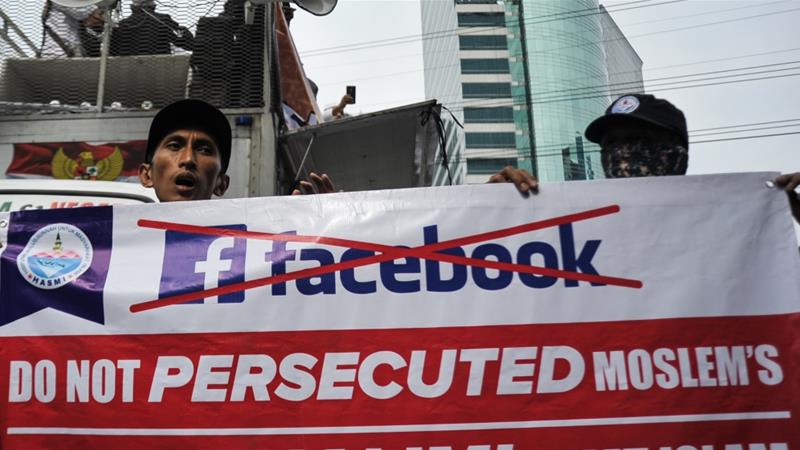
In another incident, Facebook admitted last November that it did not do enough to prevent its platform from being used to “foment division and incite offline violence” in Myanmar against the Muslim Rohingya minority. That came after the United Nations described the events surrounding the mass exodus of more than 700,000 Rohingya people from Myanmar as a “textbook example of ethnic cleansing.”


These incidents are not limited to YouTube and Facebook. In China, Bytedance chief executive Zhang Yiming had to issue a public apology in April 2018 after the company was ordered by the central government to close its popular Neihan Duanzi app for “vulgar content”. The company’s Jinri Toutiao news aggregation app was also ordered to be taken down from various app stores for three weeks. Bytedance pledged to expand its content vetting team from 6,000 to 10,000 staff, and permanently ban creators whose content was “against community values”.


Image Credit: Internet

Addressing the elephant in the room!

YouTube reportedly employees more than 10,000 people on it’s content moderation and rule enforcement team which represents a 25 percent increase from just about a year ago. according to YouTube took this decision after a number of controversies surfaced over recent past concerning children’s safety on the platform—for those who watch the content as well as those who appear in videos. Yet as other platforms have also struggled with the delicate task of protecting viewers while also ensuring free speech, the big question next year for YouTube is whether this will work.


Similarly, Facebook employees close to 15,000 people while Twitter employees close to 2,500 people to moderate the content on its platforms.


Relying purely upon humans to act as content moderators and reviewers is not the most viable option. Further the process of reviewing user-reported content is time consuming in itself. Yet, machine learning is not advanced enough at the moment to completely automate the process, though A.I. researchers at Facebook are working on software that they say will eventually enable computers to do most of the work. Current AI and ML systems are not close to being mature enough to address the complexities of moderation, given that almost all intelligence systems operate at a pattern recognition level, where any change in any one of the hundreds of attributes can throw a false positive, thereby passing the content and throwing the system off track. Advanced use cases such as differentiating a jibe from something more serious whether in a video or written format, in an efficient manner that doesn’t unduly stifle free speech is certainly out of question for many years to come.


More traditional methods of reviewers depending on user-reported content and user feedback to promote or demote content is too slow and is often regarded as “too-little, too-late“. It could take crucial hours for user-reported infractions to filter through and reach the reviewers, by which time the damage is already done.

Image Credit: Internet

To overcome these challenges, most platforms are now deploying combination of AI with human moderators to come close to building a viable system. The system begins with AI assisted, algorithms based logic program which does an initial flagging and flags anything where it finds even barely perceptible objectionable content. Once the content is flagged, it is taken down immediately or if not yet online, stopped from proceeding further, and queued up for an in-depth review by human operators. The content is then finally posted back online or taken down permanently based on the decision of human moderation process.


To illustrate this use of AI, let’s look at Inke, which is one of China’s largest live-streaming companies with 25 million users. As of the end of last year, almost 400 million people in China had done the equivalent of a Facebook Live and live-streamed their activities on the internet. Most of it is innocuous: showing relatives and friends back home the sights of Paris or showing nobody in particular what they are having for lunch or dinner (Source: South China Morning Post). Inke employs 1,200 mostly fresh-faced college graduates who have seconds to decide whether the two-piece swimwear on their screens breaches rules governing use of the platform. The team is the biggest in Inke, accounting for about 60 per cent of its workforce. The content moderators work to detailed regulations on what is allowed and what has to be removed. AI is employed to handle the grunt work of labelling, rating and sorting content into different risk categories. This classification system then allows the company to devote resources in ascending order of risk. A single reviewer can monitor more low-risk content at one time, say cooking shows, while high-risk content is flagged for closer scrutiny.


Yet even that – employing AI assisted algorithmic logic coupled with human moderators – may not be enough as Mark Zuckerberg, Facebook’s CEO and majority shareholder, published a memo on censorship in Dec 2018. “What should be the limits to what people can express?” he asked. “What content should be distributed and what should be blocked? Who should decide these policies and make enforcement decisions?” One idea he aired might be thought of as a Supreme Court of Facebook. “I’ve increasingly come to believe that Facebook should not make so many important decisions about free expression and safety on our own,” Zuckerberg wrote. “In the next year, we’re planning to create a new way for people to appeal content decisions to an independent body, whose decisions would be transparent and binding.”


Image Credit: Internet

Bigger elephant in the room

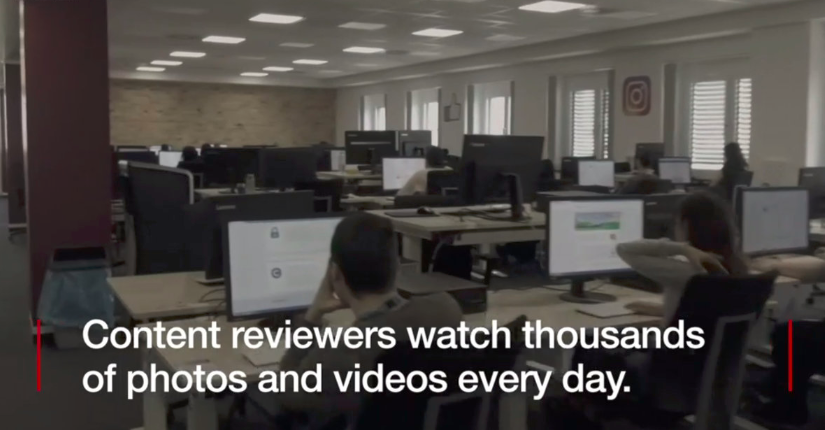
There are two major challenges to building and deploying any content monitoring system. The first challenge is simply of scale. As more than 300 hours of videos are uploaded just on YouTube every single minute, the humans monitoring the videos must be capable to correctly identify inappropriate content very, very quickly, virtually in seconds. Making those removal decisions are not simple yet must be made in seconds. Personal biases and tolerances need to be re-calibrated in favor of policies and law. In addition the biggest challenge humans face monitoring content is to maintain their objectivity while watching hours upon hours of videos. Many content reviewers have reported increase in stress levels and allegations of mental illnesses are not uncommon. A group of moderators sued Microsoft in January alleging that they were suffering from PTSD as a result of watching child abuse and other sadistic acts.


The second challenge is bigger and is not going to go anywhere anytime soon. As Mark Zuckerberg mentioned in Dec 2018, this challenge is all about who gets to regulate and to what extent, and more importantly who decides the rules of the game? Is it solely up to each content publisher or platform to define their own rules on what content to be flagged as inappropriate and taken down or demoted? Or is it up to the government or a regulatory body to fix this? Zuckerberg feels its clearly the latter.


Experts believe that for now at least human curators must continue to work alongside AI. This of course means that both the human moderators and AI backed algorithms have immense ground to cover before a reasonable degree of accuracy can be achieved. It will take time for the platforms, lets say, Facebook, to train its neural networks to streamline that process, while the human moderators continue to face the daunting task of identifying proverbial needle in the haystack.


Image Credit: Internet

Conclusion

Lets remember the main problem once again. The social media platforms are responsible for the content hosted on their platform and this responsibility cannot and must not be avoided in the name of freedom of expression, viewers’ choice, viewers’ promoted content, etc or whatever fancy term once may come up with.


When anyone speaks about identifying harmful content and the need to censor such content, it feels like the work should be done by robot moderators, but as reality beckons, AI doesn’t yet grasp context and gray areas. The struggle between free speech and censorship keeps humans in the center in this undesirable yet undeniable role.


As a content publisher, content aggregator or content reviewer, the stakes have never been higher to allow the content which is legitimate and in the interest of pubic to run freely, while any content which doesn’t meet these two conditions to be taken down as soon as it is put up before the content has the chance to reach any audience.

]]>
https://1earthtech.com/social-media-moderation-content/feed/ 0 781
Big Tech, content moderation and regulations – Three way road! https://1earthtech.com/big-tech-content-moderation/ https://1earthtech.com/big-tech-content-moderation/#respond Tue, 21 Jan 2020 19:45:30 +0000 https://1earthtech.com/?p=779 Big Tech controls lives yet has difficulty controlling what it hosts!


Introduction

When Mark Zuckerberg wrote the oped in WAPO in March 2019 asking for government and regulators to step in more aggressively to police the internet, he may have elaborated what many insiders feel regarding governing internet, and specifically what content is uploaded for viewers to view, download and use. Yet, not everything seems above board here as the challenges that Mark Zuckerberg cited so eloquently in his oped are the same challenges that have plagued tech industry for years. What has changed recently that governments are being called in to action, while so far the tech industry has fought tooth and nail for freedom of expression and freedom of speech?


All content platforms and social media companies must keep the content flowing because that is the business model: Content captures attention, provides viewership and generates data (users’ statistics). The platforms then sell that attention (read: viewership), enriched by that data (read: customized ads). But how do you deal with the objectionable, disgusting, pornographic, illegal, or otherwise verboten content uploaded alongside legitimate content?


The one thing we know for sure is that you can’t do it all with computing. To examine these issues, Roberts pulled together a first-of-its-kind conference on commercial content moderation last week at UCLA. According to Roberts, “In 2017, the response by firms to incidents and critiques of these platforms is not primarily ‘We’re going to put more computational power on it,’ but ‘We’re going to put more human eyeballs on it.’”


The debate on the usage of internet and governing content uploads is not new. The debate has been going on for some time now and is just about reaching peak interest levels around the world, with many governments promising action like EU and UK; few governments, like China, in fact taking strong action; and few just watching how the entire debate pans out and what, if any, changes come out as result.


The big tech players around the world have realized one thing – it’s a tough tight rope walk to control or govern the internet. If a platform puts in too strict controls, through user-reporting mechanism, AI backed algorithms and human monitors flagging and removing content, it will get labeled as ‘dictatorship’ and against free speech. If a platform puts in too few controls, hosting content freely and with little censorship, its going to get run over by activists from all ends of the spectrum, from left to right. It’s quite like an overflowing pot left simmering for long. The only difference is no one can lift the pot and no matter which way its tilted, boiling hot contents are sure to leave scalding marks.


Image Credit: Internet

Governments should Regulate!

Technology experts, including big tech companies themselves believe that for Zuckerberg and other big tech companies, “regulation” isn’t an uncouth word anymore. As with changing times, the big tech is now embracing regulations, not because of any newfound respect for regulations but purely as a business measure. From early days when big tech companies projected all regulations as reprehensible and fought any and all regulations tooth and nail, to the current day where they are welcoming regulations, the transformation cannot be more melodramatic.


Most of big tech today sees regulations as a set of common rules enforced by governments and regulators that’ll allow them to further cement their dominance of the internet. And if anything goes wrong, they always have the comfort of pointing the finger to the” Regulator” big brother.


Zuckerberg laid out 4 broad areas for government and regulators to govern more effectively and deeply.

Harmful content

The problem: Facebook serves as a platform for its billions of regular users to post, view and offer feedback about the content hosted on its servers. But when that content is more “terrorist propaganda” than “brunch photo,” or when it becomes “porn” than “essential context” to an image, the company has struggled to determine the right approach to removing it in time. The traditional methods of company moderators reviewing user-reported infractions is too time consuming, while the AI powered algorithms are too imprecise. Zuckerberg said he agrees with lawmakers that Facebook has too much power over what constitutes free speech.


Mark’s solution: Develop a more standardized approach by setting up an independent body of reviewers who are non-Facebook employees to decide which removal ban stays and to enforce rules. Think a Supreme Court.


Objection: The harmful content can be segregated in to multiple buckets. Facebook breaks down the kind of content it’s using AI to proactively detect into seven categories: Nudity, graphic violence, terrorism, hate speech, spam, fake accounts, and suicide prevention. It is unclear if Mark is encouraging the governments and regulators to look at any one category or all of these? The problem becomes even more interesting as at least 5 out of the 7 categories are effectively policed using AI and ML techniques.


  • Nudity and graphic violence: These are two very different types of content but Facebook is using improvements in computer vision to proactively remove both. Facebook’s AI backed algorithms depend on computer vision and a degree of confidence in order to determine whether or not to remove content. If the confidence is high, the content will be automatically removed; if it’s low, the system will call for manual review. The degree of confidence is further boosted by the right choices the system makes. Facebook claims that it removes 97% of violence and graphic content, and 96% of nudity before it is reported.
  • Hate speech: Understanding the context of speech often requires human eyes and human understanding as the context is very, very important. Is something hateful, or is it being shared to condemn hate speech or raise awareness about it? Facebook says it has started using technology to proactively detect something that might violate its policies, starting with certain languages such as English and Portuguese. Safety teams then review the content so what’s OK stays up, for example someone describing hate they encountered to raise awareness of the problem. In a major embarrassment, Facebook was used to spread fear and hate in Myanmar against Rohingya Muslims. Today, Facebook says it has hired more language-specific content reviewers, banned individuals and organizations that have broken rules, and built new technology to make it easier for people to report violating content.
  • Fake accounts: Facebook blocks millions of fake accounts every day when they are created and before they can do any harm. This is incredibly important in fighting spam, fake news, misinformation and bad ads. Recently, Facebook started using artificial intelligence to detect accounts linked to financial scams. An account reaching out to many more other accounts than usual; a large volume of activity that seems automated; and activity that doesn’t seem to originate from the geographic area associated with the account are clear warning signals. However, as a point of failure, Facebook failed to recognize several fake accounts set up by a government agency to lure fake admission seekers coming to US to stay long term without proper authorizations. Facebook did launch a complaint later with DHS about the fake accounts
  • Spam: The vast majority of work fighting spam is done automatically using recognizable patterns of problematic behavior. For example, if an account is posting over and over in quick succession that’s a strong sign something is wrong.
  • Terrorist propaganda: The vast majority of this content is removed automatically, without the need for someone to report it first. Facebook is proud of the way its AI systems have been able to remove most terrorist content, claiming that 99% of ISIS or Al-Qaeda content is removed even before being reported by users.
  • Suicide prevention: As explained above, Facebook proactively identifies posts which might show that people are at risk so that they can get help. Facebook claims it passed on information for thousands of suicide attempts to local first responders.

Image Credit: Internet


Protecting elections

The problem: Misinformation campaigns (aka “fake news”) on Facebook have interfered with democratic elections around the world. But as the company tries to provide more transparency, it’s having trouble classifying what should or shouldn’t be considered “political.” To be fair to tech companies, censorship is like walking a double-edged sword.


Mark’s solution: Let governments set common standards for verifying political actors. The NYT’s Mike Isaac thinks this could work: “When the next erroneous outburst inevitably occurs, Facebook could point toward the law it was forced to follow.”


Objection: Facebook has comprehensively shown it can tackle complicated political situations. In the past, the company has complied with requests from leaders of Vietnam and other countries to censor content critical of those governments. In P.R. China, Facebook reportedly created a censorship tool that suppresses posts for users in certain geographies as a way to potentially work with the government. In many western countries, the company has reportedly used the same technology it uses to identify copyrighted videos to identify and remove ISIS recruitment material. Further, Facebook claims that it has developed special programs to give people more information about the ads they see. These special features are since expanded to Brazil and the UK, and will soon in India.

Image Credit: The Verge


Privacy -:

The problem: The Cambridge Analytica scandal revealed that Facebook was playing fast and loose with user data. The fine legal print an user electronically signs has often given platforms incredible leeway over how they store and use users’ data while subjected to little or no regulations over how to use the data. There have been numerous breaches as companies have paid little attention to keeping the users’ data secure. To top it all, tech companies have been known to sell the data or allow usage for shady purposes. Worse of all, there are no effective laws in place to prevent misuse and seek preventive and corective actions. New privacy regulations, like Europe’s GDPR law, have come into effect…but that’s leading to an increasingly fragmented internet.


Mark’s solution: A global privacy framework à la GDPR.


Objection: Facebook and its affiliates through many data deals with parties having need to access users’ data have shown that commercial interests have often succeeded over the privacy concerns. Global frameworks like what Mark has suggested can take years to develop in best case scenario and yet not be applicable uniformly. Mark realizes that this is a gamble he is more than willing to play as its unclear who’s the regulator for a global policy framework?

Image Credit: The Verge

Data portability -:

The problem: Should you, as an internet user, be able to freely move your personal info from one service to another?


Mark’s solution: Yes. (Easier to say when he owns WhatsApp, Instagram, and Messenger.)


Objection: Again, a solution that serves Facebook and big tech’s own interest is hardly breaking news!


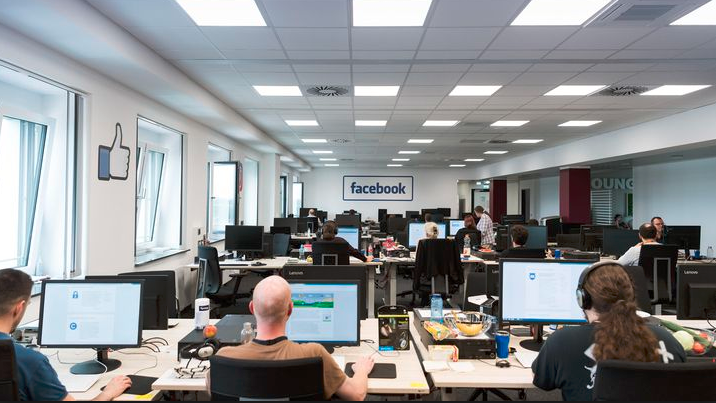
Facebook content moderators in action

Image Credit: Internet


Monika Bickert and her entire trust and Safety team at Facebook are focused to make sure that their moderators get it right while reviewing the content. There are 60 people dedicated just to crafting the policies for the company’s 15,000 content moderators. These policies are not available publicly anywhere, as these are sensitive and form the “book” which is used by safety teams and the content moderators to refer to when doing their jobs. These policies and definitions of common terms, often nuanced to the level of slangs used in local languages, are revised every two weeks to keep pace with changing ways of how people interact and speak. These sessions are often referred to as mini-legislative sessions, as different teams across the company — engineering, legal, content reviewers, external partners like nonprofit groups — provide recommendations to Bickert’s team for inclusion in the policy guidebook.


Many Facebook insiders like Neil Potts emphasize the similarity between what Facebook is doing and what government does. “We do really share the goals of government in certain ways,” he said. “If the goals of government are to protect their constituents, which are our users and community, I think we do share that. I feel comfortable going to the press with that.”


Image Credit: The Verge


Heart of the matter

In many ways, the change of heart across global tech landscape has resulted from the difficulties the platforms faced while trying to control and govern the harmful content uploaded on the internet’s content platforms. As the efforts to govern the internet continue, many who are fighting the battle daily are coming to realize the magnitude of difficulty this seemingly simple question of ‘what content to be allowed’ poses. Lets face it: Internet was never known to be deferential to peoples’ preferences. The advocates of freedom of expression and free speech, often big tech companies themselves, fought for as little government control as possible, decrying every move made by governments or regulators around the world.


Image Credit: Internet


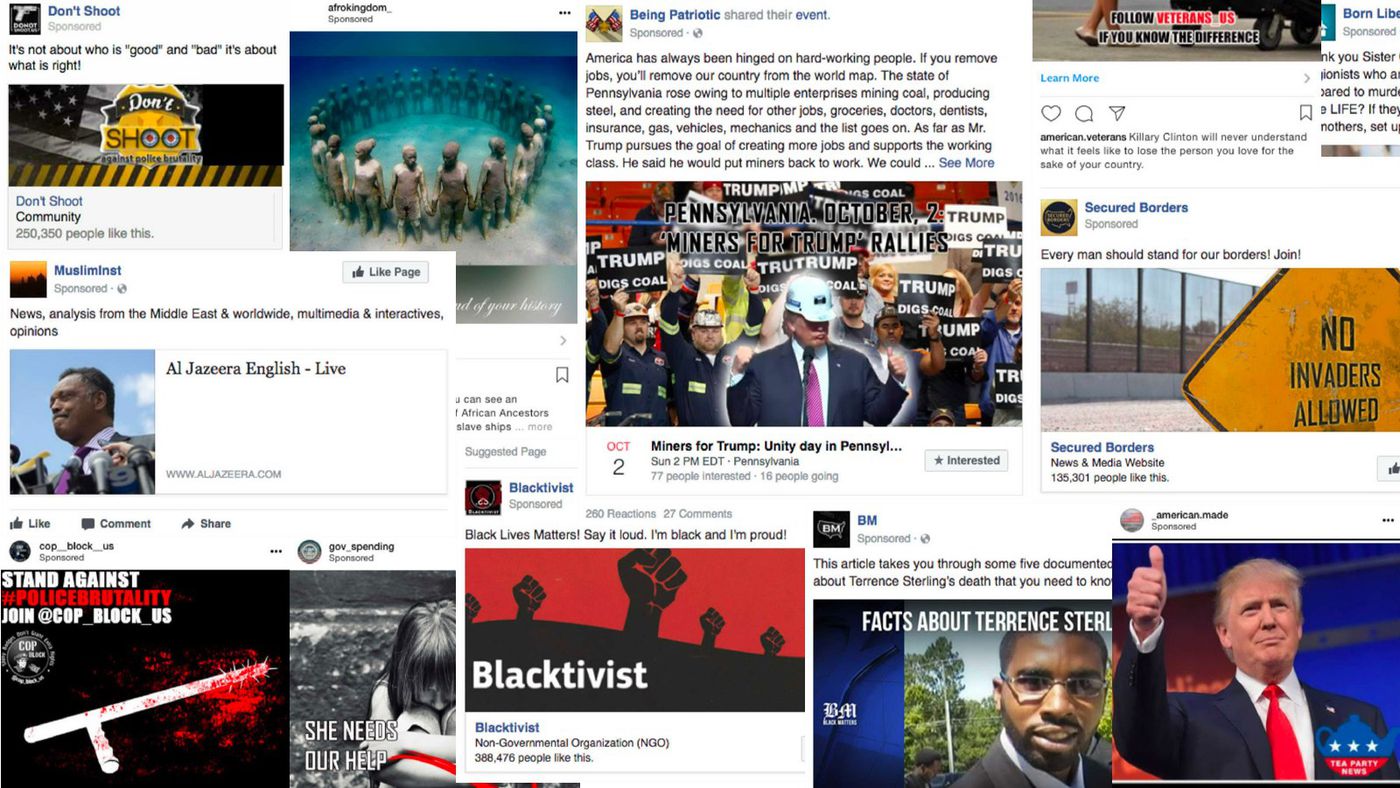
Post the 2016 US presidential elections, when the investigations spread in to how agents posing as fake advertisers used social media platforms as a medium to spread biased propaganda to favor one side, the debate around transparency in social media, controls over content available on the internet and the influence on society converged. Google, Facebook, and Twitter were identified as primary targets of these foreign-state sponsored actors as the three companies sat through multiple congressional hearings last year to discuss how foreign agents used and abused their platforms to manipulate Americans. In the aftermath, Facebook tried desperately and failed to fix its fake news problem while it simultaneously reckoned with group of Russian government–backed agents masquerading as advocacy organizations in order to keep pushing socially divisive political messages. Facebook and Google had to publicly apologize and indirectly admit lax controls after it was revealed that advertisers (read: fake) could use their platforms to target a sub-section of society, or people in any age group or ethnicity, based on racist and bigoted interests—like “threesome rape” and “Jews ruin the world.”


Facebook hasn’t always taken content review as seriously as they do now. When Facebook Live launched, the technical tool to review the videos did not show where or which part of a video reported for review tended to generate user flags. So, if a Facebook Live video was reported or flagged for inappropriate content, and it was two hours long, the reviewers had to try to skim through entire two hours of content to figure out where the objectionable material might be. Of course, that’s during the pre-election good-old days.


Dangerous fake news has spread on platforms like Facebook in Myanmar, where the Rohingya ethnic minority are persecuted. United Nations has clearly blamed the role of social media in spreading the persecution and this is not the only example of its kind.


After a man used Facebook to live stream his attack on two New Zealand mosques in March 2019, the video quickly spread. YouTube Moderators fought back hard taking down the video as newer versions kept popping up seemingly beating the controls that YouTube has in place to immediately flag already removed material. The uploaders were able to sneak past by using a loophole – exact re-uploads of the video are banned by YouTube, however videos that contain clips of the original footage must be sent to human moderators for review, thereby delaying the process. And again this loophole existed for a purely legitimate reason – to ensure that news videos that use a portion of the video for their segments aren’t removed in the process.


Image Credit: Internet


YouTube today employs an expected 12 – 14,000 people, while Facebook now has over 30,000 people working on safety and security — about half of them are content reviewers working out of 20 offices around the world. Similarly, Twitter employees close to 4,000 people in its content review team. Facebook also announced that approx. 1,000 people will work on election focused advertisements alone to prevent the likelihood of the company getting used by false advertisers again.


In addition to the manpower, the promised marvels of cutting edge technology, a.k.a. powerful AI based algorithms written specifically to identify, target, and take down or report the harmful content have been, at best under-performers and at worst, simple waste of money and time. And lets not forget this. Facebook used AI backed technology and had an approx. 5,000 strong team of content reviewers before the 2016 elections. Yet it got itself in to significant trouble and scrutiny. Facebook now claims that it has invested record amounts in the past year in keeping people safe and strengthening its defenses against abuse. Facebook also states that its policies have provided people with far more control over their information and more transparency into policies, operations and ads.


Image Credit: Vox


Facebook also claims that amid all the efforts to control content, it has also started rolling out a content appeals process for users inquiring about their own content that’s been removed. The announcement for content appeals process came much earlier, almost like building hype around the topic is more important than the topic itself. The company said it will expand on this concept so users can appeal decision on reports filed on other people’s content. In addition, Facebook said it is training AI to detect and reduce the spread of “borderline content,” which it describes as “click-bait and misinformation.”


The content appeals process announced in 2018 was not a voluntary act of kindness at Facebook, either. Many believe that this is a dual pronged strategy as Facebook executives try to recover their public image. Firstly, this is in response to the increased global scrutiny of how content is treated, sanctioned or legitimized by content platforms. This is also in part due to the lens Facebook has come under especially since The Guardian published a leaked copy of Facebook’s content moderation guidelines, which describe the company’s policies for determining whether posts should be removed from the service. Secondly, Facebook executives hope that such measures would be seen as increasing transparency and fairness, while the opposite is actually true. Moreover, any damage resulting out of such transparent practices will pale in comparison to the risks Facebook will avert.


According to Guy Rosen, VP of Product Management at Facebook, “Artificial intelligence is very promising but we are still years away from it being effective for all kinds of bad content because context is so important. That’s why we have people still reviewing reports.” At Facebook, Guy continues, “we continue to train our software system by analyzing specific examples of bad content that have been reported and removed to identify patterns of behavior. These patterns can then be used to teach our software to proactively find other, similar problems.” However these revamped efforts came after multiple reports of algorithms which failed worldwide to identify news with harmful content, instead promoting content inconsistent with the platform’s terms of service, like a man performing sexual acts on a chicken sandwich.


Lastly, a look at the role of much touted content moderator has thrown up unmitigated and unexpected, yet serious concerns. What good is a job if it takes away from the professional much more than what it compensates for. What good is a job if it adds more to the healthcare costs and leads to destruction of professional and personal lives? The job of content reviewer itself has come under criticism from many angles. In the recent past, a former Facebook moderator sued, accusing the platform of psychological harm. Former Microsoft employees sued Microsoft for similar reasons after the alleged trauma from reviewing child porn. In a more recent report, The Verge carried out a scathing review of the job conditions for content moderators at Facebook and the harrowing conditions surrounding the job in general. As one employee interviewed in the report put it: “We were doing something that was darkening our soul — or whatever you call it,” he says. “What else do you do at that point? The one thing that makes us laugh is actually damaging us. I had to watch myself when I was joking around in public. I would accidentally say [offensive] things all the time — and then be like, Oh shit, I’m at the grocery store. I cannot be talking like this.”


Image Credit: Internet


An NPR report sheds light on the activities of content moderators as 15,000 moderators contracted by the company worldwide spend their workday wading through racism, conspiracy theories and violence. In the wake of the original story carried out by the Verge, the attention has shifted to work conditions for content moderators. However this attention is not expected to bring about any big results as there are little alternatives to the practice of hiring content moderators to sift through mountains of content daily. As Newton cites in his story, that number is just short of half of the 30,000-plus employees Facebook hired by the end of 2018 to work on safety and security.


In a related CNN report, “It’s not really clear what the ideal circumstance would be for a human being to do this work,” said Sarah T. Roberts, an assistant professor of information studies at UCLA, who has been sounding the alarm about the work and conditions of content moderators for years.


Facebook would rather talk about its advancements in artificial intelligence, and dangle the prospect that its reliance on human moderators will decline over time. However that’s not going to happen anytime soon as the AI based system isn’t fully ready or dependable yet, hence the pressure is back on humans at least for the foreseeable future.

Image Credit: Internet


Conclusion

The roles of government and regulators and the big tech companies have often overlapped. In today’s context however, given the amount of data users are generating, the roles have blurred to some extent. However critical differences have always existed.


The big tech companies need to come out of their over-leveraged positions and take due responsibility for the content they host, support and spread. It is not going to be the end of the world if content platforms become more aggressive, nor is it a matter of financial survival as the tech giants have more cash-in-hand than many smaller countries.


So, the standoff between AI, human moderators, content platforms hiring the first two, and the target itself – harmful content, continues in to the future. Merely throwing money at the problem can be effective to silence critics in short-term, however long-term improvement plans warrant much more. For one though, the Big Tech has been short of making long term commitments and they have been consistent


Image Credit: Internet

]]>
https://1earthtech.com/big-tech-content-moderation/feed/ 0 779
Architectural Innovation – Change is hard! https://1earthtech.com/architectural-innovation-change/ https://1earthtech.com/architectural-innovation-change/#respond Tue, 14 Jan 2020 04:24:47 +0000 https://1earthtech.com/?p=767 What’s common between World War tank Blitzkrieg on the battlefronts of Europe and modern organizations’ historical fumbles with disruptive technologies

Image Source: Internet


The Blitzkrieg

Major JFC Fuller, then 37 years of age, was posted at the Somme battlefield in France at the time of WWI in 1916. On that battlefield, Major Fuller observed for the first time the awesome power of the newest savagery in the war technology, known simply as the armored tank. Major Fuller seized immediately that this new machine, the tank, holds the answer to most perplexing tactical question in modern day warfare – how to cross an open muddy field, littered with trenches and barbed wire against a haze of blazing guns? No approach had worked so far, and even hundreds of thousands of brave men laying down their lives only had as much effect as millions of raindrops washing against stone façade. But the tank held the most promise. For, it seemed indestructible, carried more firepower and could march on undeterred in all kinds of weather and most all ground conditions. Major Fuller enthusiastically sent reports of the success of this new weapon to the English war leadership. To Major Fuller, the evidence of tank’s superiority was undeniable and hence there exists every reason for tanks to replace the archaic ways of horse mounted cavalry warfare.


All the major countries in World War I (1914–1918) entered in to the conflict with cavalry forces. German forces continued the use of horses on the Eastern Front well into the war while on the Allied side, the United Kingdom used mounted infantry and cavalry charges throughout the war.


The British war leadership was steeped thoroughly in tradition and failed to see the alternate methods, regardless of the pragmatism or inevitable tide of changing times. One British General compared the faces of soldiers riding horses to those riding tanks and quipped about the lack of intelligence on the faces of tank mounted soldiers. Not just the Leadership, many soldiers on the front lines who had never seen tanks in action were at best skeptical of the new beast.


Major Fuller sought transfer to the Tank division and went on to produce brilliant papers of how to break the German lines, destroy vital rail and road links, invade deep in to the territory and strike at the German war offices. A tactical approach aided by airstrikes and resting squarely on unarguably superior technology available to the British Army in form of tank will surely make quick work of the Germans, Major Fuller conceived. By striking suddenly at the German command, the Blitzkrieg will cause the German army to disintegrate and fall. Major Fuller didn’t give up hope and continued in his efforts undeterred. In late 1917, during the battle of Cambrie, the British war leadership finally gave in to Fuller’s persistent demands and decided to use 400 tanks to attack German front lines. Unsurprisingly the British tanks decimated German defense system and made quick work of the barbed wires and shrugged off lines of soldiers firing guns at the armored plating of the tanks. A measly top speed of 4 miles per hour was enough for the tanks to run through German war lines and trenches. The Germans were caught off-guard and outmaneuvered tactically and strategically. The soldiers who saw the power of tanks for the first time were awe-stuck. In what can only be dubbed as an irony, the British Army decided to send in horses to take advantage of the gaps created by the tanks. This non-sensical move allowed German forces to regroup and drive the British back. The momentum was lost. And so was the tactical and strategic opportunity. Major Fuller once again undeterred carefully documented the events, recording what worked well and what may be improved. His ideas were reluctantly adapted and dubbed Plan 1919, to be used in the year 1919.


Major Fuller’s work did not go completely unrewarded though. For his pioneering papers in strategy work, Major Fuller received many accolades and won the Gold Medal from a prestigious think tank of the day. The most important possible beneficiary of his careful and well documented work however remained cold. The British Army continued to give Major Fuller a cold shoulder. The most brilliant and accurate strategic work in modern warfare was seen more as a threat than an opportunity.


The beliefs of British war leadership were so deep rooted that the newly formed Tank core and rapid advances in tank technology throughout the war years amounted to exactly nothing. Before Major Fuller’s plan saw the light of the day, the war ended in 1918. However, that was not the end of tank warfare or for that matter the strategy of sudden, lightning paced attacks backed by airstrikes destroying vital road and rail links that Major Fuller had conceived. Exactly twenty years later, at the start of World War II, Germany used the same Blitzkrieg approach to effectively lap up entire Europe within a matter of weeks, almost unchallenged and nearly unstoppable. Despite possessing clear technological superiority and strategical advantage of having a brilliant war strategist in Fuller, the British squabbled away the technical and strategic momentum to German forces by late 1930s.  Major Fuller’s strategy proved right, not just right, in fact it was proven to be arguably the biggest breakthrough in war technology since the invention of guns.


Image Source: ideanote


How enterprises react to Innovation?

Major Fuller though is not alone, nor is the blissful ignorance of ground realities a trait reserved for British War Leadership. In 1970, the photocopying giant Xerox developed a state of the art research center in Palo Alto, California, called PARC, short for Palo Alto Research Center. PARC scientists quickly paid back Xerox by doing innovative work in laser printing that would establish Xerox as leader in printing technology for decades. Shortly thereafter Xerox scientists developed the first computer, truly ahead of its time. Steve Jobs during one of his visits to PARC was stunned by what he saw, the mouse and computer interface was truly revolutionary he felt. Xerox however had other ideas.  The same Xerox leadership team that led its PARC scientists to produce breakthrough in laser printing technology in 1971 and many other innovations, seemed equally capable of squandering away the strategic advantage held by true game-changer, the personal computer. Xerox was then dubbed as the company that fumbled the future.


In 1975, Steven Sasson invented the first self-contained digital camera at Eastman Kodak. Sasson’s patent claimed an arrangement that allowed the CCD to be read out quickly (“in real time”) into a temporary buffer of random-access memory, and then written to storage at the lower speed of the storage device; essentially all modern digital cameras still use such an arrangement. His was not the first camera that produced digital images, but was the first hand-held digital camera. 37 years later, in 2012, the digital camera technology became the prime reason for Kodak’s demise. Though Kodak did eventually market both professional and consumer cameras, it did not fully embrace digital photography until it was too late.


Image Source: NY Times


In 1999, Sony launched world’s first digital music player. Sony possessed the iconic and generation-defining brand Walkman and had endorsements of virtually every heavyweight in the music entertainment industry. Yet, within few years, Apple’s ipod defined the music industry, virtually destroying the Walkman promise. Sony worried about cannibalization and was slow to react, thoughtful and diligent at every turn. If it built a music player and service that made it easy for people to share digital songs, that might hurt sales of its own music records division, which had its own profit and loss statement. Apple on the other hand had one single profit and loss statement for the entire company. Steve Jobs’s business were simple and radical. Never be afraid of cannibalizing yourself. ‘If you don’t cannibalize yourself, someone else will,’ Steve Jobs said. Result is a bed of roses for Apple, while becoming thorns under the skin for Sony.


By 2013, Nokia had lost 4/5th of its peak market capitalization in 2007. Customers were driving away in troves to competition. Nokia had ignored the glitz and glamor of Android, while it severely underestimated the new ecosystem. Microsoft lapped up Nokia’s handset business for a fraction of its value. However, unbeknownst to Microsoft, things had become so bad for Nokia that no amount of effort would be able to revive the brand. Microsoft’s own windows phone OS was in no way a challenger to Android – iOS domination. When Satya Nadella took over Microsoft from Balmer in 2014, he wrote off the entire $7.2 billion Microsoft investment in to Nokia, gave up efforts to review Microsoft’s 7 year old foray in to mobile phones and put the entire Microsoft mobile phone business on the chopping block, marking the end of a rather painful journey for Microsoft’s handheld devices business unit. This is a particularly hard pill to swallow as windows OS had won over many critics with its arguably superior interface when it launched in 2010. The initial success was short-lived and couldn’t be replicated to subsequent versions of both software and hardware.


Image Source: gsmarena


Could it all be a coincidence? The tank powered blitzkrieg, the underrated digital camera, the before-it’s-era personal computer and carry-in-your-pocket digital music player? Why do well-established, pioneering organizations lose out to maverick, new-comers? What powers the engine of growth in unconventional yet strategically sound products and technologies? Why does organizations get complacent and let upstarts overtake them? Why do leadership of these organizations fail to grasp the potential of emerging products and technologies in front of them? Isn’t guiding the organization through unknown times the primary purpose of bringing together individuals, otherwise known as leadership team? If the top organizations fail so miserably and so often, there must be some reason, some logical, rational explanation.


Answers to these questions are often hidden underneath layers of organization culture. Many modern business people, strategists and industry watchers coined the term ‘Disruptive’ and attached it to any new product, service or technology that sought to bring something new to the consumers. Disruption, in pure business terms is defined as an innovation that changes the business and industry dynamics in such a way that incumbent organizations must adapt to the change or fall by the wayside. In the face of disruptive technology or product, the incumbent organization needs to maintain its leadership status by embracing it as quickly as possible. If the organizations keep doing what worked for them in the past, they are more likely to fail as such disruptive forces demand disruption to the way of thinking and ethos of working.  “Disruption” in classic business parlance describes a process whereby a smaller company with fewer resources is able to successfully challenge established incumbent businesses. That sadly is not true of how market leaders work.

Disruptive Innovation and Architectural Innovation

The question is: why don’t organizations adapt? Its certainly not for lack of innovation. For kodak, Sony and Xerox were all highly innovative companies with zealous management teams. Then what made them lag behind and eventually lose the fight? This is where the theory of Disruptive Innovation pioneered by Clayton M. Christensen comes in. Briefly the theory of Disruptive Innovation suggests this: Specifically, as incumbents focus on improving their products and services for their most demanding (and usually most profitable) customers, they exceed the needs of some segments and ignore the needs of others. Entrants that prove disruptive begin by successfully targeting those overlooked segments, gaining a foothold by delivering more-suitable functionality—frequently at a lower price. Incumbents, chasing higher profitability in more-demanding segments, tend not to respond vigorously. Entrants then move upmarket, delivering the performance that incumbents’ mainstream customers require, while preserving the advantages that drove their early success. When mainstream customers start adopting the entrants’ offerings in volume, disruption has occurred.


While the incumbent leader organizations are looking elsewhere, the newcomers arrive, unburdened by legacy, take a half-baked product or technology and make rapid progress carving a niche market and gaining foothold in the industry to displace the incumbent.


Image Credit: HBR.ORG


The theory of Disruptive Innovation explains as much as it leaves out. The theory is certainly valid, and elegant for the most part. Christensen has a single clear idea of how disruption happens — and recommends a solution, too: disrupt yourself before you are disrupted by someone else. However, stretching it to fit all scenarios is at best a naïve attempt at explaining the why and how of how people work.


Kodak, Sony and Xerox were all highly innovative companies, each possessing an enviable track record. The technical teams at these organizations boasted of some of the sharpest minds, while the business leaders were equally brilliant. The leadership teams at these organizations could see what lay ahead.  As with innovation, the lack of vision could not be a factor. They could articulate the challenges of the times ahead and the promises of untested technologies. Yet, they were unable to put together a cohesive response strategy. It seemed no one at the helm could do the right thing. Where does this inability to lead the tanks in place of horses stem from?


The theory of Disruptive Innovation was not new in 1995 when it was first proposed, or over two decades when it was further developed. Perhaps the ideas were old, only the changing global nature of businesses made the traits ever so apparent. Or that disruption has been happening forever, we are just starting to recognize it now. Or perhaps, disruption is the normal.


When a company discovers or arrives at a successful business model often following years of painstaking work, management are given the explicit mandate to exploit that advantage to its fullest extent. This invariably means that most companies are structurally geared to manage, protect and nurture their currently successful business model. All the company’s assets – structures, operations, human resources, processes, tools and culture are geared towards doing what they have always done – protect, grow and nurture its current strengths.


It is no surprise then that swords are pulled out when there is even a shadow cast on the company’s current affairs. Any harbingers of change, which bring a radical suggestion or new idea, no matter how sound, or logically accurate, tend to be at odds with almost the entire company. This is not necessarily bad – companies do need to exploit their current positions as this is where their revenues and profits are coming from. The mistake organizations and leaders make is to focus exclusively on exploitation while ignoring most other ideas.


In the quest to understand the behavior of leaders better, theory of Disruptive Innovation does seem to fall short. Its true that Disruptive innovation changes the marketplace, however it doesn’t speak to why the incumbent organizations fail to take action? Or why the same organization with brilliant track record at innovation suddenly stops innovating?


Rebecca Henderson and Kim Clark postulated that unlike what is suggested in the theory of disruptive innovation, there are multiple points of failure where an organization fails to seize the opportunity. These points may exist all along, up and down the organization in no order. For example, in JFC Fuller’s case, almost every branch, company and division of the armed forces had little faith, mainly because many had not seen the tank in action. Questions on its size, slow pace, cramped insides, and unsightly presence were all valid, yet short-lived.


Then there are challenges about the financial viability of a product, or about its perceived value to the company, or about its future.  An architectural innovation challenges an old organization because it demands that the organization remake itself. The simple explanation is that a market leader in producing printers is much likely to accept breakthrough innovations in printer ink technology as there is no real organizational stress in pursuing that product line, and highly unlikely to accept the idea for a personal computer as there is little organizational mechanism for paying attention to the innovation and nurturing it along.


Within the camera business — Canon and Nikon made the transition to digital technology successfully while Kodak could not. Was that because Kodak was hidebound and clueless about digital technology? Not remotely as Kodak entered the digital market very early and with some early successes. What killed Kodak, though, was that it hadn’t really been a photography company for a long time, rather it was a film, photo paper, and chemical company.


The message of Henderson’s work with Kim Clark and others is that when companies or institutions are faced with an organizationally disruptive innovation, there is no simple solution. There may be no solution at all. “I’m sorry it’s not more management guru-ish,” she says. “But anybody who’s really any good at this will tell you that this is hard.”


Tesla’s solar powered vehicles, Tesla’s SpaceX, Tesla’s home solar program are all examples of what happens when organizations shun perfectly valid ideas or technologies for lack of viability, and lesser known players enter in to the market to fill that small gap of that niche product. Tesla started off as a ‘niche’ EV manufacturer, in a market segment which itself was considered a joke by several top automobile manufacturers, and in little more than 1 decade, managed to claim the spot of most valued US Automobile brand ever. And this feat is even more enviable considering that Tesla manufactures all of 3 vehicles today. That is 3 vehicle models competing against 100’s of competitors’ models, using technology which is barely two decades old against almost 120 years of development in conventional gas powered automobiles.


Oil Industry has dominated the game for almost a hundred years now. Yet, the implications for the Big Oil are really very straightforward. Adapt and invest in clean fuel or simply rollover. And that is not an exaggeration by any means. The writing has been on the wall for some time now and the Oil Industry is cognizant of the same.


Image Source: Forbes


Conclusion

The thing with new, game-changing technologies, products or ideas, is that to thrive it needs to find an organization that will accept it. Adaption of any new technology has severe implications; it not only changes the organization but often times creates a new industry or segment altogether. The tank changed the modern warfare forever; Netflix ushered in an era of online streaming; personal computers took computing out of huge air-conditioned rooms to homes; iPods created an entirely new marketplace for music; and the digital cameras brought photography to 3 year old and 80 years old alike. These are all game-changers, whose potential was not unknown to their parent organizations, yet it took alien organizations to realize their full potential.


Only those organizations which are truly willing to change themselves, reorganize and adapt, re-skin and lose its earlier identity, and let that idea, or technology or product guide it to the future, those organizations mature enough to understand that immaturity is a gift, those are the organizations that create unparalleled wealth and unimaginable success stories.

]]>
https://1earthtech.com/architectural-innovation-change/feed/ 0 767
Transform to market realities: Leading the Microsoft way! https://1earthtech.com/microsoft-way-transform-leading/ https://1earthtech.com/microsoft-way-transform-leading/#respond Thu, 02 Jan 2020 04:00:19 +0000 https://1earthtech.com/?p=734


Microsoft has mostly been recognized as the industry leader in technology and innovation. Having cornered 90% of world personal computer market and having massively popular enterprise services as a cash cow meant that Microsoft always carried significant advantage over its competitors and peers. It could literally burn few billions in cash and not break sweat over it. Or acquire couple of companies for few billions and choose to write the investment off as an unsuccessful bet. Microsoft had been the favorite of most of its critics at some point, and has been at loggerheads with various governments, domestically and overseas, and yet survived without breaking the bank. Employing more than 100,000 people since forever and leading the way in consumer and enterprise computing, Microsoft was easily considered too big to fail.


Yet during the late 2000s, trouble was brewing at Microsoft. The years leading up to 2014 were very difficult as Microsoft was seen struggling on various fronts. Part of the reason was internal while a big part of it lay outside Microsoft. Externally, technology itself was shifting along with user preferences and increasing complexity was no longer feared by most IT organizations. The focus was to move away from large, one vendor solution to having multi-vendor stack of products which gave the organization flexibility to choose the best providers. All these changes meant that Microsoft’s model was coming under increasing pressure.


Mobile platform was considered Microsoft’s biggest, most glaring shortcoming. At the start of 2014, Microsoft’s mobile market share amounted to just 3.5 percent. That was a dismal number, compared with Apple’s 15% and Android’s 80% market share. Additionally, its Surface tablet was struggling with less than 3% of the tablet market. This made Microsoft’s Windows the only major operating system that didn’t have a viable mobile component. The personal computer sales were declining at the same time, as shipments slowed down by more than 10% for the first time.


Apart from the above hardware troubles, Microsoft was coming under intense heat on the software and ecosystem side as well. Customers were growingly seeking a seamless, integrated user experience across devices and Microsoft was nowhere close to providing that. Bing remained a distant second to Google Search (18.7 percent versus 67.6 percent, respectively), and Microsoft had just released a free online version of Office — Microsoft Office Online — in response to Google Drive. Apps available on windows store numbered 1/5th of those available in App store and Google Play.


Further in the years leading to 2014, Microsoft was increasingly coming across as an organization happy to rest on its past laurels. Pace of innovation was slowing down, confidence in the organization was at an all time low, its products were seen as out of touch from market realities while the product pricing model was considered by many as greedy or obscene, or at best, overpriced. Microsoft was late to launch its smartphone, Windows phone, and the market was already in love with iPhones by the time first Windows phone came out – more than 3.5 years after the launch of first iPhone. Its new operating system, Windows 8, touted to provide seamless experience across devices was considered a market dud, while offerings such as Xbox gaming system lost out purely due to poor pricing strategy.


Dawn of an Era

When Nadella took over as Microsoft’s CEO in Feb 2014, his challenges were immediate and spotlight was always on, as is expected in case of world’s 4th largest corporation.


When Nadella came on to take the charge at Microsoft, both analysts and Wall Street agreed that the organization was fading to irrelevance. Over the next 6 years, Nadella set out on an inspiring journey, one that would see Microsoft make radical changes, charting out its course amidst uncertainty. This journey would see Microsoft change its business structure, breaking new frontiers and boundaries, launch new products and repackage old products and forge new partnerships on the road to regain its lost charm. Nadella began this journey humbly and quietly, two attributes which have become his hallmark and an unmistakable part of his legacy. Looking back, his first decisions during his first year were the hardest any CEO can be expected to make anytime during their stint as CEO, yet the finesse and calmness displayed by Nadella is worthy of unparalleled praise.


In the almost 6 years since Nadella has taken over, Microsoft’s market cap has risen from $315 billion to $830 billion. Considering that Nadella came in when Microsoft was under pressure from all fronts, and then managing to turn around the ship completely is just incredible.


2014 and Beyond: Grand Strategy, the Nadella way!

Image Source: zdnet


Nadella’s grand strategy for Microsoft covered 4 essential elements. First, to make any long lasting changes, he needed to fix the culture and maintain the improvements made in the short run. Second, products and services, across the domains of hardware and software need to reflect the changing customer outlook. Third, Microsoft needed to re-launch itself with unparalleled cooperation and collaboration, forging previously unthinkable partnerships. And fourth, in all its products and service offerings Microsoft needed to make a ruthless self-evaluation of Make vs Buy and proceed to acquire firms and businesses where it sees value.


Image Credit: Microsoft


Image Credit: Microsoft


Fixing Culture

Nadella immediately started working to create an outward focused, critique-hungry organization where formal power structures fade away to make way for productive partnerships; where direct communications are more important than showmanship; where tradition and hierarchy do not stand in way of pragmatism; and where ‘getting things done’ is more important than who does them. From his very first public appearance where he gave the impression of being directly approachable and responsible, to his first actions where he took decision to ramp down windows phone product line, Nadella meant change.


He fixed the culture through direct communication and leadership. He focused the company on cloud, winding down Windows Phone, de-emphasizing Windows as a whole, and turning Office and XBox into cloud-centric products. Back in the day, partners, vendors and developers alike talked about a much hostile environment, where it was difficult to get things done, or to get the needed resources, and the whole attitude was not geared towards cooperation. This attitude changed a great deal under Nadella and its clear that this change has a lot to do with ‘the buck stops here’ culture Nadella introduced. Not all of this worked perfectly every time, but by maintaining a growth mindset, they learned and improved. As a result, the company is the clear #2 cloud provider and occasionally the most valuable company in the US.


Windows run with everything, not just Windows run everywhere!

Nadella quickly made an impression and emphasized on Microsoft being a cloud-first and mobile-first company, moving away from a Windows-first company. The aim was to have Windows run with everything, not just having Windows run everywhere. Nadella knew that the latter goal was self-limiting and almost non-achievable whereas the former goal can lead to Microsoft becoming the number 1 and the most relevant technology company for decades to come. The world was increasingly becoming a cloud and mobile-first environment and for Microsoft to grown and remain relevant, they would need to adapt rather than resist. He laid down the entire roadmap of moving from a Windows-first company to a Cloud-first company. They underwent a huge engineering reorganization where he asked then Windows chief Terry Myerson (Microsoft Executive Vice President, former head of Windows) to step down. To speed up matters, he focused on inorganic growth, by acquiring Minecraft, LinkedIn, and Github in quick succession enabling the focus to shift towards the cloud.


Moving Office and Windows to a SAS model, dimming the gap between platforms by not only releasing popular products cross-platform but also allowing developers to use proprietary tools to build product across any platform, open sourcing .Net, making Visual Studio Community free, releasing products like Visual Studio Code for OSX and Linux, HoloLens, round the clock feature addition to Azure cloud services, are all great examples that indicate Microsoft’s shift towards openness and rapid development/innovation.


Shortly after taking over, Nadella wrote off Ballmer’s $7 billion acquisition of Nokia’s mobile phone business as a loss, eliminating more than 20,000 jobs in rather muted acknowledgment that Windows was not going to catch the iPhone and Android anytime. Microsoft was better off placing its bets elsewhere and that’s exactly what Nadella did, without remorse. Microsoft then went on to extend its collaborative approach to release more than 100 iOS apps and even embraced Linux (described later), the open-source Windows rival.


Image Source: Microsoft


With Microsoft revolutionizing its flagship MS-office suite and Windows OS through launch of Microsoft 365 Enterprise, which combines Office 365 Enterprise, Windows 10 Enterprise, and Microsoft’s Enterprise Mobility and Security features into a single subscription Office365.


Nadella is not just content with taking down barriers. He is equally keen to invest greatly in research around Mixed Reality, Artificial Intelligence and Quantum computing. Nadella reportedly believes these three to be the next key growth areas for them.


Image Credit: CSA


Cooperation and collaboration to keep customer first

Nadella seemed to be happy working on multiple fronts at the same time. From trying to shift culture at Microsoft to working with partners and collaborating across competitors, he made a point to keep customers first. Under Nadella, Microsoft went from a company trying to make customers buy Windows all the time to a company that recognized customers want solutions that Nadella laid out his new vision of cooperation through a quote which has been quoted multiple time, “It is incumbent upon us, especially those of us who are platform vendors to partner broadly to solve real pain points our customers have.”


To show his seriousness, Nadella attended Dreamforce in 2015, setting aside his personal differences with Salesforce management. In the backdrop of lawsuits both companies had filed, Nadella extended a hand of cooperation and collaboration. In the year prior, launching MS Office for iPad was Nadellas first major announcement immediately after his becoming CEO.


Image Source: Microsoft


Nadella’s acute business acumen and willingness to break traditional structures led to a truly path-breaking partnership with Linux. Azure was at a crossroads when Nadella took over. It was built to challenge Amazon’s market-leading AWS cloud service, launched several years earlier. Azure was also supposed to entice customers into meeting the bulk of their computing needs with other Microsoft products. If a client wanted Azure to run a Windows operating system, Microsoft was proud to take their business. Yet, if the client preferred the rival Linux approach (which Ballmer once dubbed a “cancer”), it was out of luck as Microsoft couldn’t offer a matching product. During a visit to a small start up called Okta Inc., based in San Francisco, to see how small start ups are using cloud, Nadella came up with Microsoft’s path-breaking move. Todd McKinnon, CEO and co-founder of Okta Inc., remembers telling Nadella, “We’re not using Azure, we use AWS.” Nadella shrugged. This wasn’t a sales call. It was somewhere between fact-finding and espionage. At the end of the hour-long visit Nadella had drawn out a detailed map of what startups like Okta wanted from the cloud. Over the next few months he met with at least seven other startups in similar settings. Those talks inspired Nadella to offer Linux at a special, lower price on Azure–forgoing Windows licensing fees to keep customers happy. The decision was so at odds with Microsoft’s usual lockstep methods that it later became the subject of a Harvard Business Review case study. Azure now is the fastest-growing of the five major cloud infrastructure services.


Image Credit: Microsoft


AWS started in 2006 while Microsoft launched Azure in 2010. Despite getting a significant early start and cornering substantial market share, AWS has been steadily losing ground to Azure. And for good reason. Microsoft has been very successful in signing on enterprise customers to Azure. Most large enterprises, especially those in financial services and those with any kind of sensitive data find better value proposition in Azure due to Azure’s substantial support for hybrid cloud applications. Azure helps companies protect the information that they deem particularly delicate or sensitive. Microsoft developed this hybrid approach by tapping in to its considerable background and experience with enterprise-level solutions and that has paid huge dividends.


Some of Azure’s products offer a sliding scale of hybrid cloud platform functionality, with one of their newest products providing almost all of the functionality of Azure on client’s own on-site data centers, with the payment and maintenance equal to the public cloud equivalent.


Azure supports the broadest selection of operating systems, programming languages, frameworks, tools, databases and devices. Run Linux containers with Docker integration; build apps with JavaScript, Python, .NET, PHP, Java and Node.js; build back-ends for iOS, Android and Windows devices. Azure supports the same technologies millions of developers and IT professionals already rely on and trust. Any developer or IT professional can be productive with Azure. The integrated tools, pre-built templates and managed services make it easier to build and manage enterprise, mobile, Web and Internet of Things (IoT) apps.


Image Credit: Right Scale


Amazon Web Services is the most popular public cloud infrastructure platform, comprising 41.5% of application workloads in the public cloud. While Amazon has long been viewed as the dominant provider of public cloud infrastructure, Microsoft Azure is gaining ground quickly in application workload. Azure currently holds 29.4% of the installed base, measured by application workloads. Google Cloud Platform trails with 3.0% of application workloads


Announced just last week, Microsoft Azure has been partnering with retail industry through its tie-ups with grocery store chain, Kroger and Walgreen Boots Alliance, the parent company of Walgreens. According to analysts, the partnership with Walgreens, which aims to develop new healthcare delivery models, technology and retail innovations to advance and improve the future of healthcare, is akin to the model Amazon has launched with Whole Foods. With Kroger, Microsoft offers retail-as-a-service, allowing Kroger to use Azure’s artificial intelligence and cloud infrastructure.


Image Source: RightScale


On the digital side, Microsoft recently announced an exclusive partnership deal with TomTom, Dutch mapping company. According to the agreement the companies reached, TomTom will become Microsoft’s leading location data provider for Microsoft Azure, putting TomTom’s maps and traffic data onto Microsoft’s cloud. Meanwhile, TomTom is picking Microsoft Azure as its preferred cloud provider.


AWS on the other hand mostly targets product makers and start ups who continue to be its main target segment. If an organization wants to build a new product on cloud, AWS is the way to go. If an organization runs an enterprise and / or has any kind of sensitive data, then Azure is your natural choice because chances are they have already made some investment in Microsoft as part of their IT strategy.


Image Credit: CSA


Make vs Buy

In his first year as CEO, Nadella hired Peggy Johnson from Qualcomm in 2014 as executive VP of business development, giving her specific mandate to strengthen Microsoft’s ties with Silicon Valley and pursue deals with companies it once solely considered rivals, such as Box and Dropbox.


In order to give the entire grand strategy push even more impetus, Nadella ordered his team to go on a buying spree. Over the last 2 years, Microsoft’s most prolific buys include scooping up LinkedIn in 2016 for $26 billion and GitHub in 2018 for $7.5 billion. Beyond the much hyped take-over of LinkedIn and GitHub, Nadella’s Microsoft has been on a quiet spree of acquiring niche firms which have added tremendous value. The below table represents how many companies has Microsoft acquired since 2014.


In 2017, Microsoft acquired Cloudyn, an innovative company that helped organizations track their cloud investments. Cloudyn gives enterprise customers tools to identify, measure and analyze consumption, enable accountability and forecast future cloud spending.


Most of Microsoft’s buys are centered around AI, Mixed Reality, Networked communities and cloud assets. “For the past five years, we’ve been incredibly consistent — buy communities, look for networked assets, look for growing markets, and look for where we’re a better owner,” Microsoft CFO Amy Hood said during a conversation with Fortune senior writer Michal Lev-Ram at the 2018 Fortune Most Powerful Women Summit in Laguna Niguel, California.


Microsoft’s most recently released quarterly statement displays stronger than before performance. Currently, Xbox Live is used by 400 million gaming devices and it has the potential to multiply its success to reach many more users across the base of 2 billion users on Nintendo Switch, Android and iOS screens. This means cross-platform play can become a big segment and that users cannot be just limited by just community features like achievements and clubs. LinkedIn now has 610 million users. And LinkedIn sessions grew 30% year-over-year driven by higher levels of engagement in the feed. And Xbox Live now has 64 million monthly active users, up from 59 million a year ago.


If one graph could say it all about Microsoft’s resurgence under Satya Nadella, the one below would be top contender. The Wall Street has rewarded Nadella’s vision and breathtaking finesse the only way it knows – through an increase in the share price, thereby increasing market capitalization.


Image Source: 500ish


The Push Forward!

Nadella’s unrelenting focus was to Identify channels to ensure sustainable growth. Nadella is a firm believer that the key to Microsoft’s future is presence across entire ecosystem, offering an entire assortment consisting of hardware and software combined with cloud computing.


In the words of one analyst, “Microsoft was a very monolithic and slow moving beast. However, four or five years ago, Microsoft completely changed. Now, it doesn’t look so much like one giant company as a weird conglomerate of thousands of little startups. They’re moving fast and nimble, trying things out and iterating very quickly.” Powered by this change in atmosphere, many of Microsoft’s erstwhile talent who left for greener pastures have been returning home. According to one report, more than 2,200 employees have returned to Microsoft after exiting once.


During the last season of Super Bowl, Microsoft aired a commercial with focus on accessibility. Specifically, the ad features the Xbox Adaptive Controller, designed primarily to meet the needs of gamers with limited mobility. In the ad, it shows several young kids sharing stories about using the Xbox Adaptive Controller. “When everybody plays, we all win,” says the tagline of the ad.

]]>
https://1earthtech.com/microsoft-way-transform-leading/feed/ 0 734
Agile Mindset https://1earthtech.com/agile-principles-mindset/ https://1earthtech.com/agile-principles-mindset/#respond Thu, 02 Jan 2020 01:46:02 +0000 https://1earthtech.com/?p=704 Agile Mindset -: Understanding principles before leading


Introduction

A mindset, or state of mind, is a set of beliefs, thoughts, biases, assumptions and values held by an individual or a group of individuals that leads the individual or the group respectively towards the choices they make. The Humans are most comfortable in choosing paths or making decisions that confirm with their beliefs, assumptions, biases and values. The existing mindset is made up of all these and rewards itself through positive reinforcement by guiding the individual or the group, in case of shared mindset, towards the path of least struggle. In other words, towards the path that is in conformance with the existing set of beliefs, thoughts, biases, assumptions and values. Simply put, it is a way of thinking about things and making decisions that those in a group share to the point that it becomes a way of life.


Flowing from the above definition, an Agile mindset can be defined as set of beliefs, thoughts, biases, assumptions and values that guide individuals and group members to make each decision to support an Agile way of working, or Agile work environment. Agile work environment at a broad level is made up of focus on collaboration, team work, flexibility to change, respect, communication, client-partnership, continuous feedback loop, learning cycle and fearlessness towards failures.


Lets not be fooled by the simplicity of the above terms. It is easier to define mindset and then attach Agile to it, or better still, define Agile terms around what should be done, or the ideal way.  In real world however, most people and teams practicing Agile struggle to understand or explain to others what constitutes an Agile mindset. Most of the times people hide behind thinly veiled excuses like, ‘Oh, I get it, but cannot explain it to others.’


Drivers of Agile mindset

The Agile mindset is the environment within which agile teams have their brightest chance to flourish. It is not laid out anywhere. It isn’t a prerequisite for an agile adoption, nor is it a standard which can be adapted for a functional agile team. This mindset is simply the best foundation on which Agile teams can propel themselves to success.


Specifically, an agile mindset is powered by 3 primary measures. First, an agile mindset always encourages early adaptation of Agile principles. Second step is continuous reinforcement and retention, while the third step is measuring metrics and driving compliance in day to day working environment and fine tuning approach as necessary. These three practices – adaptation, continuous reinforcement and retention and measurement of metrics are the key in any organization’s Agile journey.


Many enterprises begin their Agile journey with noble intentions. They want to improve their product offering to customers, improve their go-to-market or turnaround times, bring in internal efficiencies, reduce time between deployments, or all of these. However it’s quite common for many of Agile adapters to discover that they are not fully prepared for the Agile journey. This could happen due to one or combination of many factors. They may discover that employees do not fully understand Agile and any efforts to have them adapt Agile have not been fully successful. Or that the internal environment is not conducive for Agile way of working. This would primarily happen if one or more of key stakeholders or top level management is not a believer of benefits of Agile. In most cases however Agile adaptions fail because the organization tries to do too much in too little time. One of the great failure points of Agile is that Agile is not a magic wand. One cannot hope to implement few Agile practices or principles and expect overnight improvement. And when the improvements don’t come about, blame it on Agile. Agile is not a magic cure for years of inefficiencies or layers of bureaucracy in the organization or half-hearted efforts at implementation. Above all, Agile requires discipline and effort to commit to Agile principles and stay committed even in the face of less than expected benefits. In order to reap true benefits of Agile, it takes sustained and repeated training, high management focus, reinforcements and continuous practice of Agile principles. Remember: Agile is only as good as the people implementing it. So if you notice Agile is failing in your organization, guess what! Chances are something else is failing too.


Adaption of Agile methods is perhaps the easiest step. All it takes is starting implementation of Agile principles and the practices as per the chosen method. However, this is an inherent weak point as the adaptation needs to be accompanied with strong commitment as any halfhearted attempt will lead to disappointment.


The second most important aspect is continuous reinforcement and retention of Agile principles. Adapting agile in a Big Bang manner or as a quiet change is not worth much if not followed up with regular reinforcements through trainings, refreshers, communications and word of mouth messages. The Agile principles and practices need to be driven deep down to the deepest layers through untiring, unrelenting efforts by professionals like Agile coaches and leaders. Agile roles need to be strengthened and given enough autonomy to run things on the ground. Agile coaches must drive and ensure adherence to all Agile practices and ceremonies as per the chosen method. Above all, Agile must be made a part of, promoted and practiced as a ‘way of working’ and not as a special endeavor or initiative.


Whatever is the chosen method of Agile implementation– Scrum, scaled scrum, kanban, Lean or any other, the Agile coaches need to take the mantle of driving Agile principles. Constant reiterating is just one part of the journey. Teams and individuals must be constantly evaluated on their individual compliance with Agile principles and ceremonies depending on the chosen method. Individuals and teams lagging behind must be coached on the benefits of Agile and helped in order to bring them up to expectations. Remember: Agile adaptation is a disciplined team effort and reinforcement at individual and team level is necessary to enforce rigor.


And this brings us to the third part, specifically around measurement of metrics. Maintenance and adherence to product backlog, prioritizing sprint backlog, tracking efforts burned down and remaining during sprints, user stories closed and accepted by customer, are some of the metrics.

  1. Sprint burn-down -: The sprint burn-down chart visualizes how many story points have been completed during the sprint and how many remain, and helps forecast if the sprint scope will be completed on time.


  1. Lead time -: Lead time measures the total time from the moment a story enters the system (in the backlog), until it is completed as part of a sprint, or released to customers. It measures the total time for a requirement to be realized and start earning value – the speed of your value chain.


  1. Agile velocity-: Velocity measures how many story points were completed by a team, on average, over the past few sprints. It can be used to predict the team’s output in the upcoming sprints.


  1. Code coverage -: Code coverage measures the percentage of your code which is covered by unit tests. It can be measured by the number of methods, statements, branches or conditions which are executed as part of a unit test suite.


  1. Cumulative flow -: Cumulative flow is a kanban metric which shows the status of tasks – in a sprint, a release or across software teams. It can visualize bottlenecks in the process – a disproportionately large number of tasks in any of the workflow stages indicates a problem. For example, a big “bubble” in the chart in a verification or testing stage indicates this stage has insufficient resources.


Image credit : Microtools


  1. Failed deployments -: Measures the number of deployments (either to test, production environments, or both). Can help understand how solid environments are and whether teams are really building potentially shippable software.


Conclusion

Perhaps, what makes Agile difficult for lot of managers to grasp is that it’s not just a technology, methodology or process that gets implemented within an enterprise’s current culture and assumptions. The Agile way of running an organization seeks to fundamentally redefine the very concept of an enterprise which has prevailed for the last one hundred years.

Instead of an enterprise being conceived as an efficient, profitable steady-state machine aimed at exploiting its environment and existing business model and the industry its part of, the Agile organization is a growing, learning, adapting living organism that is in constant flux to exploit new opportunities and add new value for customers.

]]>
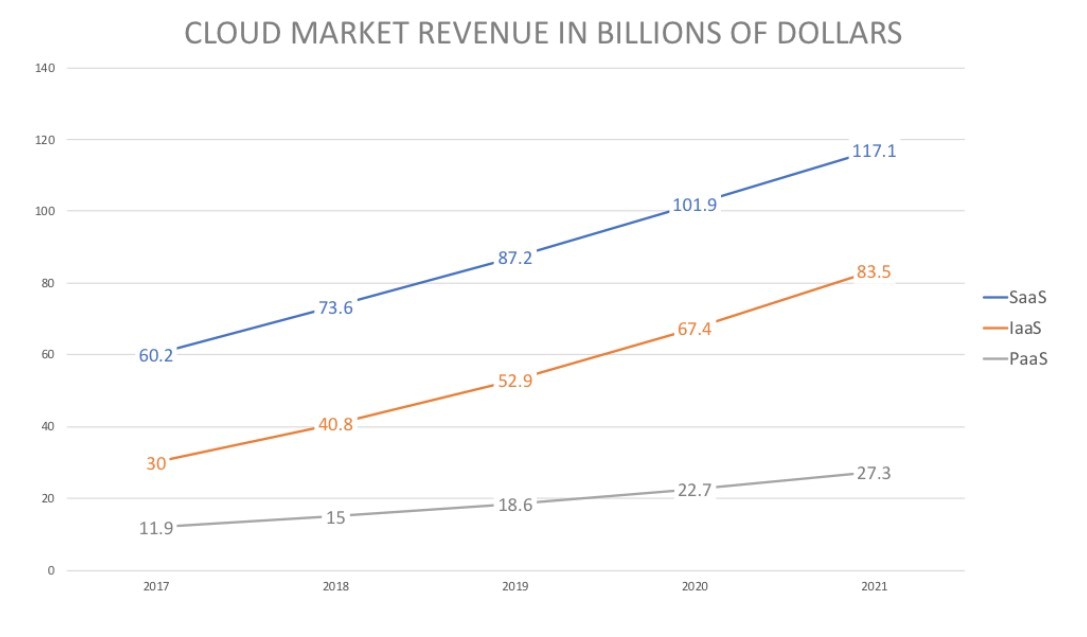
https://1earthtech.com/agile-principles-mindset/feed/ 0 704